

Severe Asthma Stem Cell Therapy | Calming Inflammation Without More Steroids

There is a quiet, exhausting math you start doing without realizing it. How many flights of stairs you can manage before you need to stop. How far from the rescue inhaler you can wander. Which season you dread arriving and which one means you can finally exhale a little. The cold air that catches in your chest in the doorway, the perfume in a meeting room, the second flight of stairs you cannot quite finish — these are the daily measurements that no one outside your own head sees.
If your asthma has crossed the line from manageable into something that defines what you can and cannot do, you are far from alone. The Global Burden of Disease Study estimated that 262 million people worldwide were living with asthma in 2019, and roughly 5 to 10 percent of them have severe asthma — meaning their disease is not controlled despite high-dose inhaled steroids plus a second controller, or requires regular oral corticosteroids and biologic agents simply to stay out of the emergency room. For perhaps 25 percent of those on a biologic, the drug never produced the response that was hoped for. For many others, the biologic worked initially and then lost effectiveness over time.
This article is written for people who are already deep into severe asthma treatment and asking a specific question: is there a way to reduce the inflammation driving this disease without simply layering on more steroids or switching to yet another biologic? We will explain what stem cell therapy for severe asthma actually involves, what the clinical and preclinical data show, where the evidence is still early, and who is — and is not — a realistic candidate. Our clinical team has worked in regenerative medicine in Malaysia for over seven years, with more than 200 patients treated across a range of inflammatory and degenerative conditions. We do not believe stem cell therapy is right for everyone with severe asthma. We will be direct about why.
Table of Contents
- Why Severe Asthma Resists Standard Control
- The Ceiling of Severe Asthma Treatment, From Inhalers to Biologics
- How Mesenchymal Stem Cells Act on Severe Asthma Inflammation
- What the Clinical and Preclinical Research Shows on Severe Asthma Stem Cell Therapy
- Severe Asthma Profiles That May or May Not Respond to Stem Cell Therapy
- A Patient's Experience with Severe Asthma Stem Cell Therapy
- The Treatment Process for Severe Asthma Patients in Malaysia
- Honest Risks and Limitations of Severe Asthma Stem Cell Therapy
- FAQ For Severe Asthma Stem Cell Therapy
- If You Are Considering the Next Step for Your Severe Asthma
- References
Why Severe Asthma Resists Standard Control
The Persistent Inflammation That Defines Severe Asthma
Asthma at its core is not a problem of the lungs themselves so much as a problem of how the immune system behaves inside them. In a healthy airway, the lining is calm — the muscles around the bronchial tubes are relaxed, the air moves easily, and the immune cells that patrol the tissue stay quiet unless they encounter a genuine threat. In severe asthma, that calm never quite arrives. The immune system has become persistently activated against substances it should ignore, and the chemical environment of the airway tilts toward inflammation.
This inflammation is driven by specific immune cells. T helper 2 cells (often abbreviated Th2 cells — a category of immune cell that orchestrates allergic-type responses) release signaling proteins called interleukin-4, interleukin-5, and interleukin-13. These signals recruit other inflammatory cells, particularly eosinophils — a type of white blood cell that, in healthy quantities, helps fight parasites but in asthma accumulates in airway tissue and releases enzymes that damage the bronchial lining. A separate population called innate lymphoid cells type 2 (ILC2s) reinforces the same pathway from a different angle, and the entire system feeds back on itself.
The result is an airway that does not just narrow when triggered. The lining is thicker, the mucus glands are larger, and the muscles surrounding the airway are denser and twitchier than they should be. Severe asthma is not the same disease as ordinary asthma with louder symptoms — it is asthma in which this inflammatory machinery has become structurally entrenched.
How Airway Remodeling Locks Severe Asthma In
Over years of uncontrolled or partially controlled inflammation, the airway changes physically — a process called airway remodeling. The smooth muscle that wraps each bronchial tube grows in mass. The basement membrane beneath the airway lining thickens. Collagen accumulates in places it would not in a healthy lung. The mucus-producing cells multiply.
This remodeling is the structural correlate of severe asthma. It is also the reason why simply suppressing today’s inflammation does not always restore yesterday’s lung function. The architecture of the airway has shifted, and at a certain point, anti-inflammatory medications can quiet the active fire without reversing the damage left by previous ones. This is the biological reason that some severe asthma patients reach a plateau on otherwise effective therapy — the medications are working, but the airway has already been changed by what came before.
Understanding this matters for the rest of this article, because stem cell therapy does not act on a single inflammatory cytokine. It acts on the broader inflammatory environment — which is the part of severe asthma where remodeling continues to be driven if inflammation persists.
The Ceiling of Severe Asthma Treatment, From Inhalers to Biologics
Where Inhaled Steroids and Bronchodilators Stop Being Enough
For most people with asthma, the combination of an inhaled corticosteroid (the daily controller — medications such as fluticasone, budesonide, or beclomethasone, taken to reduce baseline airway inflammation) and a long-acting bronchodilator (which relaxes the muscle around the airway) is enough to keep symptoms quiet and exacerbations rare. These medications are genuinely effective, and the case for using them is strong.
Severe asthma is defined precisely by the failure of this combination — even at high doses, with a leukotriene modifier or a long-acting muscarinic antagonist added on, the disease is not adequately controlled. Symptoms persist, exacerbations continue, and lung function on testing remains lower than it should be. At this point, the treatment ladder moves into a different tier.
When Biologics for Severe Asthma Lose Their Edge — or Never Quite Worked
For the past decade and a half, the biggest advance in severe asthma management has been the arrival of biologic agents — engineered proteins (most are monoclonal antibodies) designed to block one specific inflammatory signal. Omalizumab targets IgE, an antibody central to allergic asthma. Mepolizumab, reslizumab, and benralizumab target interleukin-5 or its receptor, reducing eosinophil-driven inflammation. Dupilumab blocks interleukin-4 and interleukin-13 signaling. Tezepelumab blocks an upstream signal called TSLP that triggers multiple downstream inflammatory pathways at once.
For many patients with Type 2 high (eosinophilic) severe asthma, these drugs have been transformative. Real-world data shows biologic therapy is associated with significantly fewer exacerbations, better symptom control, and reduced oral corticosteroid use. But the picture is not uniform. Approximately 25 percent of patients are classified as non-responders to their first biologic — meaning they do not achieve a clinically meaningful improvement after 12 months of treatment. Among initial responders, secondary loss of effect over time is well documented.
When a first biologic fails, response rates to the second tend to be lower; response to a third lower still. And about 40 to 60 percent of severe asthma involves the Type 2 high phenotype most addressed by current biologics — meaning that for patients with Type 2 low (neutrophilic or paucigranulocytic) severe asthma, the available biologic options are markedly more limited, with tezepelumab being one of the few that crosses both inflammatory subtypes.
The Cost of Long-Term Oral Corticosteroid Dependence in Severe Asthma
For severe asthma patients whose disease is not adequately controlled even on a biologic, the fallback is usually maintenance oral corticosteroids — prednisone or prednisolone, taken daily at low to moderate doses. They work, in the sense that they suppress the inflammation. But the cumulative cost of long-term oral steroid exposure is high: osteoporosis, weight gain, diabetes, hypertension, cataracts, adrenal insufficiency, increased infection risk, mood changes, skin thinning, and reduced bone density. Many severe asthma patients describe the steroid side-effect burden as eventually rivaling or exceeding the burden of the asthma itself.
This is the point — biologic failure, partial response, or chronic oral steroid dependence — that brings most patients into a serious consideration of stem cell therapy. Not because they are looking for a miracle. Because the cost-benefit calculation of the conventional pathway has stopped working in their favor.
How Mesenchymal Stem Cells Act on Severe Asthma Inflammation
Suppressing Th2 Cells and ILC2s in Severe Asthma
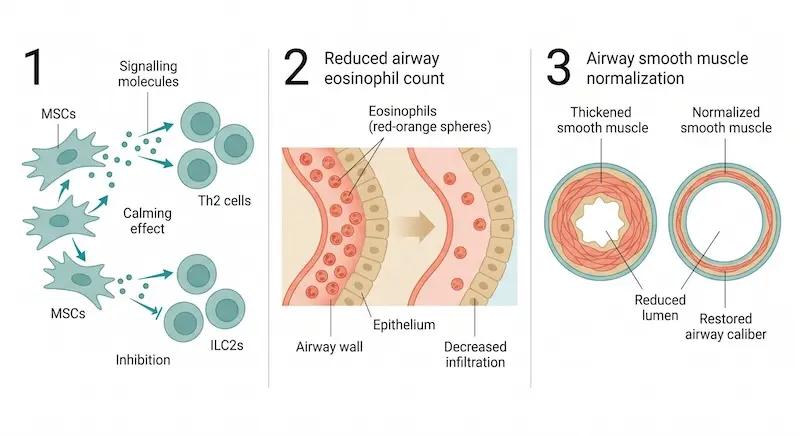
Mesenchymal stem cells, abbreviated as MSCs, are stromal cells found naturally in tissues such as bone marrow, fat, and umbilical cord. The cells themselves are not the active ingredient in the way a drug is. What they do is release signaling molecules — cytokines, growth factors, and small membrane-bound packets called exosomes — that interact with the surrounding immune environment. In severe asthma, the most clinically interesting interaction is with the Th2 cells and ILC2s that drive the disease.
Research published by Shin and colleagues in Molecules and Cells in 2021 examined the effect of human umbilical cord blood-derived MSCs in two mouse models of severe asthma. The treatment reduced lung Type 2 inflammation in both models. In direct co-culture, the umbilical cord MSCs downregulated interleukin-5 and interleukin-13 production from differentiated Th2 cells — including Th2 cells taken from human asthma patients. The MSCs were not blocking these cytokines in the way a biologic drug does. They were quieting the cells that produce them.
A separate study published in Scientific Reports demonstrated that umbilical cord MSCs administered directly into the airways of asthmatic mice reduced airway hyperresponsiveness, lowered the number of Th2 cells and ILC2s in the lung, and shifted lung macrophages from a pro-inflammatory state toward a tissue-repair-oriented state.
Reducing Eosinophilic Airway Inflammation in Severe Asthma
Eosinophils — the granulocytes that accumulate in Type 2 high severe asthma airways and release tissue-damaging proteins — are downstream of the Th2 and ILC2 pathway. When MSCs reduce the activity of those upstream cells, eosinophil recruitment into the airway decreases as a consequence. The pre-clinical evidence is consistent on this point across multiple studies and multiple model systems: MSC treatment reduces airway eosinophil counts in animal models of severe asthma, sometimes substantially.
This is mechanistically different from how anti-IL-5 biologics work. Mepolizumab and reslizumab bind and neutralize circulating IL-5; benralizumab depletes eosinophils directly through antibody-mediated cell killing. MSCs do neither. Instead, they reduce the demand for eosinophil recruitment by quieting the inflammatory cascade that produces the demand in the first place. Whether this difference translates into better long-term outcomes is a question only larger clinical trials will eventually answer.
Slowing Airway Remodeling in Severe Asthma
The third mechanism is the one most relevant to long-term disease trajectory. Airway remodeling — the structural thickening of smooth muscle, basement membrane, and collagen layers — is driven by sustained inflammatory exposure. If the inflammatory environment is calmed durably, the biological signals that drive remodeling are reduced. Pre-clinical evidence suggests MSC therapy can attenuate airway remodeling changes in animal models of chronic asthma, although the clinical question of whether this translates to humans, and over what timeline, remains an active research area.
A similar immunomodulatory pattern is at work in other chronic inflammatory diseases — patients exploring rheumatoid arthritis stem cell therapy show comparable response profiles, and the mechanistic overlap between Th2-driven asthma and other autoimmune-leaning conditions has shaped how the field thinks about which patients are most likely to respond.
What the Clinical and Preclinical Research Shows on Severe Asthma Stem Cell Therapy
The State of the Evidence: Strong Preclinical, Early Clinical
We want to be direct about where the published evidence currently stands for severe asthma stem cell therapy, because patients deserve to know this before any conversation about treatment.
The preclinical evidence — meaning animal studies and in-vitro experiments using human cells — is substantial. Multiple research groups have demonstrated that MSCs from various sources (umbilical cord, bone marrow, adipose tissue) reduce airway inflammation, decrease eosinophil counts, suppress Th2 and ILC2 activity, and attenuate airway hyperresponsiveness in mouse models of allergen-induced and house dust mite-induced severe asthma. The mechanism evidence is reproducible and increasingly well characterized.
The human clinical evidence is at an earlier stage than for some other regenerative medicine applications such as knee osteoarthritis or heart failure. There is no published large Phase III randomized controlled trial in severe asthma stem cell therapy as of 2026. What exists is a small number of registered Phase 1 and early Phase 2 trials, a handful of case reports, and a growing real-world clinical experience at centers offering the treatment internationally. Anyone considering this therapy should hold that context clearly in mind.
Registered Clinical Trials and Early Findings in Severe Asthma Stem Cell Therapy
The most directly relevant active or recently completed trials include the following.
A Phase 1 trial registered as NCT05147688, conducted by The Foundation for Orthopaedics and Regenerative Medicine, is studying the safety and efficacy of allogeneic adult umbilical cord-derived MSCs delivered by intravenous infusion in patients with pulmonary diseases including asthma and chronic obstructive pulmonary disease. The total dose is approximately 100 million cells administered as a single infusion, with follow-up at 1, 6, 12, 24, 36, and 48 months. Initial findings on the first asthma participant were reported by Sharan and colleagues in 2023.
A Phase 1 trial registered as NCT05035862, conducted at Emory University, evaluated interferon-gamma-primed MSCs in moderate-to-severe persistent asthma, with cell doses of 2 million or 5 million cells per kilogram delivered intravenously. The study was terminated early due to funding constraints, although safety data on participants enrolled before termination contribute to the field’s understanding of MSC infusion tolerability in this population.
An earlier Phase 1/2 trial registered as NCT02192736 examined intranasal delivery of mesenchymal trophic factors — the signaling molecules secreted by umbilical cord MSCs rather than the cells themselves — in 20 asthma patients, with safety as the primary endpoint and lung function and quality of life as secondary measures.
What Realistic Improvement Looks Like in Severe Asthma Stem Cell Therapy
Patients deserve realism rather than promotional optimism. Based on the published preclinical data, early human safety reports, and our own clinical experience with patients who travel to Malaysia for this treatment, the realistic outcome picture looks like this.
Improvements, when they occur, tend to be gradual rather than dramatic, with first noticeable changes typically appearing between 6 and 16 weeks after infusion. Reductions in exacerbation frequency, improvements in asthma control scores, and modest improvements in lung function measures such as forced expiratory volume in one second (FEV1) have been reported in case series and the first wave of clinical experience. Some patients report being able to work with their treating physician to gradually reduce maintenance oral corticosteroid doses over the months following treatment — although any such reduction must be managed by the rheumatologist or pulmonologist directing ongoing care, never undertaken unilaterally.
What the evidence does not yet support is claims of cure, reliable elimination of biologic therapy, or restoration of lung function to pre-asthma levels in patients with established disease. The honest framing is partial inflammatory modulation, with the magnitude and durability of effect varying considerably between patients. A meaningful proportion of severe asthma patients who receive this treatment — possibly 30 to 40 percent based on preliminary signals — may not experience clinically significant improvement.
Severe Asthma Profiles That May or May Not Respond to Stem Cell Therapy
Type 2 High (Eosinophilic) Severe Asthma Patients
Severe asthma is biologically heterogeneous, and the inflammatory phenotype matters significantly for any treatment decision — including stem cell therapy. Patients with Type 2 high asthma, characterized by elevated blood eosinophil counts (typically above 300 cells per microliter), elevated fractional exhaled nitric oxide (FeNO), and a history of allergic triggers, represent roughly 60 to 80 percent of severe asthma cases globally.
This phenotype is mechanistically the most directly relevant to MSC therapy, because the Th2 and ILC2 pathways that drive Type 2 high inflammation are precisely the targets that MSCs have been shown to suppress in preclinical models. Patients in this group who are on a biologic but still experiencing breakthrough symptoms, exacerbations, or oral corticosteroid dependence may be reasonable candidates to discuss this treatment with our team.
Type 2 Low (Non-Eosinophilic) Severe Asthma Patients
A smaller but clinically important group — perhaps 20 to 40 percent of severe asthma — has a Type 2 low phenotype, with low eosinophil counts and inflammation driven instead by Th17 and Th1 pathways, often producing a neutrophilic or mixed-cell airway picture. This phenotype is more difficult to treat with conventional biologics, because the IL-5 and IL-4/IL-13 pathways targeted by most approved biologics are less central to the disease.
The evidence for MSC therapy in Type 2 low severe asthma is more limited but biologically rational. The immunomodulatory effects of MSCs extend beyond Th2 suppression to broader regulatory T cell promotion and macrophage repolarization, which may be relevant to the inflammatory drivers of Type 2 low disease. We discuss the strength of evidence honestly with patients in this subgroup — it is less direct than for Type 2 high, but the mechanism is not absent.
When Severe Asthma Stem Cell Therapy Is Not the Right Path
There are clinical situations in which we advise against this treatment, or in which we are upfront that the likelihood of benefit is low.
Patients in the middle of an active severe exacerbation should not undergo elective stem cell therapy — they need acute stabilization with conventional emergency care first. Patients with active severe respiratory or systemic infection are excluded, because the immunomodulatory effect of MSCs could interfere with infection clearance. Patients with end-stage fixed airflow obstruction, where lung function has been permanently reduced by structural remodeling that no longer responds to bronchodilators, have less to gain biologically. Patients with active malignancy, uncontrolled cardiovascular disease, or pregnancy are not candidates.
We also turn away patients whose severe asthma is currently well controlled on their existing regimen with acceptable side effects. The investment of travel and cost for stem cell therapy is not justified for someone whose disease is already managed, and we will say so clearly.
A Patient’s Experience with Severe Asthma Stem Cell Therapy
The Decision Point in Long-Term Biologic-Refractory Severe Asthma
A woman in her late forties had been diagnosed with severe eosinophilic asthma at age 38. Over the decade since, she had cycled through two anti-IL-5 biologics — the first lost effectiveness around the eighteen-month mark, the second produced partial response but never fully controlled her exacerbations. She required at least three courses of oral prednisone per year on top of maintenance therapy. Her morning peak flow readings sat consistently below 70 percent of her personal best. Her bone density scan had shifted from normal to osteopenia over the previous three years, a change her pulmonologist attributed to cumulative steroid exposure.
She came to our clinic in Malaysia in mid-2024 after researching options that did not involve switching to a third biologic. Before accepting her for treatment, we reviewed her spirometry, blood eosinophil counts, FeNO measurements, and full treatment history. Her phenotype was Type 2 high, her disease was clearly biologic-refractory rather than biologic-naive, and her remaining airway architecture appeared intact enough on imaging that inflammatory modulation could plausibly translate into clinical improvement. We were direct with her: we could not predict her individual response, and we asked her not to make any medication changes around the treatment without her pulmonologist’s involvement.
What Changed and Didn’t Change Over Twelve Months
The first eight weeks following the intravenous infusion produced no noticeable change — a period she described as discouraging. By the third month, she reported that the morning chest tightness she had lived with for years was less prominent on most days and that her peak flow readings had begun to drift upward. At six months, her blood eosinophil count had reduced from approximately 480 cells per microliter to 220. Her asthma control test score had improved from 14 to 19. She and her pulmonologist had cautiously reduced her maintenance oral steroid dose, with no exacerbation following the reduction.
At twelve months, she remained on her biologic and her inhaled controller, with a lower oral steroid maintenance dose than she had taken in five years. She has not had a hospital-grade exacerbation since the treatment, although she had a moderate flare during respiratory virus season that responded to a short oral steroid burst. Her bone density scan at twelve months was stable rather than continuing to decline. She describes the change as meaningful without being miraculous.
This is an anonymized account based on actual clinical experience. Individual outcomes vary significantly, and this experience does not represent what all patients will experience.
The Treatment Process for Severe Asthma Patients in Malaysia
Why Allogeneic Umbilical Cord MSCs for Severe Asthma
The choice of cell source matters clinically, and it is worth explaining why we have chosen allogeneic umbilical cord-derived MSCs for severe asthma treatment specifically.
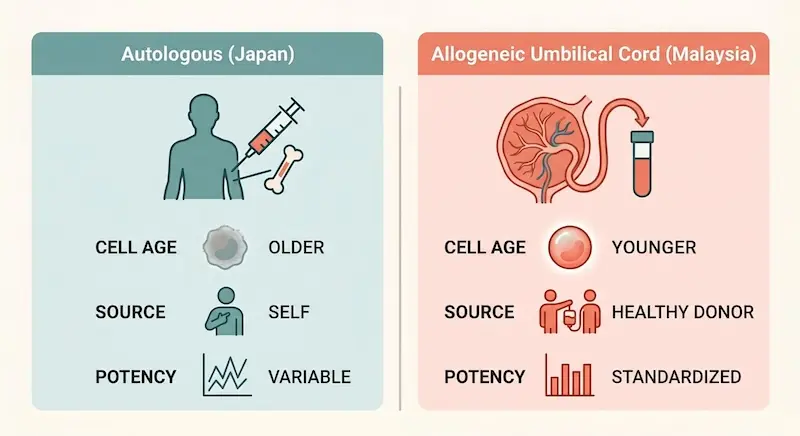
Japan’s current regenerative medicine framework primarily uses autologous stem cells — cells harvested from the patient’s own body, typically from bone marrow or adipose tissue, then processed and returned. The advantage is the absence of any rejection concern. The disadvantage, particularly relevant for a severe asthma patient, is that the cells reflect the body they came from. A patient who has had chronically activated inflammation for fifteen or twenty years, plus ongoing steroid exposure, may not have an optimal donor pool inside their own body. Bone marrow MSCs from older patients with chronic inflammatory conditions show measurably reduced anti-inflammatory potency in laboratory studies compared to cells from healthy young donors.
The MSCs we use are sourced from umbilical cord tissue donated at the time of healthy births, with full ethical consent — specifically from the Wharton’s jelly layer surrounding the cord, which contains a high concentration of young, highly active, immunomodulatorily potent MSCs. These cells have not lived through decades of inflammatory exposure. They are produced in standardized batches with quality testing on viability and potency before administration. And they have low immunogenicity — they express low levels of the surface markers that ordinarily trigger immune rejection — meaning they are tolerated by the recipient without immunosuppression.
Honest Risks and Limitations of Severe Asthma Stem Cell Therapy
Known Adverse Effects in Severe Asthma Stem Cell Infusions
Across the body of published MSC infusion trials in pulmonary and other conditions, the safety profile has been generally favorable. The most commonly reported effects are mild and self-limiting: low-grade fever in the first 24 to 48 hours, transient fatigue, occasional headache, and mild infusion-site discomfort.
For severe asthma patients specifically, there is a theoretical concern about whether intravenous cell infusion could provoke bronchospasm in a population with airways already prone to it. Across the small number of published asthma-specific trials and the broader body of MSC pulmonary work, this has not emerged as a consistent clinical problem, but it is one of the reasons that infusion is performed in a monitored setting with rescue medication available. Patients in active exacerbation or with significantly unstable disease are not treated.
Serious adverse events directly attributable to allogeneic umbilical cord MSC infusion have been uncommon in published trials across multiple conditions. Long-term safety data beyond five years remains limited, simply because the field is relatively young at the clinical scale.
What Severe Asthma Stem Cell Therapy Cannot Do
We want to be explicit about the limits, because severe asthma patients have already encountered enough overselling.
Stem cell therapy is not a replacement for ongoing pulmonology care. Patients who receive this treatment will continue to need their treating physician for monitoring, medication adjustment, and exacerbation management. This is not a treatment that should be pursued in isolation from the medical relationship that has been keeping the disease controlled.
Stem cell therapy does not reverse fixed airway remodeling. Where the bronchial muscle and basement membrane have been permanently thickened by years of inflammation, infusing stem cells will not undo that structural change. The window in which MSC therapy is most likely to be useful is in the inflammatory layer that drives further remodeling — not in the architecture that has already shifted.
Stem cell therapy cannot stop an acute asthma attack. It is not rescue therapy. It is not a substitute for inhaled bronchodilators, emergency oral steroids, or hospital care during an exacerbation. Patients should continue to use their rescue medications exactly as prescribed.
Not every patient responds. Based on the early evidence and our clinical experience, possibly 30 to 40 percent of severe asthma patients who receive this treatment may not see clinically meaningful improvement. We cannot yet reliably predict in advance who will fall into the responding versus non-responding group, although phenotype assessment and disease history provide partial information. Patients deserve this number honestly before making any commitment.
FAQ For Severe Asthma Stem Cell Therapy
No. We specifically ask severe asthma patients not to modify their existing regimen — inhaled corticosteroids, biologic therapy, or oral corticosteroids — before or immediately around the treatment. Any future reduction in these medications should be discussed with the treating pulmonologist based on objective response markers measured at 3, 6, and 12 months. Self-directed medication changes around stem cell treatment are not safe and are not what we recommend.
Most patients who respond do so gradually, with first noticeable changes appearing between weeks 6 and 16 after the infusion. The biological processes of inflammatory modulation, cytokine signaling shifts, and immune regulatory rebalancing take time. Patients who expect immediate change typically experience frustration in the first month and may draw an inaccurate early conclusion. Expect the response, if any, to develop over several months.
The honest answer is that for most patients it will not. The realistic goal is reduction in disease activity that allows the treating pulmonologist to consider gradual dose reductions in oral corticosteroids or possibly inhaled medication intensity over time. Complete replacement of biologic therapy is not what the current evidence supports, and we do not frame the treatment that way.
In nearly all jurisdictions, no. Stem cell therapy for severe asthma is considered outside standard indications by most insurance systems and is delivered as a private elective treatment. Patients should plan accordingly and not assume reimbursement.
No. Active exacerbation, recent hospitalization within the past 6 to 8 weeks, or significant clinical instability are reasons to defer treatment. The therapy is intended for chronic disease modulation, not acute management. We will ask any patient with recent destabilization to demonstrate stability for a defined period before treatment is scheduled.
If You Are Considering the Next Step for Your Severe Asthma
If you have read this far, you are likely someone who has already cycled through the standard severe asthma options and is trying to assess whether stem cell therapy is a credible next step for your specific situation — or whether it is just another claim that does not quite fit. We respect that question and approach it the same way.
We offer free online consultations for exactly that conversation. Bring your most recent spirometry, your blood eosinophil count if available, your history of biologic use, and your current medication list. We will look at your case carefully and tell you honestly whether we think this treatment fits — and if we do not, we will tell you that as well. You do not need to have made any decisions before reaching out.
References
- GBD 2021 Asthma Collaborators. “Global, regional, national burden of asthma from 1990 to 2021, with projections of incidence to 2050: a systematic analysis of the global burden of disease study 2021.” eClinicalMedicine. 2024. https://doi.org/10.1016/j.eclinm.2024.102921
- Shin JW, Ryu S, Ham J, Jung K, Lee S, Chung DH, Kang HR, Kim HY. “Mesenchymal Stem Cells Suppress Severe Asthma by Directly Regulating Th2 Cells and Type 2 Innate Lymphoid Cells.” Molecules and Cells. 2021;44(8):580–590. https://doi.org/10.14348/molcells.2021.0101
- Sharan J, et al. “Safety of cultured allogeneic adult umbilical cord-derived mesenchymal stem cell intravenous infusion for the treatment of pulmonary diseases: Preliminary findings (NCT05147688).” 2023. ClinicalTrials.gov: https://clinicaltrials.gov/study/NCT05147688
- ClinicalTrials.gov NCT05035862. “A Phase 1 Study to Evaluate Safety, Toxicity, and Potential Mechanisms of Interferon Gamma-primed Mesenchymal Stromal Cells (MSCs) for Moderate-to-severe Persistent Asthma.” Emory University. https://clinicaltrials.gov/study/NCT05035862
- Wang LT, Liu KJ, Sytwu HK, Yen ML, Yen BL. “Advances in mesenchymal stem cell therapy for immune and inflammatory diseases: Use of cell-free products and human pluripotent stem cell-derived mesenchymal stem cells.” Stem Cells Translational Medicine. 2021;10(9):1288–1303. https://doi.org/10.1002/sctm.21-0021
- Wang YH, Tsai DY, Ko YA, Yang TT, Lin IY, Hung KH, Lin KI. “Mesenchymal Stem/Stromal Cells in Asthma Therapy: Mechanisms and Strategies for Enhancement.” Cell Transplantation. 2023. https://pmc.ncbi.nlm.nih.gov/articles/PMC10278440/
- Bagnasco D, Caminati M, Menzella F, Milanese M, Rolla G, Lombardi C, Bucca C, Heffler E, Paoletti G, Testino E, et al. “One year of mepolizumab. Efficacy and safety in real-life in Italy.” Pulmonary Pharmacology & Therapeutics. 2019;58:101836. https://doi.org/10.1016/j.pupt.2019.101836
- Volpato M, Vianello A, Antonicelli L, Bagnasco D, Caminati M, Canonica GW, et al. “Oral Corticosteroids Dependence and Biologic Drugs in Severe Asthma: Myths or Facts? A Systematic Review of Real-World Evidence.” International Journal of Molecular Sciences. 2021;22(13):7132. https://doi.org/10.3390/ijms22137132
- Chung KF, Wenzel SE, Brozek JL, Bush A, Castro M, Sterk PJ, et al. “International ERS/ATS guidelines on definition, evaluation and treatment of severe asthma.” European Respiratory Journal. 2014;43:343–373. https://doi.org/10.1183/09031936.00202013
- Song N, Scholtemeijer M, Shah K. “Mesenchymal Stem Cell Immunomodulation: Mechanisms and Therapeutic Potential.” Trends in Pharmacological Sciences. 2020;41(9):653–664. https://doi.org/10.1016/j.tips.2020.06.009