

Atopic Dermatitis Stem Cell Therapy | Can Skin Inflammation Be Calmed Without Steroids?
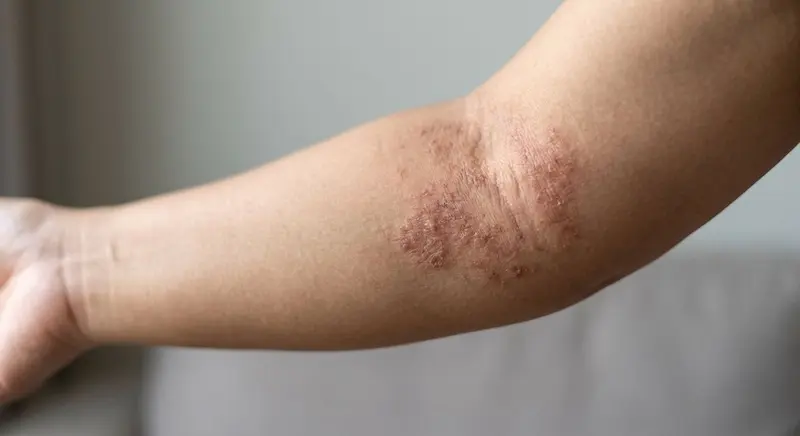
The patch on your inner elbow flared up again last week. The skin behind your knees has been thickened and rough for so long you have stopped noticing it—until something brushes against it and the itching restarts in earnest. You used the topical steroid as instructed, the redness faded, and then within ten days of stopping, the flare came back. The cycle has been going on for months. Or years. Or, for some, decades.
If that pattern is familiar, you are far from alone. According to global epidemiology data, atopic dermatitis affects an estimated 230 million people worldwide, including roughly 15 to 20 percent of children and 2 to 10 percent of adults across most countries studied. For some, the condition is a manageable inconvenience. For others—particularly those whose disease begins in childhood and persists into adulthood—it shapes sleep, work, relationships, and self-image in ways that are difficult to convey to anyone who has not lived with it.
The conventional treatment ladder is well-defined: emollients, topical steroids, calcineurin inhibitors, oral immunosuppressants, and biologic agents like dupilumab for those who can access them. These tools genuinely help many patients. But for a significant minority, the experience plays out differently—the steroids work less effectively over time, the biologics produce side effects that are difficult to live with, or the disease simply does not respond as well as the prescribing brochure suggested.
This article is for that group. We will explain how stem cell therapy approaches atopic dermatitis at the immune level, what specific clinical trial data has shown in real numbers, who is a realistic candidate, and where the honest limitations lie. Our team has been working in regenerative medicine in Malaysia for over seven years, treating more than 200 patients with allogeneic umbilical cord-derived mesenchymal stem cells. We do not believe this treatment is appropriate for everyone, and we will be direct about who it is and is not for.
Table of Contents
- Why Atopic Dermatitis Becomes a Long-Term Condition
- Where Standard Atopic Dermatitis Treatments Reach Their Limit
- How Stem Cell Therapy Works in Atopic Dermatitis
- Clinical Evidence on Stem Cell Therapy for Atopic Dermatitis
- A Patient's Experience with Atopic Dermatitis Stem Cell Therapy
- Who Is a Good Candidate for Atopic Dermatitis Stem Cell Therapy
- Honest Risks and Limitations of Atopic Dermatitis Stem Cell Therapy
- FAQ About Atopic Dermatitis Stem Cell Therapy
- If You Are Considering This Path
- References
Why Atopic Dermatitis Becomes a Long-Term Condition
The Misdirected Immune Response in Atopic Dermatitis
At the biological core of atopic dermatitis is an immune system that has miscategorized harmless environmental triggers as threats. In a person without the condition, the immune system distinguishes between dangerous invaders and routine substances—pollen, dust, certain food proteins, even the natural microbes that live on healthy skin. In atopic dermatitis, that distinction is blurred. The immune system mounts a chronic inflammatory response against substances that should not provoke one.
Specifically, atopic dermatitis is driven by a particular branch of the immune response known as Type 2 inflammation, dominated by immune cells called Th2 helper T-cells. These cells release signaling proteins called cytokines, including interleukin-4, interleukin-13, and interleukin-31. Each plays a specific role in the inflammatory cascade. Interleukin-31 is now understood to be one of the most direct molecular drivers of itch in atopic dermatitis—which explains why the urge to scratch in this condition is so much more intense than the itch from a simple bug bite or dry skin.
This is why atopic dermatitis cannot simply be moisturized away. The immune signaling continues regardless of what is applied to the skin’s surface. Without something that addresses the immune dysregulation itself, the cycle restarts each time external suppression is withdrawn.
The Damaged Skin Barrier in Atopic Dermatitis
The second core problem is the skin barrier. Healthy skin has a tightly organized outer layer that holds moisture in and keeps irritants and microbes out. In atopic dermatitis, this barrier is structurally compromised. A protein called filaggrin, which plays a critical role in maintaining barrier integrity, is often produced in insufficient amounts or in dysfunctional forms.
The result is skin that loses water faster than normal and allows allergens, irritants, and microbes to penetrate more easily—which in turn provokes further immune response. The barrier defect and the immune defect are not separate problems; they feed each other. A weakened barrier admits more triggers, and persistent inflammation further weakens the barrier.
Why the Atopic Dermatitis Cycle Self-Reinforces
The combination produces a self-sustaining loop that explains why the condition rarely resolves on its own. Inflammation damages the barrier; the damaged barrier admits more triggers; more triggers provoke more inflammation; the inflammation triggers itching; scratching causes microscopic skin injury; the injury releases inflammatory signals that further activate the immune system.
Topical treatments interrupt parts of this cycle—a steroid cream suppresses inflammation in the area where it is applied, a moisturizer temporarily restores some barrier function—but they do not address the upstream immune dysregulation that keeps generating the cycle in the first place. This is the fundamental reason why most patients with moderate-to-severe atopic dermatitis remain dependent on external suppression for years or decades.
Where Standard Atopic Dermatitis Treatments Reach Their Limit
What Topical Steroids Can—and Cannot—Do for Atopic Dermatitis
Topical corticosteroids have been the foundation of atopic dermatitis treatment for over fifty years. Used appropriately, they reduce inflammation effectively and quickly, and for patients with mild or moderate disease, they often allow long-term symptom control with manageable risk.
The challenge emerges in two scenarios. The first is when the disease is severe enough that high-potency steroids are required across large body surface areas for prolonged periods. Long-term, widespread application of potent steroids carries documented risks: skin thinning, telangiectasia (visible small blood vessels at the surface), striae (stretch marks), and systemic absorption that can suppress the body’s own steroid production.
The second scenario is what many patients describe as the steroid plateau or, in more severe cases, topical steroid withdrawal. The skin becomes progressively less responsive to the same potency, requiring stronger formulations or larger application areas. When patients attempt to taper off, they frequently experience rebound flares more severe than their original disease. The phenomenon of topical steroid withdrawal—a constellation of symptoms occurring when long-term steroid users discontinue treatment—is now formally recognized in dermatology literature, though its exact mechanism remains under active investigation.
When Biologics and Systemic Therapy for Atopic Dermatitis Fall Short
For patients with moderate-to-severe atopic dermatitis, biologic agents have transformed treatment options. Dupilumab, which blocks the receptor for interleukin-4 and interleukin-13, has produced dramatic improvements for many patients. Newer agents—JAK inhibitors like upadacitinib and abrocitinib, and other biologics like tralokinumab—have expanded the toolkit further.
But these treatments are not universal solutions. Roughly 30 to 40 percent of patients on dupilumab do not achieve a 75 percent reduction in disease severity scores at one year. A subset develop side effects—conjunctivitis is commonly reported with dupilumab, and JAK inhibitors carry warnings about cardiovascular events, blood clots, and infection risk. Cost and access remain significant barriers in many countries; in others, the medications work well but require indefinite continuation, with the question of long-term safety still being clarified through post-marketing surveillance.
For patients with this profile—those who have either failed to respond adequately to biologics, cannot tolerate them, or are reluctant to commit to indefinite systemic immune modulation—the clinical landscape narrows considerably. It is this group that most often begins exploring whether stem cell therapy offers a different kind of approach.
How Stem Cell Therapy Works in Atopic Dermatitis
Calming the Th2 Immune Response in Atopic Dermatitis
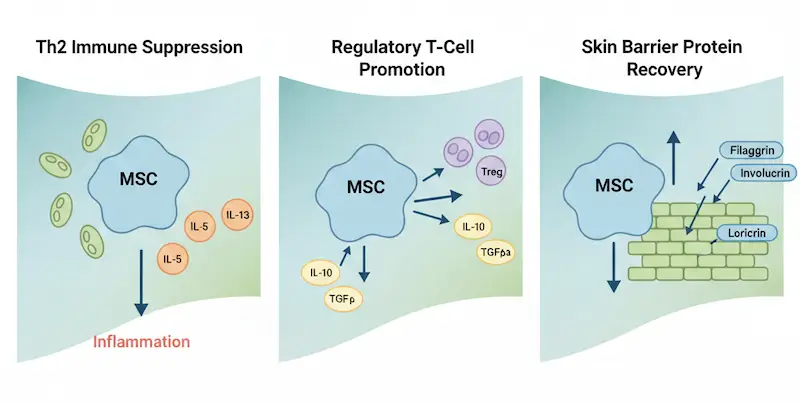
The most important difference between mesenchymal stem cell therapy and conventional atopic dermatitis treatments is mechanistic. Topical steroids suppress local inflammation. Biologics block specific cytokines. Mesenchymal stem cells (MSCs) work upstream of both, by modulating the behavior of the immune cells that produce the inflammatory signals in the first place.
When infused into a patient with atopic dermatitis, MSCs migrate toward sites of active inflammation and release a complex mixture of signalling molecules. Among the most relevant effects is the suppression of Th2-type immune responses—the very pathway driving atopic dermatitis. Laboratory studies have demonstrated that MSCs can reduce the proliferation of Th2 cells, decrease the production of interleukin-4 and interleukin-13, and promote the activity of regulatory T-cells—a specialised immune cell population whose function is essentially to tell the rest of the immune system to stand down.
This is conceptually similar to how MSC therapy operates in other immune-mediated conditions. Patients we have seen for rheumatoid arthritis stem cell therapy receive the same cell type, working through overlapping mechanisms—immune regulation rather than blanket immune suppression.
Supporting Skin Barrier Recovery in Atopic Dermatitis
Beyond immune modulation, MSCs release growth factors that influence the local skin environment in ways relevant to barrier recovery. These include factors that support the function of keratinocytes—the cells that produce the proteins maintaining barrier integrity—and signaling molecules that promote tissue repair rather than ongoing inflammatory response.
The clinical implication, in patients who respond, is a gradual shift in the skin’s overall behavior: less reactivity to environmental triggers, slower water loss, and a measurable reduction in the frequency and severity of flares. This is not the same as an immediate clearing of existing lesions; it is a slower change in how the skin behaves over time, often most apparent in the reduced frequency of new flares rather than the dramatic improvement of existing ones.
Why Allogeneic Umbilical Cord MSCs for Atopic Dermatitis
In Japan, where the regenerative medicine framework primarily authorizes autologous cell therapy, MSCs are typically harvested from the patient’s own bone marrow or fat tissue. The advantage is the absence of any immune rejection concern. The limitation, particularly relevant for patients with chronic immune-mediated conditions, is that the cells reflect the immune environment they came from. A patient whose Th2 system has been chronically dysregulated for twenty years carries that dysregulation into the cells available from their own body.
The treatment we offer in Malaysia uses allogeneic umbilical cord-derived MSCs—cells sourced from ethically donated umbilical cord tissue collected at birth from healthy newborns with full donor consent. These cells are biologically young, highly proliferative, and characterized by particularly strong immunomodulatory output. Because umbilical cord MSCs express low levels of the surface markers that typically trigger immune rejection, they are well tolerated by recipients without the need for any immunosuppressive medication. Each batch is quality-tested for viability and potency before clinical use, allowing for consistent dosing across patients.
For atopic dermatitis specifically, where the goal is to introduce a regulatory signal into a chronically activated immune environment, the source of the cells matters more than it does in some other applications.
Clinical Evidence on Stem Cell Therapy for Atopic Dermatitis
Key Trial Findings on Stem Cell Therapy for Atopic Dermatitis
The clinical evidence base for MSC therapy in atopic dermatitis is younger than for the conditions where stem cells have been studied longest, but it is not absent. Several Phase I and Phase IIa trials have been completed, with results published in peer-reviewed journals.
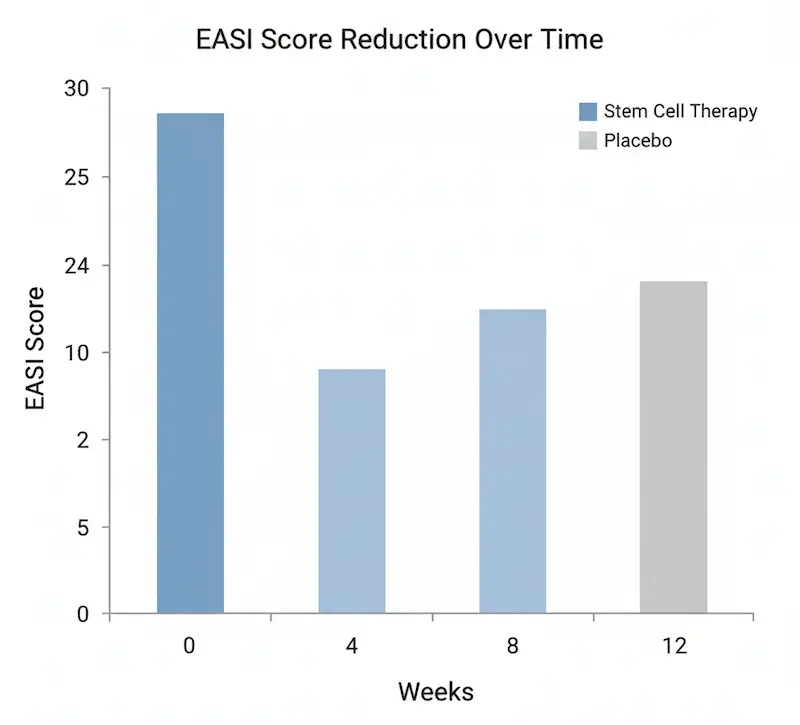
The most cited published study is the work of Kim and colleagues, published in Stem Cells in 2017. This Phase I/IIa trial enrolled 34 patients with moderate-to-severe atopic dermatitis who received subcutaneous administration of human umbilical cord blood-derived MSCs at varying dose levels. At twelve weeks post-treatment, the higher-dose group showed an Eczema Area and Severity Index (EASI) score reduction of 50 percent or more in approximately 55 percent of treated patients—a result categorized clinically as a meaningful response. Pruritus scores measuring itch severity, and serum IgE levels (an antibody elevated in allergic conditions) also decreased in a measurable way. No serious adverse events related to the cell therapy were reported.
Subsequent investigator-initiated and registry studies have extended this work. A 2020 review published in Frontiers in Cell and Developmental Biology synthesized findings across multiple early-phase trials and reported broadly consistent improvements in EASI scores, pruritus, and quality-of-life measures, alongside a generally favorable safety profile. The reviewers also noted that response was variable—a substantial portion of patients did not achieve the 50 percent threshold—and that durability of effect beyond 12 to 24 months remained an open question.
More recent preclinical and translational studies have continued to clarify the mechanisms involved, including documented reductions in Th2 cytokine production, restoration of regulatory T-cell function, and indirect effects on skin barrier proteins in animal models of atopic dermatitis.
What Realistic Improvement After Atopic Dermatitis Stem Cell Therapy Looks Like
We want to be precise about what these numbers mean for an individual patient considering treatment, because vague summaries of “encouraging results” do not help anyone make a real decision.
A 50 percent reduction in EASI score is a clinically meaningful change. For a patient with severe disease covering much of the body, it can mean the difference between debilitating daily symptoms and a manageable condition. But it does not mean clear skin. It means roughly half the previous level of disease activity. Some patients exceed this threshold and experience much greater improvement; others fall below it and see modest or no change. The pattern of response is not currently predictable from baseline characteristics alone.
Improvement timelines also vary. Most patients in published trials began noticing changes between four and twelve weeks post-treatment, with maximum effect typically observed at three to six months. Pruritus reduction often precedes visible improvements in skin appearance—a pattern that is consistent with the immune modulation hypothesis, since itching is among the most cytokine-driven symptoms of the condition.
Approximately 30 to 45 percent of patients in available trial data did not achieve the response threshold. We do not currently have a reliable way to predict in advance who will fall into the responder versus non-responder group. This is not a comfortable truth, but it is part of any honest discussion of this treatment.
A Patient’s Experience with Atopic Dermatitis Stem Cell Therapy
A Long-Term Atopic Dermatitis Patient’s Decision to Try MSC Therapy
A man in his late thirties had been managing moderate-to-severe atopic dermatitis since childhood. His disease had affected his arms, neck, and face throughout most of his adult life. He had used topical steroids of varying potencies, oral cyclosporine for two separate periods earlier in his thirties, and dupilumab for eighteen months. Dupilumab had produced significant initial improvement, but he had developed persistent conjunctivitis severe enough that his ophthalmologist recommended discontinuation. After stopping the biologic, his disease had progressively returned to baseline within about four months.
He came to our clinic in late 2024, having read several published trial summaries and consulted with his dermatologist about the absence of obvious next steps. We reviewed his clinical history, current medications, and recent dermatologic assessments. He was a reasonable candidate: documented moderate-to-severe disease, intolerance to a leading biologic, no active systemic infection, and realistic expectations about what stem cell therapy could and could not offer.
How Recovery Unfolded After Atopic Dermatitis Stem Cell Treatment
The first three to four weeks produced no noticeable change—a period he described as the hardest, because the absence of immediate response was easy to interpret as treatment failure. By week six, he reported that the intensity of his nighttime itching had reduced. The lesions on his arms had not yet visibly improved, but he was sleeping more consistently than he had in months. By week twelve, areas of skin that had been actively inflamed for months were transitioning to a less active state, with reduced redness and thickening.
At his six-month follow-up, his EASI score had dropped from a baseline of 28 to 12—a reduction in the range observed in the higher-responder group of published trials. He had reduced but not eliminated his use of topical treatments. His dermatologist back home agreed that further reduction could be considered cautiously, with monitoring. He has not been a complete responder—mild eczema on his hands persists, and he expects to need ongoing skin care—but he describes the change as the first sustained improvement he has experienced in many years.
This is an anonymized account based on actual clinical experience. Individual results vary and outcomes cannot be guaranteed for all patients.
Who Is a Good Candidate for Atopic Dermatitis Stem Cell Therapy
Atopic Dermatitis Patients Who May Benefit from Stem Cell Treatment
Stem cell therapy for atopic dermatitis tends to show the clearest results in patients who meet several conditions. They have moderate-to-severe atopic dermatitis confirmed by a dermatologist, with EASI scores typically above 16. They have tried conventional treatments—topical steroids, calcineurin inhibitors, and ideally a systemic agent or biologic—without sustained adequate response, or have experienced side effects that limit ongoing use. They are not currently in an acute flare with widespread skin infection, which would need to be addressed first. They understand and accept that the treatment works through gradual immune modulation rather than immediate symptom suppression, and that response is not guaranteed.
Patients whose disease is primarily driven by Type 2 inflammation—the typical pattern in adult atopic dermatitis—appear to respond more consistently than those with mixed inflammatory patterns or those whose presentation overlaps significantly with other dermatologic conditions.
When Atopic Dermatitis Stem Cell Therapy May Not Be the Right Fit
We are direct with patients when we do not think this treatment is appropriate for their situation.
Patients with mild atopic dermatitis well controlled on topical therapy alone are unlikely to gain enough additional benefit from systemic stem cell therapy to justify the cost and travel involved. Patients with active widespread skin infection require treatment of the infection before any immune-modulating therapy can be considered. Pregnant patients are excluded from elective MSC therapy. Patients with active malignancy, severe uncontrolled systemic illness, or active autoimmune conditions other than atopic dermatitis require careful individualized assessment.
Patients seeking guaranteed remission or complete clearance of skin disease should know that this is not what the available data supports. The treatment is best understood as a way to potentially shift the immune environment in a more favorable direction, alongside continued skin care—not as a definitive cure.
Recovery and What to Expect After Atopic Dermatitis Stem Cell Therapy
The recovery from MSC infusion is far less intensive than recovery from any conventional dermatologic procedure. There is no wound to heal, no medication to taper urgently, no period of strict activity restriction. Most patients describe the days immediately following the infusion as unremarkable, sometimes with mild fatigue or low-grade fever in the first 24 to 48 hours that resolves without specific intervention.
The most important thing we communicate about the recovery period is patience. Unlike a topical steroid—which can produce visible improvement within days—MSC therapy works through a slower biological process. The cells need time to engraft, modulate the immune environment, and influence the inflammatory cascade. Most patients who respond begin noticing changes between weeks four and twelve, with maximum effect typically at three to six months. Expecting meaningful change within the first two weeks is likely to produce frustration and may lead to an inaccurate early conclusion that the treatment has not worked.
We advise continued skin care—including emollients and prescribed topicals as guided by your dermatologist—throughout the post-treatment period. Stem cell therapy is not a replacement for skin care; it is an addition to it that, in patients who respond, may reduce the intensity of what skin care alone needs to manage.
Honest Risks and Limitations of Atopic Dermatitis Stem Cell Therapy
Known Side Effects of Atopic Dermatitis Stem Cell Treatment
The safety profile of allogeneic MSC therapy in atopic dermatitis trials has been generally favorable across the published literature. The most commonly reported effects following infusion are mild and self-limiting: low-grade fever within 24 to 48 hours, transient fatigue, and occasional headache. These typically resolve without specific treatment.
Serious adverse events directly attributable to the cell therapy itself have been uncommon. The Phase I/IIa trial published by Kim and colleagues, along with subsequent registry data, has not reported significant safety signals, including no documented cases of immune rejection despite the use of allogeneic cells. This is consistent with the broader pattern observed in MSC therapy for other indications.
Theoretical risks warrant mention even when they have not materialized in trial data. Because MSCs modulate immune activity, there is a theoretical interaction concern when patients are simultaneously taking systemic immunosuppressive medications. We assess this on a case-by-case basis and coordinate with the patient’s dermatologist about any medication adjustments. We do not unilaterally recommend stopping existing treatment before MSC therapy—that decision belongs with the treating physician who manages ongoing care.
Long-term safety data—five years, ten years—remains limited because the field is relatively young at the clinical scale. We disclose this honestly to every patient and contribute follow-up data to the growing registry of post-treatment outcomes in regenerative medicine.
What Stem Cell Therapy Cannot Do for Atopic Dermatitis
We want to be specific about the limits, because vagueness on this point serves no one.
Stem cell therapy cannot cure atopic dermatitis. The genetic and environmental factors that predispose someone to the condition do not change after treatment. What may change is the activity level of the immune dysregulation that drives clinical symptoms—which can translate to meaningful improvement in disease severity and quality of life, but is not the same as eliminating the underlying tendency.
It cannot guarantee response. Roughly 30 to 45 percent of patients in available trial data do not achieve the response thresholds used in the studies. We cannot reliably predict who will and will not respond, although honest pre-treatment assessment provides some useful information about candidacy.
It is not an emergency intervention. Patients in severe acute flares need conventional management to stabilize their condition before elective stem cell therapy is appropriate. The slow timeline of MSC therapy is poorly matched to situations that require rapid relief.
And it is not a substitute for ongoing dermatologic care. Patients who undergo this treatment continue to need follow-up with their dermatologist, ongoing skin care, and—in most cases—some level of baseline topical or systemic treatment. The realistic framing is that stem cell therapy may shift the floor of the disease in a favorable direction, allowing other treatments to do their work more effectively, but it does not stand alone.
FAQ About Atopic Dermatitis Stem Cell Therapy
Both target the Type 2 immune response that drives atopic dermatitis, but at different levels. Dupilumab blocks a single receptor for two specific cytokines and requires continuous administration to maintain effect. MSCs work by modulating the upstream immune cells producing those cytokines, with effects that may persist after a single treatment course in patients who respond. Neither approach eliminates the underlying genetic predisposition.
Most likely yes, at least in some form. Patients who respond to MSC therapy often find they need less potent steroids less frequently, but maintenance skin care—including topical anti-inflammatory treatment as needed—typically remains part of long-term management.
Available trial data tracks outcomes to 12 to 24 months in most studies. Some patients maintain improvement well beyond that period, while others experience gradual return of disease activity. Re-treatment may be considered for patients who initially respond and later see effects diminish. Long-term durability data beyond two to three years remains limited and is an active area of research.
Regulatory status varies significantly by country. In Japan, autologous stem cell therapies for various conditions operate under specific frameworks. In Malaysia, where we work, the treatment is conducted under regulated medical practice. We recommend independently verifying the regulatory status applicable in your country before making any decision.
In most cases, yes. We do not ask patients to discontinue their existing treatment before or during MSC therapy. Decisions about adjusting topical or systemic medications belong with the treating dermatologist, ideally informed by the response observed after stem cell therapy.
If You Are Considering This Path
Atopic dermatitis is one of those conditions where the gap between what conventional medicine can offer and what patients need to feel okay in their own skin can feel very wide. If you have reached the point where the cycle of flares and treatments has become exhausting, and you are wondering whether something more fundamental might be possible, that is a legitimate question worth investigating.
We offer free online consultations for exactly this kind of conversation. Bring your treatment history, your photographs, your skepticism, and your questions. We will give you our honest read on whether your case falls within the range where this therapy has shown meaningful evidence of benefit—or whether it does not. You are not committing to anything by reaching out other than the conversation itself.
References
- Kim HS, Lee JH, Roh KH, Jun HJ, Kang KS, Kim TY. “Clinical Trial of Human Umbilical Cord Blood-Derived Stem Cells for the Treatment of Moderate-to-Severe Atopic Dermatitis: Phase I/IIa Studies.” Stem Cells. 2017;35(1):248–255. https://doi.org/10.1002/stem.2401
- Shin TH, Kim HS, Choi SW, Kang KS. “Mesenchymal Stem Cell Therapy for Inflammatory Skin Diseases: Clinical Potential and Mode of Action.” International Journal of Molecular Sciences. 2017;18(2):244. https://doi.org/10.3390/ijms18020244
- Na K, Yoo HS, Zhang YX, Choi MS, Lee K, Yi TG, Song SU, Jeon MS. “Bone Marrow-Derived Clonal Mesenchymal Stem Cells Inhibit Ovalbumin-Induced Atopic Dermatitis.” Cell Death & Disease. 2014;5:e1345. https://doi.org/10.1038/cddis.2014.299
- Daltro SRT, Meira CS, Santos IP, Ribeiro Dos Santos R, Soares MBP. “Mesenchymal Stem Cells and Atopic Dermatitis: A Review.” Frontiers in Cell and Developmental Biology. 2020;8:326. https://doi.org/10.3389/fcell.2020.00326
- Langan SM, Irvine AD, Weidinger S. “Atopic Dermatitis.” The Lancet. 2020;396(10247):345–360. https://doi.org/10.1016/S0140-6736(20)31286-1
- Bieber T. “Atopic Dermatitis: An Expanding Therapeutic Pipeline for a Complex Disease.” Nature Reviews Drug Discovery. 2022;21(1):21–40. https://doi.org/10.1038/s41573-021-00266-6