

Crohn’s Disease Stem Cell Therapy | Calming Inflammation When Biologics Fall Short
Knowing where every restroom is on your daily route. Cancelling plans an hour before you were supposed to leave. Watching what you eat with the kind of attention most people reserve for important deadlines. If you have been living with Crohn’s disease for any length of time, these are not abstractions — they are the texture of daily life.
You are not alone. An estimated 3 to 4 million people worldwide live with Crohn’s disease, and incidence is rising in regions where the condition was once rare. Most patients begin treatment with anti-inflammatory medications, move to immunosuppressants, and eventually to biologics — engineered drugs that block specific inflammatory proteins. For many, this works. For roughly one in three patients, the first biologic does not produce a meaningful response. For others, the response fades over time. And for a significant proportion, the disease eventually leads to surgery — bowel resection, fistula repair, or both.
This article is written for patients who have already traveled some distance along that pathway and are now asking a different question. Is there a treatment that addresses the underlying immune dysregulation rather than simply adding another layer of medication?
We will look at what the clinical evidence for Crohn’s disease stem cell therapy actually shows — including a treatment that has been formally approved in Europe for a specific Crohn’s disease complication, and the broader research on what stem cells can and cannot do for inflammatory bowel disease more generally. Our team has been working in regenerative medicine in Malaysia for over seven years, with more than 200 patients treated. We will not tell you stem cell therapy is a cure. We will be specific about where the evidence is strongest, where it is thinnest, and what realistic expectations look like.
Table of Contents
- The Two Faces of Crohn's Disease That Make It So Hard to Treat
- Where Standard Crohn's Disease Treatment Hits Its Ceiling
- How Stem Cell Therapy Targets Crohn's Disease Differently
- Clinical Trial Evidence for Crohn's Disease Stem Cell Therapy
- Allogeneic Umbilical Cord MSCs vs Autologous Cells for Crohn's Disease
- Who Is — and Is Not — a Good Candidate for Crohn's Disease Stem Cell Therapy
- A Patient's Experience with Crohn's Disease Stem Cell Therapy
- Honest Risks and Limitations of Crohn's Disease Stem Cell Therapy
- FAQ About Crohn's Disease Stem Cell Therapy
- If You Are Weighing Whether This Is a Reasonable Next Step
- References
The Two Faces of Crohn’s Disease That Make It So Hard to Treat
How Chronic Inflammation Damages the Crohn’s Disease Bowel
Crohn’s disease is a chronic inflammatory bowel condition in which the immune system mistakenly attacks tissues lining the digestive tract. Unlike a normal immune response — which switches on to fight infection and then resolves — the inflammation in Crohn’s disease has no natural off-switch. It can affect any part of the gastrointestinal tract from mouth to anus, though it most commonly involves the end of the small intestine and the beginning of the colon.
What makes the condition particularly difficult is that the inflammation goes deep. Rather than staying on the surface lining of the bowel, it penetrates through multiple layers of the bowel wall. This is the biological reason that simple anti-inflammatory medications often cannot reach far enough to stop the process. The thickened, inflamed bowel wall narrows the passage of food, causes the abdominal pain and diarrhea that dominate daily life, and produces the fatigue, weight loss, and nutritional deficiencies that many patients describe as harder to live with than the digestive symptoms themselves.
Each period of active inflammation leaves behind a small amount of structural damage that does not fully resolve when the flare subsides. Over years and decades, this accumulating damage explains why Crohn’s disease tends to be a progressive condition — and why the goal of treatment has shifted in recent years from simply controlling symptoms to preventing structural progression.
Why Fistulas and Strictures Develop in Crohn’s Disease
The depth of inflammation in Crohn’s disease is what gives rise to its two most challenging complications: fistulas and strictures.
A fistula is an abnormal tunnel that forms between two structures that should not be connected — for example, between a segment of inflamed bowel and the skin near the anus (a perianal fistula), or between two loops of intestine. Fistulas form because the deep inflammation eats through the bowel wall and the body’s healing response creates a passageway around the damage rather than closing it cleanly. Perianal fistulas affect approximately 20 to 30 percent of Crohn’s disease patients at some point in the disease course. They are notoriously difficult to heal — surgical repair often fails, the tunnel reopens, and patients can spend years cycling through procedures.
A stricture is a narrowing of the bowel where repeated inflammation and healing have produced scar tissue that no longer stretches. As the passage narrows, food has increasing difficulty moving through, leading to cramping, pain after meals, and eventually obstruction. Strictures are the most common reason for bowel surgery in Crohn’s disease.
These complications matter because they are structural problems layered on top of an immune problem. Drugs that quiet the inflammation cannot reopen a fistula tract that has been there for two years. Drugs cannot stretch a scarred narrowing back to a normal calibre. This is the gap that makes Crohn’s disease one of the conditions where regenerative approaches have received the most concentrated research attention.
Where Standard Crohn’s Disease Treatment Hits Its Ceiling
When Biologics Stop Working for Crohn’s Disease
The treatment pathway for Crohn’s disease has expanded significantly over the past two decades. Patients typically begin with aminosalicylates or budesonide for mild disease, move to immunomodulators such as azathioprine or methotrexate for moderate cases, and then to biologics — engineered antibodies that target specific inflammatory proteins. The first class of biologics, anti-TNF agents such as infliximab and adalimumab, transformed outcomes for many patients when they were introduced in the late 1990s and 2000s. More recent additions including vedolizumab (which targets gut-specific immune cell trafficking) and ustekinumab (which blocks IL-12 and IL-23 signalling) have expanded options further.
Each new class has helped patients who failed earlier ones. But the broader pattern across the literature is sobering. Approximately 30 percent of Crohn’s disease patients do not achieve clinical response to their first biologic — what is termed primary non-response. Among those who do respond initially, an estimated 30 to 40 percent will experience secondary loss of response over time, often because the body produces neutralizing antibodies against the drug. Each subsequent biologic switch is associated with progressively lower response rates.
For patients who exhaust two or three biologic classes, the conversation often turns to JAK inhibitors — a newer class of oral medications — or to surgery. JAK inhibitors carry their own concerns about infection risk and cardiovascular safety that are still under active regulatory review. And the surgical pathway, while sometimes unavoidable, comes with its own difficulties.
The Limits of Surgery in Crohn’s Disease
Approximately half of patients with Crohn’s disease will require at least one bowel surgery within ten years of diagnosis. This is not a failure of medical management — for many patients, surgery represents the appropriate intervention for an established stricture or a fistula complex that medication cannot reach.
The challenge with surgery in Crohn’s disease is that, unlike in some other surgical diseases, removing the affected segment does not cure the underlying condition. The immune dysregulation that drove inflammation in one section of the bowel remains. Within five years of an initial bowel resection, roughly half of patients will have evidence of disease recurrence at or near the surgical site. Repeated resections shorten the bowel over a lifetime — a complication that, in advanced cases, can lead to short bowel syndrome and dependence on intravenous nutrition.
For perianal fistulas specifically, surgical management is even more limited. The combination of medical therapy, seton placement, and various fistula repair techniques succeeds in achieving durable closure in only a fraction of patients with complex disease. Many patients live with chronic seton drainage for years.
This is the clinical reality that explains why patients with biologic-refractory Crohn’s disease, or with stubborn perianal fistulas, increasingly look toward regenerative medicine. They are not rejecting conventional treatment. They are asking whether something that addresses the immune dysregulation itself could complement what they are already doing.
How Stem Cell Therapy Targets Crohn’s Disease Differently
Resetting Immune Dysregulation in Crohn’s Disease
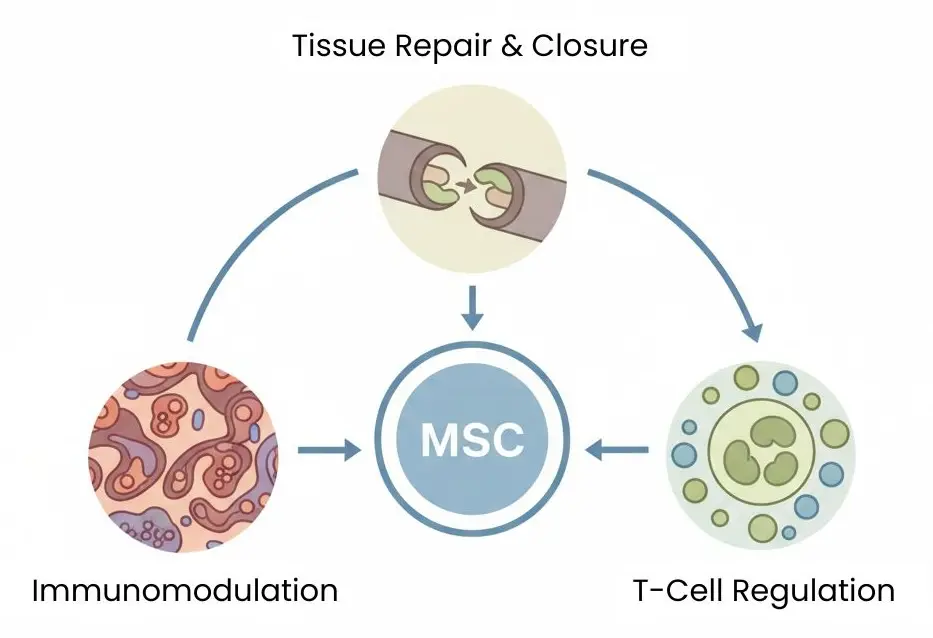
Mesenchymal stem cells — MSCs — are not anti-inflammatory drugs in the conventional sense. They do not block a single inflammatory protein the way a biologic does. Instead, they communicate with the immune system itself through a complex set of signalling molecules.
When MSCs are infused into a patient with Crohn’s disease, they migrate preferentially toward sites of active inflammation. Once there, they release cytokines (chemical messengers between immune cells) that shift the immune environment away from its attack state. Specifically, MSCs suppress the activity of T-cells and dendritic cells that drive inflammation in Crohn’s disease, while simultaneously promoting the expansion of regulatory T-cells, often called Tregs — a specialized population of immune cells whose function is essentially to instruct the rest of the immune system to stand down.
This bidirectional action — turning down the attack while turning up the brakes — is a meaningfully different mechanism from how biologics work. Biologics block a single downstream protein. MSCs interact with the upstream immune cells themselves. Whether this produces better long-term outcomes is still being studied, but the difference in approach is part of why MSCs remain biologically interesting to researchers working on autoimmune inflammatory conditions such as Crohn’s disease and rheumatoid arthritis, where similar immune dysregulation drives the disease.
Promoting Tissue Healing in Crohn’s Disease Fistulas
The second mechanism is most relevant to one of Crohn’s disease’s most difficult complications: the perianal fistula.
When MSCs are injected directly into a fistula tract, they release growth factors and signalling proteins that promote local tissue repair. They appear to encourage the migration of healthy cells into the damaged area, suppress the local inflammatory environment that has prevented the tract from closing, and support the formation of new small blood vessels (angiogenesis) that bring nutrients to the healing tissue. The result, in patients who respond, can be closure of fistula tracts that have remained open despite years of conventional management.
This is the mechanism that led to the development and eventual European regulatory approval of darvadstrocel (also known as Cx601 or Alofisel) — an allogeneic adipose-derived MSC therapy specifically for complex perianal fistulas in Crohn’s disease. It remains one of the few conditions where stem cell therapy has reached formal regulatory approval for a specific indication, which is important context for anyone evaluating the evidence base.
The Three Mechanisms of MSC Action in Crohn’s Disease
Pulling these threads together, MSCs appear to act on Crohn’s disease through three overlapping mechanisms.
The first is immune modulation — restoring balance to the immune system rather than suppressing it broadly. The second is local tissue repair — supporting the closure of fistulas and the healing of damaged bowel mucosa. The third is anti-fibrotic action — releasing signals that may slow the formation of the scar tissue responsible for stricture development.
None of these mechanisms is fast. MSCs do not work like a steroid that takes effect in days. The biological processes they set in motion take weeks to months to produce visible change. This is genuinely important to understand before considering treatment, because expecting rapid relief sets patients up for early disappointment.
Clinical Trial Evidence for Crohn’s Disease Stem Cell Therapy
The ADMIRE-CD Trial: MSCs for Perianal Crohn’s Disease Fistulas
The strongest body of evidence for stem cell therapy in Crohn’s disease comes from the ADMIRE-CD trial, published by Panés and colleagues in The Lancet in 2016. This was a Phase 3, randomized, double-blind, placebo-controlled study — the most rigorous trial design in clinical research — that enrolled 212 patients with complex perianal fistulas that had failed conventional treatment including at least one biologic.
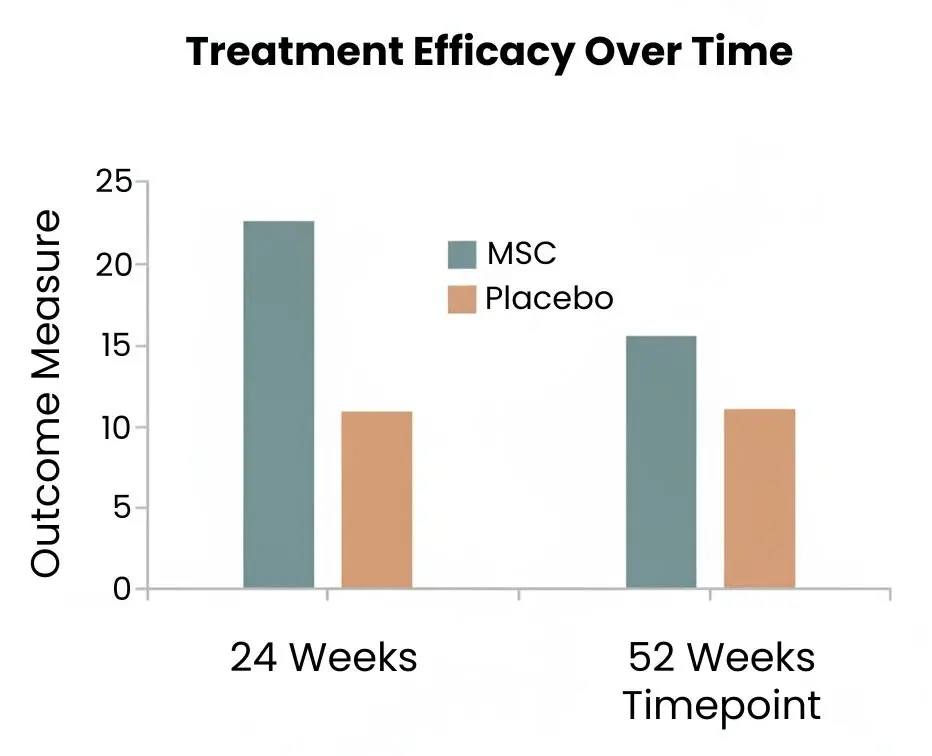
Patients received a single local injection of either darvadstrocel (an allogeneic adipose-derived MSC product) or placebo, delivered directly into the fistula tracts. At week 24, 50 percent of patients in the MSC group achieved combined remission — defined as closure of all treated external openings combined with absence of collections greater than 2 cm on MRI — compared with 34 percent in the placebo group. The difference was statistically significant.
A longer-term follow-up of the same trial, published by Panés and colleagues in Gastroenterology in 2018, examined outcomes at 52 weeks. Combined remission at one year was 56.3 percent in the MSC group versus 38.6 percent in placebo, with the difference remaining statistically significant. The safety profile was favourable, with the most common adverse events being mild proctalgia (pain at the procedure site) that resolved without intervention.
These results were robust enough that the European Medicines Agency approved darvadstrocel in 2018 for the treatment of complex perianal fistulas in adults with non-active or mildly active luminal Crohn’s disease. This approval is significant because it represents one of the few instances in which stem cell therapy has met the regulatory standard of evidence required for formal market authorization. For patients evaluating the credibility of MSC therapy for Crohn’s disease, this is the strongest data point in the field.
Trials of Intravenous MSCs for Luminal Crohn’s Disease
The evidence base for intravenous MSC therapy in luminal Crohn’s disease — meaning the inflammation in the bowel itself, rather than perianal fistulas — is younger and the trials have been smaller. But several published studies are worth knowing about.
A Phase 2 study by Forbes and colleagues, published in Clinical Gastroenterology and Hepatology in 2014, examined intravenous infusion of allogeneic bone marrow-derived MSCs in 15 patients with luminal Crohn’s disease who had failed conventional therapy including biologics. After four weekly infusions, 12 of 15 patients showed a clinical response defined as a reduction in Crohn’s Disease Activity Index (CDAI, the standard clinical measure) of 100 points or more. Three of the 15 achieved clinical remission. The treatment was well tolerated, with no serious adverse events related to the cells.
A study by Dhere and colleagues published in Alimentary Pharmacology and Therapeutics in 2016 examined autologous bone marrow MSCs in a small cohort and reported clinical improvement in a proportion of patients alongside reductions in endoscopic disease activity. Smaller case series and Phase 1/2 trials have produced broadly consistent findings: clinical improvement in roughly 40 to 60 percent of biologic-refractory patients, with safety profiles that have not raised significant concerns.
What the data does not yet show is a Phase 3 randomized controlled trial for intravenous MSCs in luminal Crohn’s disease at the scale of ADMIRE-CD. This is a real and significant gap. The evidence for intravenous MSC therapy in luminal Crohn’s disease is promising but does not yet meet the standard that the perianal fistula evidence has reached. Patients deserve to know this distinction.
Allogeneic Umbilical Cord MSCs vs Autologous Cells for Crohn’s Disease
Why Cell Source Matters in Crohn’s Disease Treatment
Stem cell therapy can be structured in two fundamentally different ways: using cells taken from the patient’s own body (autologous) or using cells from a healthy donor (allogeneic).
In Japan, the regulatory framework primarily permits autologous treatment for most conditions, including inflammatory and autoimmune diseases. The advantage of autologous cells is the absence of immune rejection risk — the cells are genetically the patient’s own. The disadvantages, particularly in a chronic autoimmune condition like Crohn’s disease, are several. The harvesting procedure (typically bone marrow aspiration or liposuction) is invasive and produces its own recovery requirements. The cells must be expanded in a laboratory over several weeks before they can be administered. And critically, the cells of a 45-year-old with 15 years of Crohn’s disease — repeated medication exposure, episodes of malnutrition, and a chronically dysregulated immune environment — are not biologically equivalent to cells from a healthy young donor.
Multiple laboratory studies have shown that MSCs harvested from patients with chronic autoimmune conditions have reduced proliferative capacity and diminished immunomodulatory function compared to cells from healthy donors. This is not a minor technical detail in the context of Crohn’s disease — the immunomodulatory capacity of the cells is precisely the property that is supposed to be doing the therapeutic work.
The Allogeneic Approach Used in Malaysia for Crohn’s Disease
The Crohn’s disease stem cell therapy we offer in Malaysia uses allogeneic umbilical cord-derived MSCs — cells sourced from ethically donated umbilical cord tissue (specifically the Wharton’s jelly layer) collected at the time of healthy term deliveries, with full donor consent. These cells are biologically young, characterized by particularly potent immunomodulatory capacity, and produced in standardized, quality-controlled batches that allow cell viability and potency to be verified before each treatment.
Importantly, umbilical cord MSCs express low levels of the surface markers that ordinarily trigger immune rejection. Across the body of allogeneic MSC clinical trials — including the ADMIRE-CD trial for Crohn’s perianal fistulas, which used allogeneic adipose-derived cells — immune rejection has not emerged as a clinically significant problem. The cells are immunologically tolerated even when given to genetically unrelated patients.
For a Crohn’s disease patient whose own immune system has been chronically dysregulated for years, receiving cells from a healthy young donor avoids the question of whether the patient’s own cells have been compromised by the disease environment. This is the same reasoning that informs our approach to other chronic inflammatory conditions, where cell potency and consistency directly affect what is biologically possible at the target tissue.
Who Is — and Is Not — a Good Candidate for Crohn’s Disease Stem Cell Therapy
Crohn’s Disease Patients Who Tend to Benefit From MSC Therapy
Based on the published trial data and our clinical experience over seven years, certain patient profiles tend to respond more clearly than others.
Patients with complex perianal fistulas — particularly those that have failed surgical and biologic management — represent the strongest evidence-based candidacy, supported by the ADMIRE-CD Phase 3 data. For these patients, local MSC injection has demonstrated meaningful improvement over placebo in a properly controlled trial.
Patients with luminal Crohn’s disease who have failed at least one biologic and have active inflammation but not yet severe structural damage may also be appropriate candidates, with the understanding that the evidence base here is smaller and the expected response rate is in the range of 40 to 60 percent rather than a guarantee. The realistic goal is reduction in disease activity and a possible reduction in the frequency or severity of flares — not elimination of the disease.
Patients should be on optimized current therapy and stable enough to travel. They should have realistic expectations: stem cell therapy is intended to complement, not replace, ongoing gastroenterological care. And they should be willing to wait — the biological response typically takes 8 to 16 weeks to become apparent.
When Crohn’s Disease Stem Cell Therapy Is Not Recommended
Stem cell therapy is not appropriate for patients in acute severe Crohn’s disease flares requiring hospitalization, intravenous steroids, or urgent surgical consideration. The immediate priority in these situations is stabilization, not regenerative therapy.
Patients with active intra-abdominal abscess, active systemic infection, or untreated severe stricture causing obstruction require those problems to be addressed first. MSC therapy will not drain an abscess or open a fibrotic stricture — these are mechanical problems that need mechanical solutions.
Patients with active cancer or a recent history of malignancy require specialist evaluation before any stem cell therapy is considered. Pregnant or breastfeeding women are excluded from the treatment.
We are also direct with patients whose disease is currently well controlled on existing medication with acceptable side effects. The expected additional benefit from MSC therapy in this group may not justify the cost and travel involved. If this is our assessment after reviewing a patient’s case, we will say so clearly during the initial consultation.
Finally, patients seeking a guaranteed cure should understand that this is not what the current data supports — and we will not frame the treatment in those terms regardless of how it might be requested.
Recovery and Follow-Up After Crohn’s Disease Stem Cell Treatment
Recovery from MSC therapy is meaningfully different from recovery from bowel surgery. Most patients are comfortable travelling home within two to three days of the procedure. Return to ordinary daily activity is generally possible within a week.
Existing Crohn’s disease medications are continued without interruption. This point is important enough to state clearly: stem cell therapy is intended to work alongside conventional treatment, not as a replacement for it. Any adjustments to biologics, immunomodulators, or other medications must remain the responsibility of the patient’s treating gastroenterologist, not made unilaterally before or after a stem cell infusion.
Follow-up is structured at three months, six months, and twelve months post-treatment. We ask patients to track and report changes in bowel symptoms, energy levels, appetite, and inflammatory markers measured by their local physician. For perianal fistula patients, MRI follow-up at six months is recommended to objectively assess any anatomical change.
Improvement, when it occurs, typically begins to emerge between 8 and 16 weeks after treatment. Patients who have noticed no change at six months have generally not gone on to show changes at one year — an honest piece of information that helps patients plan their next steps if the treatment has not produced the response they hoped for.
A Patient’s Experience with Crohn’s Disease Stem Cell Therapy
A Crohn’s Disease Patient After Multiple Biologic Failures
A woman in her late forties had been managing Crohn’s disease for sixteen years. She had been through azathioprine, methotrexate, infliximab, adalimumab, and most recently vedolizumab. The first three had each worked for two to three years before either losing effect or producing side effects that became difficult to live with alongside her work as a teacher. Vedolizumab had reduced her flare frequency but had not brought her into clinical remission. Her CRP remained elevated, her calprotectin levels were stubbornly high, and a recent colonoscopy had shown active inflammation in the terminal ileum and ascending colon.
Her gastroenterologist had begun discussing whether surgery on the most affected segment was becoming appropriate. She was reluctant — she had watched a sibling with Crohn’s disease go through repeated bowel resections over fifteen years and end up with significant short-bowel symptoms — and asked her doctor whether anything else was available.
She came to our clinic in early 2025 after several weeks of researching the published evidence. Before accepting her, we reviewed her records carefully. Her clinical picture met the criteria where we believe MSC therapy can reasonably be offered: documented biologic failure, active inflammation rather than pure structural damage, no active abscess or stricture requiring urgent attention, and an understanding that this was a complement to her ongoing care rather than a replacement.
How the Six Months After Treatment Unfolded
She received intravenous allogeneic umbilical cord-derived MSC therapy over a single visit. The infusion itself was uneventful. She experienced a low-grade fever for about 36 hours afterward and described feeling generally tired for several days, which is in line with what we tell patients to expect.
The first eight weeks brought no noticeable change — a period she described as discouraging, though she had been prepared for it. Around week ten, she noticed that her usual urgency in the mornings had become less consistent. By the third month, she reported that her bowel frequency had dropped from six to seven times daily to three to four, and that her energy in the afternoons had improved noticeably. At six months, her CRP had dropped by approximately 60 percent from its pre-treatment level, and her gastroenterologist reported that her calprotectin had also declined substantially. She remained on vedolizumab — her gastroenterologist elected not to change her medication regimen until the twelve-month assessment.
She did not enter remission. She still has Crohn’s disease, and the question of long-term durability remains open. But she described the experience as “the first time in years that things have moved in a direction other than worse.” Surgery has, for now, been deferred.
This is an anonymized account based on actual clinical experience. Individual results vary, and this experience does not represent what every patient will experience.
Honest Risks and Limitations of Crohn’s Disease Stem Cell Therapy
Known Side Effects in Crohn’s Disease Stem Cell Trials
The safety profile of allogeneic MSC therapy in Crohn’s disease has been favourable across published trials, including the Phase 3 ADMIRE-CD study. This is not a dismissal of risk — it is an accurate description of what the accumulated data shows.
The most commonly reported effects following intravenous infusion are mild fever within 24 to 48 hours, transient fatigue, and occasional headache, all of which typically resolve without specific intervention. For local injection of MSCs into perianal fistulas, the most common reported event is mild procedural site pain that resolves within days. In ADMIRE-CD, no serious adverse events were attributed to the cells themselves across 212 patients.
Several theoretical risks warrant mention. Because MSCs modulate immune activity, there is a theoretical interaction concern in a patient simultaneously receiving immunosuppressive medication. For this reason, we do not ask patients to discontinue their existing Crohn’s disease treatment before MSC therapy. The decision about whether and when to adjust biologics or immunomodulators must remain with the treating gastroenterologist. Long-term safety data beyond two to three years remains limited in the field generally, and this is an honest limitation that we disclose to every patient.
What Stem Cell Therapy Cannot Do for Crohn’s Disease
It is essential to set realistic expectations.
Stem cell therapy cannot reverse fibrotic stricturing disease. A bowel segment in which repeated inflammation has produced a fibrotic, scarred narrowing will not be reopened by MSCs. If you have a clinically significant stricture causing obstructive symptoms, surgical or endoscopic management is the appropriate intervention.
Stem cell therapy cannot drain an active abscess, close a deep penetrating fistula that has reached an organ, or substitute for surgical management of severe disease. The treatment is not a substitute for the conventional care pathway — it is an adjunct intended to address the immune dysregulation that conventional drugs may not fully control.
Not every patient responds. Based on the published evidence base, approximately 50 percent of biologic-refractory perianal fistula patients achieve combined remission with MSC therapy in controlled trials — a meaningful improvement over placebo but not a guaranteed result. For luminal Crohn’s disease, the responder proportion in smaller trials has been in the 40 to 60 percent range. This means a significant minority — at least 30 to 50 percent of patients — do not achieve clinically meaningful benefit. We cannot predict with certainty in advance who will fall into which group, and we believe patients deserve this number before making any decision.
Stem cell therapy is not a cure for Crohn’s disease. The underlying genetic and environmental factors that drive immune dysregulation remain. The realistic framing is this: it is an attempt to modulate active inflammation, support tissue healing where possible, and potentially extend the duration during which the disease remains controlled — alongside, not instead of, the conventional care that has been working for you.
FAQ About Crohn’s Disease Stem Cell Therapy
Biologics block a specific inflammatory protein — TNF-alpha, IL-12/23, or an integrin involved in immune cell trafficking — from the outside. MSCs, in contrast, interact with the immune cells themselves, releasing signals that shift T-cell and dendritic cell behaviour while promoting regulatory T-cells. The mechanism is upstream and broader. Whether this produces better long-term outcomes is still being studied, but the mechanistic difference is part of why some patients who have failed multiple biologics still respond to MSC therapy.
No. We do not ask patients to discontinue their existing Crohn’s disease medication before MSC therapy, and we strongly advise against doing so without direct supervision from your treating gastroenterologist. The treatment is designed to work alongside conventional care, not as a replacement.
The biological processes set in motion by MSCs take time. Most patients who respond begin noticing changes between weeks 8 and 16 after treatment. Patients who have noticed nothing by six months have generally not gone on to show changes at one year. Expecting rapid relief within the first month is likely to produce frustration and may lead to an inaccurate early conclusion.
This is an open question in the field. The ADMIRE-CD trial used a single local injection for perianal fistulas and demonstrated benefit out to 52 weeks. For luminal disease, some protocols have used multiple infusions; others single infusions. The optimal frequency and whether re-treatment is beneficial after a period of time has not been definitively established. We discuss this with each patient based on their individual situation.
In Malaysia and most other jurisdictions, allogeneic MSC therapy for Crohn’s disease outside of the EU-approved darvadstrocel indication is not covered by standard health insurance. Patients pay out of pocket. We are transparent about pricing during the consultation and do not include pricing in marketing materials because the appropriate treatment plan — and therefore the cost — depends on the individual case.
If You Are Weighing Whether This Is a Reasonable Next Step
Crohn’s disease has a way of shrinking the world over time — the meals you avoid, the trips you decline, the long discussions with doctors about which medication to try next. If you have reached a point where the conventional pathway is no longer providing the relief you need but you are not ready for surgery, you may be wondering whether stem cell therapy is a credible option for your specific case.
We offer free online consultations to look at exactly this question. Bring your recent labs, your imaging or endoscopy reports, and your treatment history. We will give you an honest answer — including telling you if we think this treatment is unlikely to help your particular situation. You are not committing to anything by reaching out other than the conversation itself.
References
- Panés J, García-Olmo D, Van Assche G, et al. Expanded allogeneic adipose-derived mesenchymal stem cells (Cx601) for complex perianal fistulas in Crohn’s disease: a phase 3 randomised, double-blind controlled trial. Lancet. 2016;388(10051):1281–1290. https://doi.org/10.1016/S0140-6736(16)31203-X
- Panés J, García-Olmo D, Van Assche G, et al. Long-term efficacy and safety of stem cell therapy (Cx601) for complex perianal fistulas in patients with Crohn’s disease. Gastroenterology. 2018;154(5):1334–1342.e4. https://doi.org/10.1053/j.gastro.2017.12.020
- Forbes GM, Sturm MJ, Leong RW, et al. A phase 2 study of allogeneic mesenchymal stromal cells for luminal Crohn’s disease refractory to biologic therapy. Clin Gastroenterol Hepatol. 2014;12(1):64–71. https://doi.org/10.1016/j.cgh.2013.06.021
- Molendijk I, Bonsing BA, Roelofs H, et al. Allogeneic bone marrow-derived mesenchymal stromal cells promote healing of refractory perianal fistulas in patients with Crohn’s disease. Gastroenterology. 2015;149(4):918–927.e6. https://doi.org/10.1053/j.gastro.2015.06.014
- Dhere T, Copland I, Garcia M, et al. The safety of autologous and metabolically fit bone marrow mesenchymal stromal cells in medically refractory Crohn’s disease — a phase 1 trial with three doses. Aliment Pharmacol Ther. 2016;44(5):471–481. https://doi.org/10.1111/apt.13717
- Ng SC, Shi HY, Hamidi N, et al. Worldwide incidence and prevalence of inflammatory bowel disease in the 21st century: a systematic review of population-based studies. Lancet. 2017;390(10114):2769–2778. https://doi.org/10.1016/S0140-6736(17)32448-0
- Ben-Horin S, Kopylov U, Chowers Y. Optimizing anti-TNF treatments in inflammatory bowel disease. Autoimmun Rev. 2014;13(1):24–30. https://doi.org/10.1016/j.autrev.2013.06.002
- Le Blanc K, Mougiakakos D. Multipotent mesenchymal stromal cells and the innate immune system. Nat Rev Immunol. 2012;12(5):383–396. https://doi.org/10.1038/nri3209