Rheumatoid Arthritis Stem Cell Therapy | Managing Inflammation Without Escalating Drugs

The morning stiffness that makes your fingers feel like they belong to someone else. Unscrewing a toothpaste cap. Buttoning a shirt. Gripping a coffee mug. Most people do these things without thinking. For the estimated 18 million people worldwide living with rheumatoid arthritis, each of these small acts is a daily reminder that something inside the body has turned against itself.
Rheumatoid arthritis is not simple wear-and-tear on the joints. It is an autoimmune condition — meaning the immune system, which is meant to protect you from infection, mistakenly attacks the lining of your own joints. Over years, this persistent assault breaks down cartilage, erodes bone, and causes the kind of damage that cannot be reversed.
Many people manage well on medication, especially when treatment begins early. But for a significant proportion of patients — roughly 30 to 40 percent — the drugs stop working as well as they once did, or produce side effects that accumulate over time and affect daily life. For these patients, the standard answer from the medical system is to add more drugs, switch to stronger biologics, or consider joint surgery.
This article explores a different question: could stem cell therapy offer a way to calm the immune system’s attack on the joints — without simply adding another layer of medication?
We will not tell you this is a cure. What the clinical data shows is more nuanced than that — and we think more useful. Over seven years, our clinic in Malaysia has worked with more than 200 patients using allogeneic umbilical cord-derived mesenchymal stem cells (MSCs) — a type of stem cell drawn from healthy donor cord tissue, not from the patient’s own body. This article shares what the peer-reviewed research says, what we have observed in practice, and where the honest limits of this approach lie.
Table of Contents
- Why Rheumatoid Arthritis Is So Difficult to Stop
- The Ceiling of Conventional Drug Therapy for Rheumatoid Arthritis
- What Stem Cell Therapy Does in Rheumatoid Arthritis
- What the Clinical Data Shows for Rheumatoid Arthritis Stem Cell Treatment
- Who Is — and Is Not — a Good Candidate for Rheumatoid Arthritis Stem Cell Therapy
- One Patient's Experience With Rheumatoid Arthritis Stem Cell Treatment
- The Treatment Journey: How Rheumatoid Arthritis Stem Cell Therapy Works in Malaysia
- Honest Risks and Limitations of Rheumatoid Arthritis Stem Cell Therapy
- FAQ About Rheumatoid Arthritis Stem Cell Treatment
- References
Why Rheumatoid Arthritis Is So Difficult to Stop
How the Immune System Misfires in Rheumatoid Arthritis — and Why It Keeps Going
To understand why rheumatoid arthritis is so hard to control, it helps to understand what is happening inside the joint at a biological level.
The joint lining — called the synovium — is normally a thin, smooth membrane that produces fluid to keep the joint moving freely. In rheumatoid arthritis, the immune system identifies proteins within this membrane as a threat, even though they are not. Immune cells flood into the synovium and begin releasing inflammatory signals — proteins called cytokines (chemical messengers such as TNF-alpha, interleukin-6, and interleukin-1 that instruct the body to produce and sustain inflammation).
This creates a self-reinforcing loop. Inflammation triggers more immune cell activity, which produces more inflammatory signals, which summons more immune cells. Unlike a normal immune response — which resolves once the genuine threat is gone — this loop in rheumatoid arthritis has no natural off-switch. The synovium thickens, becomes hot and swollen, and begins to invade the surrounding cartilage and bone.
What makes this particularly difficult to treat is that the underlying mechanism — the immune system’s false identification of self-tissue as a target — is not corrected by stopping the symptoms. Treating the inflammation is not the same as treating the cause.
How Joint Damage in Rheumatoid Arthritis Compounds Over Time
The joint damage in rheumatoid arthritis is cumulative and largely irreversible.
The thickened, inflamed synovium produces enzymes — proteins that break down tissue — which directly erode cartilage, the smooth shock-absorbing surface that allows bones to glide past one another. Once cartilage is lost, the underlying bone becomes exposed. In severe or long-standing rheumatoid arthritis, the bones themselves begin to erode and deform.
This explains why consistent disease control matters so much in early RA. Every period of uncontrolled inflammation leaves a small amount of permanent structural damage. Over years and decades, these periods accumulate — which is why many patients who have had rheumatoid arthritis for twenty years carry significantly more joint damage than those diagnosed ten years ago, even when both have received treatment throughout.
The central challenge is that current approved medications work by suppressing the immune response — but they do not correct the underlying tendency of the immune system to keep attacking the joint in the first place.
The Ceiling of Conventional Drug Therapy for Rheumatoid Arthritis
When DMARDs and Biologics for Rheumatoid Arthritis Lose Their Effectiveness
The current standard of care for rheumatoid arthritis follows a stepwise approach.
The first step is typically a disease-modifying antirheumatic drug (DMARD) — most commonly methotrexate, a medication that dampens the immune response broadly. For many patients, this achieves good disease control with manageable side effects, and some patients remain well-controlled on methotrexate for years.
When methotrexate alone is insufficient, biologic agents are added. Biologics are targeted therapies — engineered proteins that block specific inflammatory signals, such as TNF-alpha or interleukin-6 — and they have been transformative for many RA patients with moderate-to-severe disease.
The problem is durability. Studies consistently suggest that roughly 30 percent of patients do not meaningfully respond to their first biologic agent. Among those who do respond initially, up to 40 percent experience what is termed secondary failure — the drug gradually loses its effectiveness, often because the body produces antibodies that neutralise it.
When the first biologic fails, clinical response rates to the second are lower. When the second fails, response to the third is lower still. For patients on their third or fourth biologic agent, clinical response rates in published trials can fall below 20 percent. At that point, many rheumatologists discuss switching to a JAK inhibitor — a newer class of oral drug — or begin conversations about joint surgery for the most damaged areas.
The Side Effect Burden of Rheumatoid Arthritis Medications That Grows Over Time
Each additional medication brings its own risk profile — and these risks do not disappear; they accumulate.
Methotrexate requires regular liver function monitoring even at low doses, as it can cause liver inflammation over time. Some patients experience nausea, mouth sores, and fatigue severe enough to affect daily functioning, even at doses well within the therapeutic range.
Biologic drugs that suppress TNF-alpha reduce the body’s capacity to fight infection. Serious infections — including reactivation of latent tuberculosis — are a documented risk with long-term biologic use, requiring screening and monitoring at regular intervals. JAK inhibitors, the newest class of RA medication, carry additional concerns about blood clot risk and cardiovascular events that are currently under active regulatory review.
For many long-term rheumatoid arthritis patients, this creates a difficult ongoing calculation: the drugs that control the disease also, over time, gradually increase vulnerability to other health problems. The question — “is there a way to manage the inflammation without simply escalating the immunosuppression?” — is one we hear from almost every patient who reaches our clinic.
What Stem Cell Therapy Does in Rheumatoid Arthritis
Resetting the Immune Response in Rheumatoid Arthritis From the Root
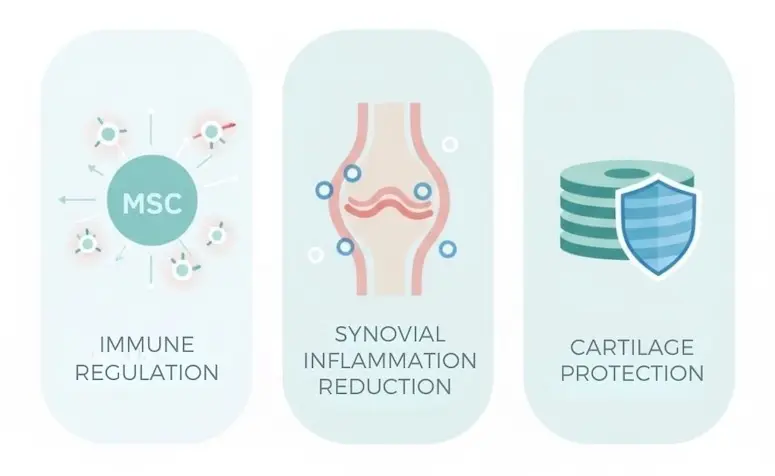
The most important distinction between mesenchymal stem cells (MSCs) and conventional rheumatoid arthritis medications is mechanistic: drugs block specific inflammatory proteins. MSCs interact with the immune cells themselves.
MSCs are stromal cells — a type of cell found naturally in bone marrow, fat tissue, and umbilical cord tissue — with a well-documented role in regulating inflammation. When infused into a patient with rheumatoid arthritis, MSCs migrate toward sites of active inflammation and begin releasing signalling molecules that shift the immune system away from its attack state.
Specifically, MSCs suppress the activity of T-cells and B-cells — the immune cells primarily responsible for the inflammatory assault on the joint lining. They also stimulate the growth of regulatory T-cells, often abbreviated as Tregs — a specialised immune cell population whose function is essentially to tell the rest of the immune system to stand down. This bidirectional effect — suppressing the attack cells while amplifying the restraining cells — represents a fundamentally different approach from biologics, which block a single downstream protein without addressing the upstream immune cells producing it.
Reducing Synovial Inflammation in Rheumatoid Arthritis
MSCs also exert direct anti-inflammatory effects within the joint environment itself.
They secrete molecules that suppress the local production of TNF-alpha, interleukin-6, and interleukin-1 — the same inflammatory proteins that biologic drugs target — but from within the inflamed tissue rather than from the systemic circulation. MSCs also reduce the activity of inflammatory macrophages (another immune cell type that contributes directly to joint destruction in rheumatoid arthritis) while promoting a tissue-repair-oriented macrophage state instead.
The combined result is a reduction in the overall inflammatory tone of the synovium — the joint lining — which can translate clinically to less swelling, less morning stiffness, and potentially slower progression of structural joint damage.
Similar immunomodulatory mechanisms are active in other autoimmune inflammatory conditions. Patients with ankylosing spondylitis — another HLA-associated inflammatory arthritis driven by immune dysregulation — show comparable patterns of MSC response, which has given us additional insight into the biological profiles most likely to benefit.
Protecting Cartilage and Bone in Rheumatoid Arthritis
The third mechanism is protective rather than immunological in nature.
MSCs secrete growth factors — proteins that support the survival and repair of neighbouring cells — into the joint environment. In a rheumatoid arthritis patient, these growth factors may help sustain the remaining cartilage cells (chondrocytes) and slow the enzymatic breakdown of cartilage tissue that occurs during active inflammatory episodes.
It is important to state clearly: MSCs do not regenerate cartilage that has already been destroyed. What they may do is protect what remains, and create a local environment where further cartilage breakdown proceeds more slowly. This is meaningfully different from structural repair — but for patients whose primary concern is preventing further deterioration, it represents a clinically relevant goal in its own right.
What the Clinical Data Shows for Rheumatoid Arthritis Stem Cell Treatment
Key Trial Results From Peer-Reviewed Research on Rheumatoid Arthritis
The clinical evidence for MSC therapy in rheumatoid arthritis is growing, but it is important to be honest about where it currently stands. There are no large Phase III randomised controlled trials yet. What exists is a body of Phase I/II data that is encouraging, reproducible, and peer-reviewed — and which we will summarise accurately.
The most significant published clinical trial to date is the Cx611 study, conducted by Álvaro-Gracia and colleagues and published in the Annals of the Rheumatic Diseases in 2017. This was a Phase Ib/IIa trial involving 48 patients with active, refractory rheumatoid arthritis — meaning patients who had already failed at least two biologic agents. The patients received intravenous infusions of expanded allogeneic adipose-derived (fat tissue-derived) MSCs at varying dose levels.
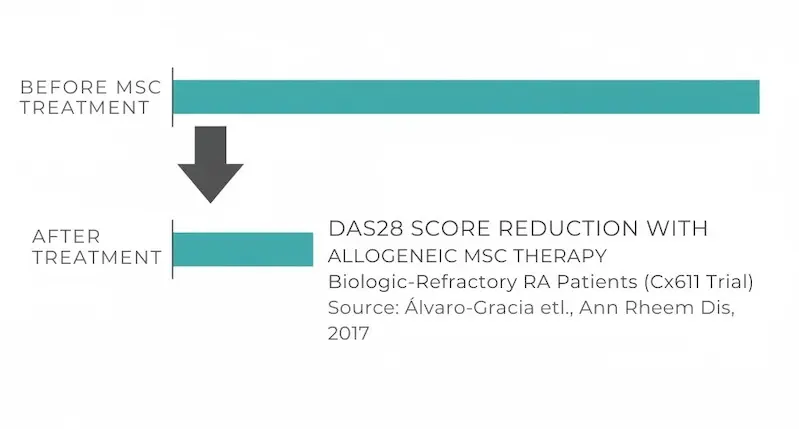
The results showed the treatment was safe: no serious adverse events were attributed to the stem cell infusions across any dose group. Disease activity scores — measured by the DAS28 index, the standard clinical measure of rheumatoid arthritis severity (a composite score incorporating joint counts, inflammatory markers, and patient-reported disease assessment) — showed significant improvement in the higher-dose groups at the 12-week mark. Approximately 35 percent of participants met the threshold for a clinically meaningful response — a notable finding given that this group had exhausted multiple prior lines of therapy.
An earlier study by Liang and colleagues, published in Clinical Rheumatology in 2012, reported outcomes in a small cohort of refractory rheumatoid arthritis patients receiving allogeneic bone marrow-derived MSC infusions. All four patients in the study showed improvements in DAS28 scores alongside reductions in two standard blood markers of systemic inflammation — erythrocyte sedimentation rate (ESR) and C-reactive protein (CRP) — without significant adverse effects observed.
What the Numbers Mean in Real Terms for Rheumatoid Arthritis Patients
A DAS28 score above 5.1 indicates high disease activity — significant swelling, pain, and systemic inflammation. A score below 3.2 indicates low disease activity. A score below 2.6 meets the clinical threshold for remission.
In the Cx611 trial, patients entering with scores in the high-disease-activity range showed reductions that moved a meaningful proportion of them — around one in three — into the moderate or low disease activity range by week 12. This does not mean pain disappeared, or that medication was eliminated. What it means is that for approximately one in three patients who had failed all prior therapies, a measurable and clinically significant reduction in disease activity was documented.
It is also worth naming what the data does not yet show. There are currently no large-scale, long-term randomised controlled trials demonstrating that MSC therapy maintains these effects at the two-year or three-year mark. The durability of response is an open and actively researched question. We believe patients deserve to know this before making any decision.
Who Is — and Is Not — a Good Candidate for Rheumatoid Arthritis Stem Cell Therapy
Profiles That Tend to Respond Well to Stem Cell Therapy for Rheumatoid Arthritis
Not every rheumatoid arthritis patient is an appropriate candidate for MSC therapy, and we assess this carefully before accepting a patient for treatment.
Those who tend to benefit most share several characteristics. They have a confirmed rheumatoid arthritis diagnosis and have tried at least one conventional DMARD (typically methotrexate). They have active disease — measured by elevated CRP or ESR, or by DAS28 scores in the moderate-to-high range — that is not fully controlled by their current medication. They are either experiencing side effects from their current treatment that affect quality of life, or have reached a point where additional drug escalation offers diminishing returns. Their joint damage is present but not yet at end stage: there is still meaningful cartilage to protect, and active inflammation — rather than pure structural collapse — is the primary problem.
Systemic lupus erythematosus (SLE) — another autoimmune condition involving immune dysregulation at the cellular level — has shown similar patterns of MSC responsiveness, which has helped us refine our understanding of which patient profiles are most likely to benefit across autoimmune diagnoses.
Cases Where Stem Cell Therapy May Not Be the Right Fit for Rheumatoid Arthritis
There are patient profiles where we advise against this treatment — or where we are transparent that the likelihood of benefit is low.
Patients with end-stage joint damage, where cartilage has been almost entirely destroyed and bone is grinding against bone, are unlikely to experience meaningful benefit from stem cell therapy. The dominant issue at that stage is structural, and the most appropriate intervention is likely joint replacement surgery.
Patients with an active severe infection should not receive MSC therapy: the immune-modulating effect of the cells could interfere with the body’s ability to clear the infection.
Patients whose rheumatoid arthritis is already well controlled on current medication with acceptable side effects may not have enough to gain from this treatment to justify the investment of time, travel, and cost.
And patients who are looking for a guarantee of remission or a complete cure should understand clearly that this is not what the current data supports — and that we do not offer framing that suggests otherwise.
One Patient’s Experience With Rheumatoid Arthritis Stem Cell Treatment
A Case of Refractory Rheumatoid Arthritis After Multiple Failed Biologics
A woman in her mid-fifties. Diagnosed with rheumatoid arthritis eleven years earlier. Over that time, she had tried methotrexate, two different biologic agents, and a JAK inhibitor — each of which had either stopped working within two to three years or produced side effects she found difficult to manage alongside a demanding working life. Her hands and wrists remained consistently swollen and warm. The fatigue she described as bone-deep had progressively limited the hours she could work each week.
She came to our clinic in Malaysia in early 2025 after her rheumatologist indicated that surgical review of her wrists was becoming a realistic next step. Before accepting her for treatment, we reviewed her inflammatory markers, imaging, and treatment history. She was a suitable candidate: active disease, documented biologic failure, and enough remaining joint architecture that reducing inflammation could still make a functional difference. We were direct with her before any infusion: we could not predict her individual response, and we would not suggest she modify her existing medication.
What Changed — and What Didn’t — After Treatment for Rheumatoid Arthritis
In the first six weeks following the MSC infusion, she noticed no meaningful change. By the third month, she reported that the morning stiffness — which had previously lasted three to four hours — had shortened to around forty minutes. Hand grip was noticeably stronger, and she was able to return to tasks she had gradually stopped attempting. At the six-month follow-up, her DAS28 score had moved from the high-disease-activity range to the moderate range. Her CRP had reduced by approximately 40 percent from its pre-treatment level. She continued her baseline DMARD at a dose her rheumatologist elected to maintain, pending the twelve-month assessment.
She described her experience as “not a dramatic transformation, but the first time in years that things seem to be moving in the right direction rather than the wrong one.” No medication was eliminated. No promise was made or implied. But for a patient who had reached the end of the conventional escalation pathway, a measurable shift in disease activity over six months represented a meaningful change in daily life.
※ This is an anonymised account shared with the patient’s consent. Individual outcomes vary. This experience does not represent what all patients will experience.
The Treatment Journey: How Rheumatoid Arthritis Stem Cell Therapy Works in Malaysia
The Five Steps From First Consultation to Follow-Up for Rheumatoid Arthritis Patients
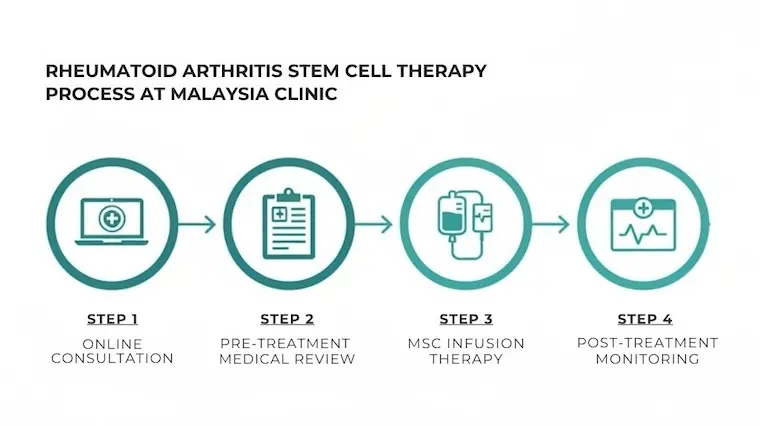
The process is structured to be as manageable as possible for patients travelling from outside Malaysia, most of whom remain in-country for one to two weeks.
Step one is an online consultation. We review your current rheumatoid arthritis diagnosis, treatment history, recent blood work, and any available imaging. This is where we assess suitability — and it is also where we will be direct if we do not think this treatment is appropriate for your situation. Step two is a pre-treatment medical review. If the initial consultation indicates suitability, we request recent laboratory results — including CRP, ESR, full blood count, and liver function tests — and ask your current rheumatologist to provide a summary of your disease status. We do not accept patients who arrive in Malaysia without this groundwork in place. Step three is the treatment itself. The MSC infusion is delivered intravenously — via a drip line, similar to a standard IV — over approximately one hour. Most rheumatoid arthritis patients at our clinic receive between one to three infusions as total, determined by the pre-treatment assessment of current disease activity and treatment history. The MSCs used are allogeneic — drawn from healthy donor umbilical cord tissue collected at the time of birth — rather than from the patient’s own body. Step four is immediate post-treatment monitoring. Most return to their accommodation the same day and are typically able to travel home within two to three days of the final infusion.
Why Malaysia Uses Allogeneic Umbilical Cord-Derived MSCs for Rheumatoid Arthritis
The choice of cell source is clinically significant, and it is worth explaining.
Umbilical cord tissue — specifically the Wharton’s jelly layer surrounding the cord — contains a high concentration of MSCs that are young, highly active, and characterised by a particularly potent immunomodulatory capacity. Because these cells come from newborn tissue collected at the time of a healthy delivery — with full donor consent — they have not been exposed to the decades of cumulative environmental stressors, immune challenges, and pharmaceutical exposures that affect cells harvested from an adult patient.
In Japan, stem cell therapies for autoimmune conditions commonly use autologous cells — meaning cells harvested from the patient’s own fat tissue or bone marrow. The advantage of autologous cells is the absence of any rejection concern. The disadvantage, particularly relevant for rheumatoid arthritis patients, is that in a person whose immune system is already chronically dysregulated, the harvested cells may themselves carry signs of that dysregulated environment. Allogeneic umbilical cord-derived MSCs sidestep this entirely: they bring a healthy, potent immunomodulatory signal from outside the patient’s existing inflammatory milieu.
Patients considering knee osteoarthritis treatment at our clinic receive MSCs from the same allogeneic cord-tissue source, for similar reasons related to cell potency and consistency.
Honest Risks and Limitations of Rheumatoid Arthritis Stem Cell Therapy
Known Adverse Effects and How They Are Managed in Rheumatoid Arthritis Patients
Transparency about risk is not optional — it is a core part of how we operate.
The most commonly reported effects following MSC infusion are mild and self-limiting. A low-grade fever in the 24 to 48 hours following the infusion is reported by approximately 15 to 20 percent of patients — thought to reflect the immune system’s recognition of and response to the donor cells, not an active infection. Fatigue and generalised muscle ache in the days following the infusion are also commonly reported. These effects typically resolve without medical intervention.
In published clinical trials involving MSC therapy, serious adverse events directly attributable to the cells themselves have been uncommon. The Cx611 trial — which included 48 patients over multiple dose levels — reported no serious treatment-related adverse events in any participant.
That said, several theoretical risks warrant mention. Because MSCs modulate immune activity, there is a theoretical interaction concern when a patient is simultaneously receiving immunosuppressive medications. For this reason, we do not ask rheumatoid arthritis patients to discontinue their existing treatment before or during MSC therapy — both because of the genuine clinical risk of doing so, and because decisions about medication adjustment must remain with the treating rheumatologist, not made unilaterally before or after a stem cell infusion.
What Stem Cell Therapy Cannot Do for Rheumatoid Arthritis
We want to be as clear about the limits as we are about the potential.
MSC therapy for rheumatoid arthritis is not a replacement for ongoing rheumatological care. Patients who receive this treatment will continue to need follow-up with their rheumatologist, monitoring of disease activity, and in most cases, some level of baseline medication. This is not a treatment that can or should be pursued in isolation from conventional medical management.
MSC therapy does not rebuild cartilage that has already been destroyed. If a joint has reached end-stage structural failure, infusing stem cells will not restore it. The appropriate framing for this treatment is disease modulation and protective support in the context of active, ongoing inflammation — not structural repair of established damage.
For patients whose disease is already well controlled on current medication with acceptable side effects, the expected additional benefit from MSC therapy may not justify the cost and travel involved. We will say this clearly in an initial consultation if it is our assessment.
Finally, not all patients respond. Based on available peer-reviewed data and our clinical experience over seven years, approximately 30 to 40 percent of patients with active, refractory rheumatoid arthritis may experience a clinically meaningful reduction in disease activity following MSC treatment. This means 60 to 70 percent may experience limited or no benefit. We cannot currently predict with certainty who will fall into which group — though the pre-treatment assessment provides meaningful information. Patients deserve to know this number before making any decision.
FAQ About Rheumatoid Arthritis Stem Cell Treatment
No. We ask all patients to continue their existing medications throughout the treatment process. Discontinuing immunosuppressive drugs without rheumatological supervision carries real and documented clinical risk in rheumatoid arthritis patients, and we do not recommend it under any circumstances. If disease activity improves following treatment, any consideration of medication reduction should be made collaboratively with the patient’s treating rheumatologist over subsequent follow-up appointments.
This varies by individual. Most patients with moderate-to-severe active disease receive between one and three infusions during their visit. The appropriate number is determined during the pre-treatment medical review, based on current disease activity scores, inflammatory marker levels, and prior treatment history.
The timeline varies. Some patients begin to notice changes — reduced morning stiffness, less joint swelling, slightly improved grip — within four to six weeks. Others do not observe meaningful changes until the three-month mark, which is consistent with the time needed for immunological shifts to translate into measurable clinical improvement. The three-month and six-month follow-up consultations are where we typically see the most informative outcome data.
No. Stem cell therapy for rheumatoid arthritis in Malaysia is not covered by health insurance and is a self-funded medical procedure. Specific costs depend on the number of infusions required and the individual pre-treatment assessment, and these are discussed transparently during the initial consultation. We do not publish specific figures in editorial content, as they are not uniform across patients.
Yes, in most cases. We are aware that both biologics and MSC therapy act on the immune system, and the timing of the MSC infusion relative to the biologic dosing schedule is managed carefully during the pre-treatment assessment. This is one of the reasons we require full treatment history before accepting a patient — and one of the reasons ongoing communication with the home rheumatologist is a non-negotiable part of the process.
If you have reached this point and are wondering whether this might be relevant to your situation, we understand the position you may be in.
Exhausting the conventional medication pathway while watching the disease continue — or managing side effects that have become harder to live with than the condition itself — is a genuinely difficult experience. We offer free online consultations for patients who want to discuss their specific case, and we will give you an honest answer about whether we think this treatment is appropriate for you. You do not need to have made any decision beforehand.
References
- Álvaro-Gracia JM, et al. “Intravenous administration of expanded allogeneic adipose-derived mesenchymal stem cells in refractory rheumatoid arthritis (Cx611): results of a multicentre, dose escalation, randomised, single-blind, placebo-controlled phase Ib/IIa clinical trial.” Annals of the Rheumatic Diseases. 2017;76(9):1612–1617. https://doi.org/10.1136/annrheumdis-2016-210498
- Liang J, et al. “Allogeneic mesenchymal stem cells transplantation in patients with refractory RA.” Clinical Rheumatology. 2012;31(1):157–161. https://doi.org/10.1007/s10067-011-1816-0
- Le Blanc K, Ringdén O. “Immunomodulation by mesenchymal stem cells and clinical experience.” Journal of Internal Medicine. 2007;262(5):509–525. https://doi.org/10.1111/j.1365-2796.2007.01844.x
- Smolen JS, et al. “Rheumatoid arthritis.” Nature Reviews Disease Primers. 2018;4:18001. https://doi.org/10.1038/nrdp.2018.1
- GBD 2019 Diseases and Injuries Collaborators. “Global burden of 369 diseases and injuries in 204 countries and territories, 1990–2019.” The Lancet. 2020;396(10258):1204–1222. https://doi.org/10.1016/S0140-6736(20)30925-9