

Hip Osteoarthritis Stem Cell Treatment | Can You Avoid a Replacement?

Putting on your socks has turned into a small daily strategy session. Getting out of a low car seat means bracing yourself first. There is a deep ache in the groin or the side of the hip that shows up when you walk too far, and lately it wakes you when you roll over in bed. If you have been told you have hip osteoarthritis, none of this will sound dramatic — and that is exactly the point. It is the slow, ordinary erosion of movement that wears people down.
You are far from alone. Drawing on the Global Burden of Disease Study 2021, researchers estimate that around 35.9 million people worldwide were living with hip osteoarthritis, and the number of cases is projected to rise by roughly 79 percent by 2050 as populations age. Most of these people will travel the same well-worn path: anti-inflammatory tablets, physiotherapy, perhaps an injection or two, and eventually a conversation about a hip replacement.
In recent years, stem cell treatment for hip osteoarthritis has become one of the most talked-about — and most over-promised — options in this space. Some clinics claim they can regrow your cartilage and let you skip surgery entirely. Some doctors dismiss the whole idea. We are going to take a more careful route: we will explain what the clinical data actually supports, describe how the treatment works in plain language, and be honest about where the evidence still has gaps.
We are a clinical team based in Malaysia with over seven years of experience and more than 200 patients treated using allogeneic (donor-derived) umbilical cord mesenchymal stem cells. We do not claim this is a cure for hip osteoarthritis, and we will tell you plainly what it can and cannot do.
Table of Contents
- Why Hip Osteoarthritis Quietly Gets Worse Instead of Better
- The Gap in Conventional Hip Osteoarthritis Treatment
- Comparing Stem Cell Sources for Hip Osteoarthritis: Autologous vs. Allogeneic Umbilical Cord
- How Stem Cells Act Inside an Arthritic Hip Joint
- What the Clinical Evidence Shows for Hip Osteoarthritis Stem Cell Treatment
- Which Hip Osteoarthritis Patients Are Realistic Candidates
- The Honest Risks and Limits of Hip Osteoarthritis Stem Cell Treatment
- FAQ About Hip Osteoarthritis Stem Cell Treatment
- Ready to Look at Your Own Hip Osteoarthritis Case?
- References
Why Hip Osteoarthritis Quietly Gets Worse Instead of Better
The Ball-and-Socket Joint Under Constant Load
The hip is a ball-and-socket joint: the rounded head of the thigh bone sits inside a cup in the pelvis, with both surfaces lined by smooth cartilage. That cartilage is the part that lets the joint glide silently while carrying most of your body weight with every step. Think of it as the lining of a well-oiled hinge — when it is intact, you never notice it working.
In hip osteoarthritis, this lining gradually wears thin. The problem is that cartilage has almost no blood supply of its own. Most tissues in your body repair themselves by flooding the damaged area with blood carrying oxygen, nutrients, and repair cells. Cartilage cannot do this. It relies on a small, slow-working population of cells, and once it wears past a certain point, it does not simply grow back. The hip is also a deep joint, buried under thick muscle, which is partly why hip osteoarthritis is often noticed later than the same wear pattern that affects the more accessible knee.
How Inflammation Turns Wear Into a Cycle
Hip osteoarthritis is not just innocent “wear and tear.” As cartilage breaks down, tiny fragments irritate the joint lining, which triggers inflammation. That inflammation releases enzymes that chew through even more cartilage, and the bone underneath responds by thickening and forming irregular spurs. The joint stiffens, the range of motion shrinks, and the simple act of rotating your leg to step into a bathtub becomes a calculated movement.
It becomes a self-feeding loop: damage causes inflammation, and inflammation causes more damage. Left to itself, the joint does not stabilise — it slowly declines. This is the reason rest, painkillers, and willpower alone cannot reverse the underlying problem.
The Gap in Conventional Hip Osteoarthritis Treatment
What Medication and Injections Can and Cannot Do for Hip Osteoarthritis
Standard care for hip osteoarthritis usually begins with painkillers such as paracetamol, then anti-inflammatory medication, and sometimes a corticosteroid injection into the joint. These approaches genuinely help — but only by turning down the volume on pain. None of them repairs cartilage or halts the disease.
There is also a practical wrinkle specific to the hip. Hyaluronic acid injections — a gel-like lubricant commonly offered for knee osteoarthritis — are not routinely used or even available for the hip in many countries, partly because the deep joint is harder to inject and the evidence is weaker there. Corticosteroid injections, meanwhile, tend to lose effectiveness with repeated use, and some research suggests that frequent steroid exposure may actually accelerate cartilage breakdown over time. For many hip osteoarthritis patients, the toolbox of conservative options is genuinely smaller than it is for the knee.
Why a Hip Replacement Is Effective but Not a Decision to Rush
At the far end of the ladder sits total hip replacement. It is, by most measures, one of the most successful operations in modern medicine — many people experience dramatic, lasting pain relief and a return to normal walking. We say this clearly because honesty cuts both ways: for advanced hip osteoarthritis, a replacement is often the right answer.
But it is still major surgery. It requires anaesthesia, weeks to months of rehabilitation, and carries real risks of infection, blood clots, dislocation, and implant loosening. Artificial joints also have a finite lifespan, often around 15 to 20 years, which means a younger patient may face a second, more complex revision operation later in life. For people who are past the point where painkillers help, but who are not yet ready for — or not yet suited to — a replacement, there is an uncomfortable gap. Stem cell treatment for hip osteoarthritis aims to occupy that gap: not to replace surgery, but to potentially delay it and improve daily life in the meantime.
Comparing Stem Cell Sources for Hip Osteoarthritis: Autologous vs. Allogeneic Umbilical Cord
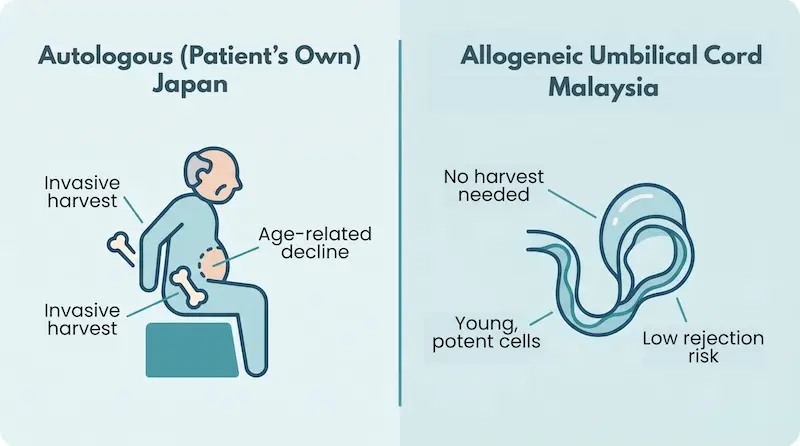
Autologous Stem Cells for Hip Osteoarthritis: Using Your Own Cells
In Japan and several other countries, most stem cell clinics use autologous mesenchymal stem cells (MSCs) — cells harvested from the patient’s own bone marrow or fat tissue. The clear advantage is that rejection is not a concern, because the cells are your own.
The drawbacks, however, matter a great deal for hip osteoarthritis specifically. The harvesting itself is invasive, involving bone marrow aspiration or liposuction. The cells must then be cultured in a laboratory over weeks. And here is the catch that is rarely advertised: stem cell quality declines with age, and hip osteoarthritis overwhelmingly affects older adults — exactly the group whose own cells are least vigorous. Studies have shown that MSCs from older donors have reduced ability to multiply and weaker anti-inflammatory power.
Allogeneic Umbilical Cord MSCs for Hip Osteoarthritis: The Approach We Use
We use allogeneic MSCs derived from donated umbilical cord tissue, specifically a part called Wharton’s jelly. These cells come from healthy, screened newborn donors and are among the youngest and most biologically active MSCs available.
This brings several practical advantages for a hip osteoarthritis patient. There is no invasive harvesting from your own body. The cells can be prepared in standardised, quality-checked doses, so their potency is known before treatment. And because umbilical cord MSCs are “quiet” to the immune system — they carry low levels of the surface markers that normally trigger rejection — adverse immune reactions are very rare. For an older patient whose own cells may already be compromised, starting with young donor cells is, biologically, a stronger position. We use this same allogeneic cord-tissue source for patients we treat for inflammatory joint conditions such as rheumatoid arthritis, for the same reasons of potency and consistency.
How Stem Cells Act Inside an Arthritic Hip Joint
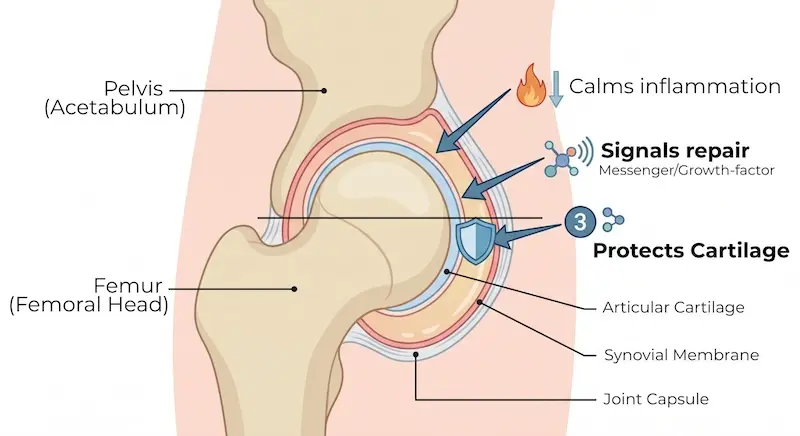
Calming the Inflammation Driving Hip Osteoarthritis Pain
Mesenchymal stem cells behave less like a repair kit and more like a mediator walking into a conflict. Inside an arthritic hip, they release signalling molecules called cytokines (think of these as chemical messages passed between cells) that calm the overactive immune response. Rather than just spraying water on the flames, they help turn down the fire alarm itself. In laboratory and clinical studies, MSCs have been shown to shift the joint’s immune cells from a destructive “attack” mode toward a “clean up and rebuild” mode.
Signalling for Cartilage Repair and Protecting What Remains
The second role is encouraging repair. MSCs secrete growth factors — chemical messengers that wake up the body’s own repair cells — and these signals nudge the remaining cartilage cells to start producing new cartilage material. Importantly, the stem cells mostly do not become new cartilage themselves; they act more like a foreman directing the workers already on site.
The third role is protection. MSCs release molecules that slow down the enzymes responsible for breaking cartilage apart. By restraining the wrecking crew while encouraging the repair crew, the goal is to tip the balance inside the hip from destruction toward preservation. This is the same family of mechanisms at work when stem cells are used in the knee, and you can read our fuller account of that process in our article on knee osteoarthritis stem cell treatment.
What the Clinical Evidence Shows for Hip Osteoarthritis Stem Cell Treatment
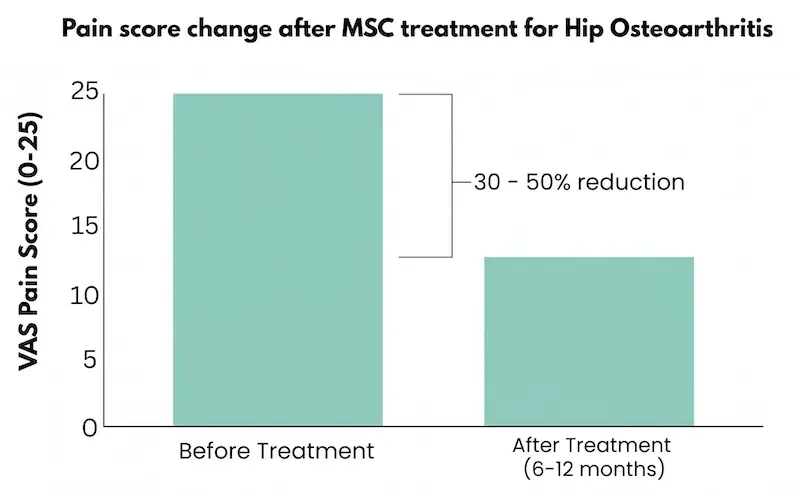
What Pain and Function Studies Report for Hip Osteoarthritis
We want to be straight about something first: the evidence base for the hip is younger and thinner than for the knee. Research on hip osteoarthritis has historically lagged behind, and there are no large, definitive randomised controlled trials yet for stem cell treatment of the hip. What exists is a body of smaller cohort studies and case series.
A 2025 scoping review by Reali and colleagues, published in Cureus, gathered the available clinical studies on intra-articular (inside-the-joint) stem cell therapy for hip osteoarthritis. Across these studies, pain reduction was consistent, with visual analog scale (VAS) pain scores typically falling by 30 to 50 percent. Function, measured by tools such as the Harris Hip Score and the WOMAC index (which combines pain, stiffness, and physical function), also improved, and a few studies reported imaging evidence suggesting cartilage repair.
How to Read These Hip Osteoarthritis Numbers Honestly
A 30 to 50 percent drop in pain is meaningful — it can be the difference between pain that dominates your day and pain that is present but manageable. But these figures come mostly from observational studies without the rigour of large placebo-controlled trials, so they should be read as encouraging signals rather than settled proof.
One supporting example: a prospective study following 71 hip osteoarthritis patients treated with stem cells and structured rehabilitation tracked their function with a standardised hip questionnaire over a full twelve months, reporting functional gains across the follow-up period. The honest summary is this: the early hip-specific data points in a favourable direction, the safety record so far is reassuring, and the long-term evidence is still being built. Anyone who tells you the hip results are already proven beyond doubt is overstating the case.
Which Hip Osteoarthritis Patients Are Realistic Candidates
Hip Osteoarthritis Patients Who May Benefit
In our experience, and consistent with the published data, stem cell treatment for hip osteoarthritis tends to help most in people who share a recognisable profile. They have mild to moderate hip osteoarthritis with some cartilage and joint space still remaining, rather than a joint that has collapsed completely. They have not gained adequate relief from conventional approaches such as physiotherapy, painkillers, or injections. They are trying to delay a hip replacement, or are not yet candidates for one. And they are in reasonable general health, without active joint infection or an uncontrolled autoimmune condition.
A realistic mindset matters too. The patients who do best understand that improvement, when it comes, is gradual — emerging over months, not days — and that the goal is to reduce pain and slow decline, not to grow a brand-new joint.
Hip Osteoarthritis Patients Who Are Not Ideal Candidates
This treatment is not right for everyone, and we say so before anyone travels. People with end-stage hip osteoarthritis, where cartilage is almost entirely gone and the bone is grinding on bone with significant deformity, are unlikely to gain meaningful benefit from stem cells alone — at that stage, a hip replacement remains the most effective option. People whose hip pain is actually coming from somewhere else, such as the lower spine, also will not respond to a hip injection; hip and back pain can overlap, which is one reason we review imaging carefully, and why our article on low back pain stem cell therapy exists alongside this one.
Patients with active cancer, uncontrolled blood disorders, or a current systemic infection should not undergo stem cell treatment, and pregnant women are excluded.
What Recovery After Hip Osteoarthritis Stem Cell Treatment Looks Like
Most patients describe the first few weeks as quiet — some notice mild soreness, others feel no change at all at first, which is completely normal and not a sign of failure. Improvements in pain and movement tend to begin emerging from around the second or third month, with the fuller effect developing over six to twelve months as the biological processes mature. Patients are usually advised to avoid high-impact activity for the first few weeks while keeping up gentle movement, since a stiff hip benefits from staying mobile within comfortable limits.
The Honest Risks and Limits of Hip Osteoarthritis Stem Cell Treatment
Known Side Effects of Hip Osteoarthritis Stem Cell Treatment
The safety profile reported so far is generally reassuring. The most common side effects are temporary and minor: soreness at the injection site, mild swelling, and short-lived stiffness in the days after the procedure. Because any injection into a joint carries a small risk of infection, we perform the procedure under sterile, imaging-guided conditions to keep that risk low. Allergic or immune reactions are uncommon with umbilical cord-derived cells because of their low immunogenicity.
We are also transparent that long-term safety data specifically for the hip, beyond a couple of years, remains limited simply because the field is young. We monitor every patient over time rather than treating and walking away.
What Stem Cells Cannot Do for Hip Osteoarthritis
It is worth being blunt here, because the internet is full of the opposite. Stem cells cannot rebuild a hip joint that is already destroyed. If the cartilage is gone and the bone surfaces are grinding directly against each other, the biology simply does not support regeneration at that level, and a replacement is the more honest recommendation.
Not everyone responds. Some patients gain real pain relief and better movement; others notice only modest change, and a meaningful minority notice little at all — and we cannot yet predict with certainty who will fall into which group. Stem cell treatment for hip osteoarthritis is not a guaranteed solution. It is best understood as an attempt to ease pain, calm inflammation, and potentially delay surgery in carefully chosen patients — not as a replacement for the operation when the joint has reached the end of the road.
FAQ About Hip Osteoarthritis Stem Cell Treatment
This varies between people. Reported benefits in hip studies have lasted from one to several years, with some case data describing sustained improvement at the two-year mark. Because the long-term evidence is still being gathered, we do not promise a fixed duration, and some patients may consider repeat treatment over time.
Only to a limited and inconsistent degree, and only when some cartilage still remains. A few studies have shown imaging signs of cartilage repair, but stem cells cannot rebuild a joint that has completely collapsed. The more reliable effects are reduced inflammation and pain rather than dramatic structural regrowth.
PRP mainly targets inflammation and can ease pain, while stem cells additionally signal for repair and protection of remaining cartilage. Some clinics combine the two. The evidence for either in the hip is still developing, and neither is a guaranteed fix.
The hip is a deep joint, so the injection is guided by ultrasound or fluoroscopy to place the cells accurately. It is performed under local anaesthesia, and most patients describe only mild, short-lived soreness afterward.
Most people who respond begin to notice changes between the second and third month, with the fuller effect developing over six to twelve months. Expecting immediate relief in the first couple of weeks usually leads to unnecessary discouragement.
Ready to Look at Your Own Hip Osteoarthritis Case?
If you have read this far, you are probably weighing up whether stem cell treatment makes sense for your specific hip — and feeling the pull between wanting relief and being wary of the bigger promises out there. We understand that position completely.
We offer free online consultations where you can share your imaging and history, and we will tell you honestly whether we think you are a realistic candidate, including when we think you are not. You do not need to have made any decision to reach out — many people use the conversation simply to understand their options more clearly.
References
- GBD 2021 Osteoarthritis Collaborators. “Global, regional, and national burden of osteoarthritis, 1990–2020 and projections to 2050: a systematic analysis for the Global Burden of Disease Study 2021.” The Lancet Rheumatology, 2023. DOI: 10.1016/S2665-9913(23)00163-7
- Reali GE, Fernandes DA, Martins EC. “Outcomes Following Stem Cell-Based Therapies for Hip Osteoarthritis: A Scoping Review.” Cureus, 17(11):e96419, 2025. DOI: 10.7759/cureus.96419
- “Current Evidence on Mesenchymal Stem Cells for Hip Osteoarthritis: a Narrative Review.” Regenerative Medicine, 2023. DOI: 10.2217/rme-2023-0071
- Global, regional, and national disease burden of hip osteoarthritis and its predicted level to 2050: an epidemiological analysis from 1990 to 2021. Discover Public Health, 2026. DOI: 10.1186/s12982-026-01389-0
- One-Year Functional Evaluation of Patients After CD34+ Stem Cell Treatment for Hip Osteoarthritis. Journal of Clinical Medicine, 2024. (PMID via PMC11677983)