
Heart Failure Stem Cell Therapy | Can Damaged Heart Muscle Actually Recover?
Climbing one flight of stairs now requires a pause at the top. Tasks that once took five minutes now need a rest halfway through. You take the medications exactly as prescribed — every morning, without fail — and yet the shortness of breath keeps returning, the fatigue sits in your chest like something heavy, and the last echocardiogram showed that your heart still isn’t pumping the way it should.
If that is your experience, you are among the estimated 64 million people worldwide living with heart failure. And you may already be asking the question that most medical consultations don’t fully address: is there anything beyond medication management that can actually improve what’s happening inside the heart muscle itself?
That question is what this article is about.
Heart failure is one of the most researched areas in stem cell medicine. Clinical trials have now been running for over fifteen years, with real data — specific numbers, identifiable patient profiles, and honest assessments of where the results fell short. We are going to cover that data here, including what it showed, what it did not show, and what realistic expectations look like for someone considering this path.
We have been working in Malaysia with patients from across the Asia-Pacific region for over seven years, with more than 200 individuals treated across multiple conditions. This article is not a promotion of a particular outcome. It is an honest account of what we know, and where the limits are.
Table Of Contents
- Why Heart Failure Doesn't Repair Itself
- What Medications and Devices Can — and Cannot — Do for Heart Failure
- How Stem Cell Therapy Approaches Heart Failure Differently
- What Clinical Trials Have Actually Shown About Stem Cells and Heart Failure
- A Patient's Account: What Heart Failure Recovery Looked Like Month by Month
- Is Stem Cell Therapy Right for Your Heart Failure?
- Honest Risks and Limitations of Stem Cell Therapy for Heart Failure
- FAQ about Heart Failure Stem Cell Therapy
- What You Can Do Next
- References
Why Heart Failure Doesn’t Repair Itself
The Heart’s Limited Capacity for Renewal in Heart Failure
The human body is remarkably good at repairing itself in most contexts. Skin heals after cuts. Bones knit back together after fractures. The liver can regenerate substantial portions of itself after damage, a biological fact that enables living-donor liver transplants.
The heart works differently.
For most of the twentieth century, scientists believed that heart muscle cells — called cardiomyocytes — were produced once, before birth, and never again. More recent research has revised that picture slightly. A landmark study from the Karolinska Institute used radiocarbon dating techniques to demonstrate that some cardiomyocyte renewal does occur throughout a human lifetime. The rate, however, is less than 1% per year in young adults and declines further as we age. In practical terms, this means that the heart cannot meaningfully replace cardiomyocytes lost to injury, pressure damage, or chronic ischemia — reduced blood supply over time.
When cardiomyocytes die, they are replaced by scar tissue, a process called fibrosis. Scar tissue is structurally stable, which is why the body uses it in wound healing. In the heart, however, scar tissue does not contract. It takes up the space where working muscle once existed, and it contributes nothing to the pumping function that the heart needs to perform tens of thousands of times every day.
How Scar Tissue Drives Heart Failure Progression
The replacement of functional muscle by scar tissue sets off a cascade that explains why heart failure tends to progress rather than stabilize.
As scar tissue accumulates, the heart compensates by remodeling — the chambers stretch, the walls thin, and the architecture of the ventricles changes to accommodate a weakened pump. Remodeling temporarily helps the heart maintain output, but it comes at a cost: the enlarged, remodeled heart is less efficient, more susceptible to arrhythmias, and more vulnerable to further damage.
The kidneys respond to reduced cardiac output by retaining fluid — a rational evolutionary response to what they interpret as a blood volume problem. The retained fluid increases the load on an already struggling heart. Neurohormonal systems that evolved to respond to emergencies become chronically activated, accelerating the deterioration of both cardiac structure and function.
This is the cycle that defines heart failure. Not a single injury, but an ongoing biological process in which each element of the disease drives the next. And at the center of it is a biological fact that medicine has not yet found a way to directly reverse: once heart muscle is lost to significant fibrosis, the body does not reclaim it.
Understanding this is essential to understanding both the limits of conventional treatment and the specific biological targets that stem cell therapy is attempting to address.
What Medications and Devices Can — and Cannot — Do for Heart Failure
The Real Role of Standard Heart Failure Medications
The medications used in heart failure are genuinely effective for what they are designed to do. This point is important, and it is not a caveat to be skipped over.
ACE inhibitors and ARBs reduce the strain on the heart by widening blood vessels and lowering the resistance the heart must pump against. Beta-blockers slow the heart rate and reduce the workload of each beat, while also protecting against arrhythmias. SGLT2 inhibitors — originally developed for type 2 diabetes, which frequently develops alongside heart failure as a shared condition — have shown meaningful reductions in hospitalization and mortality across multiple large trials. Diuretics help the kidneys clear excess fluid that would otherwise accumulate in the lungs and lower limbs.
In combination, these medications have been shown to reduce mortality, reduce hospitalizations, and improve quality of life for many heart failure patients. They represent decades of research and are appropriately considered the foundation of heart failure care.
What they do not do is repair damaged muscle or reverse fibrosis. They create a more favorable environment in which the heart can function — less strain, better fluid balance, reduced neurohormonal activation — but the underlying structural problem remains. A heart with an ejection fraction of 30% on well-optimized medication may stabilize, and in some patients may even show modest improvement in ejection fraction as the heart is protected from further stress. The scar tissue, however, persists. The structural repair that would fundamentally change the trajectory of the disease does not occur through medication alone.
This is not a criticism of current treatments. It is simply an accurate description of their mechanism — and the gap that explains why so many patients, even those who are compliant and well-managed, eventually find themselves at a ceiling.
When Devices and Surgery Reach Their Limit in Heart Failure
For patients with more severe heart failure, additional interventions exist.
Implantable cardioverter-defibrillators protect against sudden cardiac death from arrhythmias that are more common in the remodeled heart. Cardiac resynchronization therapy devices — sometimes called biventricular pacemakers — improve the coordination of contractions between the heart’s chambers and can produce meaningful functional improvements in appropriately selected patients. In the most severe cases of systolic dysfunction, a left ventricular assist device provides mechanical circulatory support, partially taking over the pumping work of the left ventricle.
Heart transplantation is the most effective treatment for end-stage heart failure. But donor organs are scarce, the surgical procedure carries significant risk, and recipients require lifelong immunosuppression — with all of the complications, infections, and secondary conditions that entails. The demand for donor hearts far exceeds supply in every country in the world.
The clinical reality for a large number of heart failure patients is this: they are not sick enough to qualify for transplant evaluation, but they are not well enough to live without significant daily limitation. Their condition is stable, but stability in heart failure often means a carefully managed plateau, not recovery.
It is this population — people with moderate to severe heart failure who are well-managed on medications and devices but continue to look for something that addresses the underlying biology — that cardiac stem cell research has been most focused on.
How Stem Cell Therapy Approaches Heart Failure Differently
Three Mechanisms Behind Cardiac Stem Cell Therapy for Heart Failure
The most important misconception to address upfront: mesenchymal stem cells (MSCs) — the type used in most cardiac stem cell trials — do not work by transforming themselves into new cardiomyocytes and rebuilding lost heart muscle.
That idea, which informed much of the early enthusiasm in the field, has not been supported by the evidence accumulated over the past two decades. MSCs transplanted into cardiac tissue retain their identity as MSCs; they do not reliably differentiate into beating heart muscle cells in a clinically meaningful way.
What the research has identified instead are three indirect but potentially significant mechanisms:
The first is paracrine signaling. MSCs release a broad spectrum of signaling molecules — growth factors, cytokines, exosomes — that communicate with surrounding cells. In the context of heart failure, these signals appear to reduce inflammation in cardiac tissue, inhibit the progression of fibrosis, promote the survival of cardiomyocytes that are under stress but not yet dead, and stimulate the heart’s own limited repair processes. This is not rebuilding lost muscle; it is supporting what remains.
The second is angiogenesis — the formation of new small blood vessels. Areas of heart muscle that are chronically under-supplied with blood can remain alive but severely under-functioning, a condition called hibernating myocardium. Improved vascular supply to these areas, promoted by signals from MSCs, can restore some functional capacity to tissue that has been struggling for years.
The third is immunomodulation. Chronic low-grade inflammation plays an underappreciated but significant role in heart failure progression. MSCs have demonstrated the ability to modulate the activity of immune cells that drive tissue damage, shifting the local immune environment toward one that is less destructive and more permissive of tissue maintenance. A similar inflammatory mechanism contributes to conditions like rheumatoid arthritis, where stem cell therapy’s immunomodulatory effects have also been studied.
These mechanisms do not reverse extensive established fibrosis. But they create conditions in which the heart’s remaining viable muscle can function better, and in which the pace of further deterioration may be slowed.
Why Allogeneic Cord-Derived MSCs Are Used for Heart Failure in Malaysia
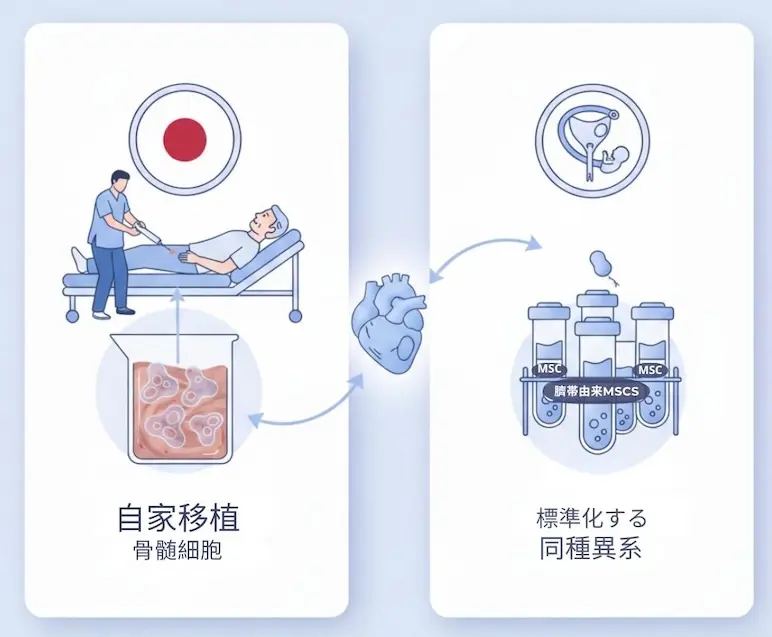
Stem cell therapy can be structured in two ways: using cells taken from the patient’s own body (autologous) or using cells from a healthy donor (allogeneic).
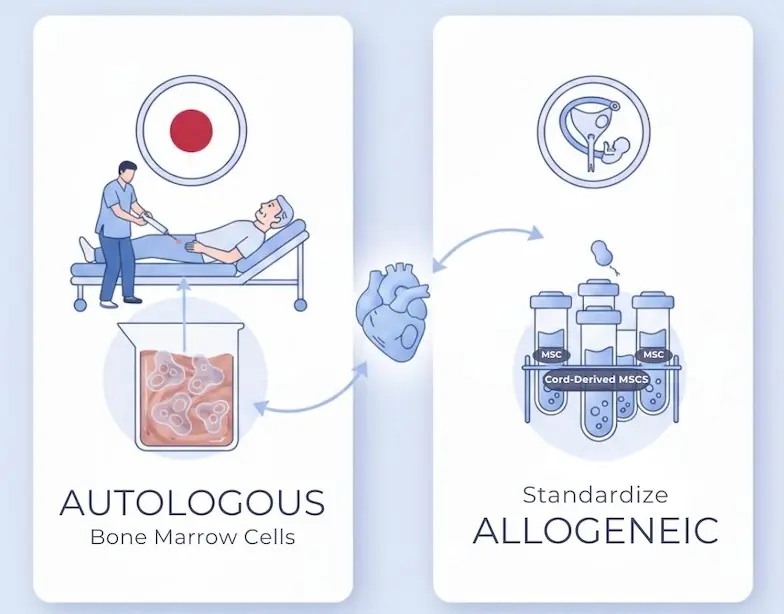
In Japan, autologous treatment is the standard approach under the existing regulatory framework. Cells are harvested from the patient’s own bone marrow or adipose tissue, processed, and returned. The advantage is the absence of immune rejection risk. The disadvantage is that the cells come from an older, potentially disease-affected body.
Multiple studies have suggested that MSCs taken from patients with established cardiovascular disease show measurably reduced potency compared to cells from healthy donors — lower proliferative capacity, reduced secretion of beneficial signaling molecules, and diminished immunomodulatory function. For a patient in their sixties or seventies with a decade of heart failure progression, the cells available from their own body may be a less robust starting point.
The allogeneic cord-derived MSCs used in Malaysia are sourced from the umbilical cord tissue of healthy newborns delivered by consented donors. These cells are younger in biological terms, show higher proliferative and secretory activity in laboratory studies, and are available in standardized preparations that allow for consistent dosing.
A direct head-to-head comparison of autologous versus allogeneic MSCs in cardiac conditions has been conducted — the POSEIDON trial, discussed in the next section — and the allogeneic cells showed comparable or slightly superior results on several measures. That said, the evidence for superiority of either approach in the cardiac context is not yet definitive. Cell source is one variable among many.
What Clinical Trials Have Actually Shown About Stem Cells and Heart Failure
Key Heart Failure Studies and What They Measured
The clinical trial landscape for cardiac stem cell therapy is more developed than for most other conditions where stem cells are being studied. Trials have been running since the early 2000s, and several randomized, controlled studies have now been completed and published in peer-reviewed journals.
The POSEIDON trial (Hare et al., JAMA, 2012) is one of the most directly relevant. It enrolled 30 patients with ischemic cardiomyopathy — heart failure arising from coronary artery disease — and randomized them to receive either autologous MSCs (cells from their own bone marrow) or allogeneic MSCs (cells from a healthy donor), delivered by transendocardial injection. At 12 months, both groups showed improvements in the six-minute walk test, a standard measure of functional cardiac capacity. Scar tissue volume measured on cardiac MRI was reduced in both groups. The allogeneic group had a somewhat better safety profile, and notably, there were no serious immune reactions despite the use of donor cells — an important finding for a field that once worried about rejection.
The MSC-HF trial (Mathiasen et al., European Heart Journal, 2015) followed 60 patients with severe chronic ischemic heart failure who received either MSC injections directly into the heart muscle or a placebo. At six months, the MSC group showed a mean improvement in ejection fraction of approximately 6 percentage points — a shift from roughly 30% toward 36% on average — compared to no statistically significant change in the placebo group. Exercise capacity, measured by the six-minute walk test, also improved. Quality of life scores were better in the MSC group.
The C-CURE trial (Bartunek et al., Journal of the American College of Cardiology, 2013) used a specialized form of cardiac-lineage-specified cells in 46 patients with chronic heart failure. The treated group showed improvements in ejection fraction and in a composite clinical score at six months, compared to patients receiving standard care alone.
The Cochrane systematic review of stem cell therapy for chronic ischemic heart disease and heart failure (Fisher et al., 2016), which analyzed 33 randomized trials involving over 1,500 patients, found that bone marrow-derived cells were associated with improvements in ejection fraction averaging around 3–4 percentage points, reductions in scar tissue volume, and improvements in functional class and quality of life measures. The reviewers noted that the quality of evidence was moderate, and called for larger, more rigorous trials — which is an accurate description of where the field stood.
Which Heart Failure Patients Showed the Most Improvement in Clinical Trials
Across multiple trials, a consistent pattern emerged regarding which patients showed the clearest benefit.
Patients with ischemic cardiomyopathy — heart failure arising from coronary artery disease and chronic underperfusion — showed more consistent results than those with non-ischemic forms. This is likely because the mechanism of angiogenesis and support of hibernating myocardium is more directly relevant to ischemic damage.
Ejection fraction in the range of 25–45% at baseline was the range studied most frequently, and the range in which meaningful improvements were recorded. This represents hearts that are significantly compromised but retain substantial viable, potentially responsive muscle.
Evidence of hibernating myocardium on imaging — areas that are under-functioning due to ischemia rather than fully replaced by fibrosis — was a positive prognostic factor. These are the areas most likely to respond to improved vascular support and reduced inflammatory load.
What the trials consistently did not show was dramatic functional recovery, normalization of ejection fraction to healthy ranges, or elimination of the need for ongoing medication. The improvements observed were real and clinically meaningful for many patients — changes in exercise capacity and quality of life that matter significantly in daily life. But they were incremental, not transformative. This honesty is important to carry into any consultation.
A Patient’s Account: What Heart Failure Recovery Looked Like Month by Month
A man in his early sixties, diagnosed with ischemic heart failure following a heart attack five years before consulting us. His ejection fraction at the time of initial evaluation was 31%. He had been on a full optimized medication regimen for three years — ACE inhibitor, beta-blocker, diuretic, and SGLT2 inhibitor — and was medically stable. Stable, but severely limited. He could not walk more than fifteen continuous minutes without stopping. He slept propped up on two pillows to avoid the breathlessness that came when lying flat. He described a constant low-level fatigue that he had gradually stopped mentioning to his cardiologist because it never changed.
He received allogeneic cord-derived MSC therapy in Malaysia in early 2024. The infusion was administered intravenously over approximately two hours. No immediate adverse events were recorded.
In the first month, he noticed nothing. This is typical. Patients are told before treatment to expect a latency period, and the first four to six weeks often feel indistinguishable from the period before treatment.
By the second month, he was sleeping with one pillow instead of two on most nights. He characterized the change as subtle but consistent. By the third month, he was walking for twenty-five continuous minutes. At the six-month echocardiogram, his ejection fraction measured at 37%. He described his daily fatigue as “manageable where before it was constant.”
He did not return to the cardiac function of someone who had never had a heart attack. He continues his full medication regimen and will likely do so indefinitely. But the ceiling on his daily activity has risen, and by his own account, that ceiling matters.
Not every patient experiences changes on this timeline or at this magnitude. Some patients report primarily subjective improvements — better sleep, more consistent energy — without clear changes in ejection fraction on follow-up imaging. Some show no measurable change. This account is one data point, not a template.
※ This account reflects one individual’s experience and does not represent a guaranteed or typical outcome for any other patient.
Is Stem Cell Therapy Right for Your Heart Failure?
Heart Failure Profiles That Tend to Respond Well to MSC Therapy
Based on available clinical trial data and our experience in Malaysia, the patients who tend to show the clearest benefit from MSC therapy for heart failure share a recognizable profile.
Ejection fraction in the range of 25–45% represents the most studied and most responsive segment. These are hearts that are substantially compromised but retain significant viable muscle tissue — tissue that can potentially respond to the paracrine signals and vascular support that MSCs provide.
Ischemic etiology — heart failure arising from coronary artery disease, prior myocardial infarction, or chronic ischemia — has been the focus of the majority of clinical trials. The mechanisms by which MSCs appear to benefit cardiac function are particularly well-suited to ischemic damage: angiogenesis improves supply to under-perfused but viable tissue; immunomodulation addresses the chronic inflammation that drives ischemic remodeling.
Clinical stability at the time of treatment is important. MSC therapy is not an emergency intervention, and it is not appropriate for someone currently hospitalized for decompensated heart failure. Patients should be on optimized medical therapy, hemodynamically stable, and without active infection.
The presence of hibernating myocardium — viable but under-functioning heart muscle identified on nuclear imaging or cardiac MRI — is perhaps the most specific positive predictor. This is the tissue that angiogenesis and inflammatory reduction are most likely to benefit.
Many patients with heart failure also manage type 2 diabetes, which independently affects cardiac muscle function and microvascular health. The intersection of these two conditions is a well-documented clinical challenge, and both are areas where MSC therapy has been actively researched.
Heart Failure Situations Where Stem Cell Therapy May Not Be Suitable
End-stage heart failure with extensive fibrosis throughout most of the left ventricular wall, severe remodeling, and no significant remaining viable tissue leaves little for stem cell therapy to support. In these cases, the more clinically appropriate conversation is about transplant evaluation, LVAD candidacy, or palliative care planning.
Active cardiac inflammation — myocarditis — is a contraindication for the current treatment approach. Recent myocardial infarction within the past four to six weeks requires stabilization before any elective intervention. Severe valvular disease causing hemodynamic compromise needs structural correction — percutaneous or surgical — before stem cell therapy is considered.
Heart failure with preserved ejection fraction (HFpEF), where the heart contracts normally but cannot relax and fill properly, represents a different underlying biology from HFrEF, and the evidence base for MSC therapy specifically in HFpEF is substantially thinner. Patients with this diagnosis should be aware that most of the published trial data does not directly apply to their condition.
Significant concurrent kidney disease — which frequently develops alongside heart failure in a pattern sometimes called cardiorenal syndrome — requires careful evaluation because renal function affects both the clearance of cells and the interpretation of fluid and electrolyte balance post-treatment.
These are not rules that can be applied categorically. Individual assessment with recent echocardiography, laboratory panels, and imaging is how appropriate candidacy is actually determined.
What Heart Failure Patients Should Expect During and After MSC Therapy
The observation period following treatment is typically one to two days before the patient can return home. Patients are explicitly instructed to maintain their existing cardiac medications without any interruption. This point is important enough to repeat: stem cell therapy for heart failure is designed to work alongside established treatment, not as a replacement for it. No medication changes should be made without direct guidance from the cardiologist who manages ongoing cardiac care.
Follow-up echocardiography is scheduled at three months and six months post-treatment. These imaging studies allow objective assessment of any change in ejection fraction, ventricular dimensions, and regional wall motion. Patients are also asked to track and report symptoms — exercise tolerance, sleep position, frequency of breathlessness — throughout the follow-up period.
Functional improvements, when they occur, typically begin to emerge between two and four months post-treatment. Structural changes on imaging, if present, are usually visible by the six-month scan. Patients who have not noticed any change by six months have generally not gone on to show changes at one year — which is honest information for anyone setting expectations.
Honest Risks and Limitations of Stem Cell Therapy for Heart Failure
Known Side Effects and How They Are Managed in Heart Failure Patients
The safety profile of allogeneic MSC therapy in cardiac trials has been generally favorable. This is not a dismissal of risk; it is what the accumulated trial data shows.
The most commonly reported immediate effects following infusion are mild fever, transient fatigue, and occasional headache in the one to two days following treatment — effects consistent with mild immune activation that resolve without specific intervention.
Immune rejection has not emerged as a significant clinical problem in allogeneic MSC trials, including cardiac ones. MSCs express low levels of the MHC class II proteins that typically trigger rejection responses, and they actively suppress the inflammatory pathways that drive rejection. The POSEIDON trial specifically compared allogeneic versus autologous MSCs and found no safety advantage for autologous cells — a finding that supports the use of donor-derived cells in clinical practice.
Arrhythmia — irregular heartbeat — is a theoretical concern when any cells are introduced into or near cardiac tissue, particularly via transendocardial injection. The infusion method used in Malaysia is intravenous, which avoids direct cardiac injection and is associated with lower arrhythmia risk.
Patients with heart failure and concurrent conditions — in particular, significant kidney disease, liver dysfunction, or active diabetes — require additional pre-treatment evaluation because these conditions can interact with how the treatment is tolerated and cleared.
What Stem Cell Therapy Cannot Fix in Heart Failure
This section matters as much as any other.
Stem cell therapy cannot reverse extensive, established fibrosis. A left ventricle in which the majority of the myocardium has been replaced by scar tissue does not regenerate. The window in which MSC therapy is most likely to provide benefit is before this endpoint is reached — in patients with meaningful viable tissue remaining.
It will not eliminate the need for cardiac medications. It will not repair structurally abnormal valves. It will not clear significant coronary artery blockages that are causing ongoing ischemia — those require percutaneous coronary intervention or bypass surgery, which may need to be addressed before or alongside any consideration of stem cell therapy.
Long-term outcome data — what happens at five years, ten years — is limited. The longest follow-up periods in published trials are generally two to three years. Whether the benefits seen at six to twelve months are durable, whether cells need to be re-administered, and what the optimal dosing schedule is over time are all questions that the field has not yet definitively answered.
Ejection fraction improvements in the trials that showed them averaged in the range of 4–8 percentage points. For a patient starting at 30%, an improvement to 36–38% is clinically meaningful — it may correspond to significantly better exercise capacity and symptom control — but it does not restore normal cardiac function.
These are not reasons to dismiss the evidence. They are the context in which the evidence should be read.
FAQ about Heart Failure Stem Cell Therapy
Five Questions Heart Failure Patients Ask Most Often Before Treatment
Japan has established a regulatory framework for autologous stem cell therapy, where cells are sourced from the patient’s own bone marrow or adipose tissue. The allogeneic cord-derived MSCs used in Malaysia come from healthy newborn donors. The practical difference lies in cell age, biological potency, and standardization of the cellular product. Multiple studies have suggested reduced potency in MSCs sourced from patients with established cardiovascular disease, which is one reason allogeneic cells have been a focus of international cardiac research. Neither approach has been established as definitively superior in cardiac conditions; both have clinical trial data supporting their use.
No. Patients must not discontinue or reduce their cardiac medications without explicit direction from their managing cardiologist. MSC therapy is designed to complement, not replace, optimized medical management. Stopping medications in anticipation of treatment would be medically inappropriate and potentially dangerous for heart failure patients.
This is one of the genuinely open questions. Published trials with follow-up periods of six to twelve months show maintained benefit in responders during that window. Data beyond two to three years is limited, and what the field does not yet know is whether one treatment cycle is durable over the longer term, or whether repeat treatment may be needed. This uncertainty is stated clearly at consultation, not discovered afterward.
The preparation phase — submitting records, completing remote evaluation, and receiving a candidacy assessment — can take one to two weeks depending on document availability. The treatment itself requires approximately two to three days in Malaysia: the day of infusion and one to two days of monitoring.
The presence of a cardiac device is not automatically a contraindication. The relevant question is the underlying reason the device was implanted, the current cardiac status, and whether the overall clinical picture is compatible with treatment. This is assessed individually based on submitted records.
What You Can Do Next
If you have read to this point and are wondering how the clinical picture maps to your specific situation — your ejection fraction numbers, your imaging history, the medications you are currently on — that is exactly what our free online consultations are designed to address.
We do not make decisions in that first call. We review what you share, ask the questions that matter clinically, and tell you honestly whether your case falls within the range where this therapy has shown evidence of benefit — or whether it does not.
If the honest answer is that stem cell therapy is unlikely to be meaningful for your situation, we will say that too. You are not committing to anything by reaching out other than the conversation itself.
References
- Hare JM, et al. “Comparison of allogeneic vs autologous bone marrow–derived mesenchymal stem cells delivered by transendocardial injection in patients with ischemic cardiomyopathy: the POSEIDON randomized trial.” JAMA. 2012;308(22):2369–2379. https://doi.org/10.1001/jama.2012.25321
- Mathiasen AB, et al. “Bone marrow-derived mesenchymal stromal cell treatment in patients with severe ischaemic heart failure: a randomized placebo-controlled trial (MSC-HF trial).” Eur Heart J. 2015;36(27):1744–1753. https://doi.org/10.1093/eurheartj/ehu580
- Bartunek J, et al. “Cardiopoietic stem cell therapy in heart failure: the C-CURE (Cardiopoietic stem Cell therapy in heart failURE) multicenter randomized trial with lineage-specified biologics.” J Am Coll Cardiol. 2013;61(23):2329–2338. https://doi.org/10.1016/j.jacc.2013.02.071
- Fisher SA, et al. “Stem cell therapy for chronic ischaemic heart disease and congestive heart failure.” Cochrane Database Syst Rev. 2016;12:CD007888. https://doi.org/10.1002/14651858.CD007888.pub3
- Bergmann O, et al. “Evidence for cardiomyocyte renewal in humans.” Science. 2009;324(5923):98–102. https://doi.org/10.1126/science.1164680
- Savarese G, Lund LH. “Global public health burden of heart failure.” Card Fail Rev. 2017;3(1):7–11. https://doi.org/10.15420/cfr.2016:25:2