Chronic Fatigue Syndrome Stem Cell Therapy | Can Immune Rebalancing Reduce Fatigue When Rest and Medication No Longer Help?

You woke up exhausted after ten hours of sleep. You cancelled plans again — not because you wanted to, but because you knew what would happen if you didn’t: two days of worsening symptoms that you’ve come to call a “crash.” You’ve already tried the sleep hygiene advice, the pacing strategies, the antidepressants your previous doctor suggested despite the fact that you don’t feel depressed — you feel physically ill. And yet your test results keep coming back normal.
If that sounds familiar, you may be one of an estimated 17 to 24 million people worldwide living with myalgic encephalomyelitis and chronic fatigue syndrome, more commonly referred to as ME/CFS. It is one of the most misunderstood and underdiagnosed conditions in modern medicine. Up to 90% of people who have it have never received a formal diagnosis.
In recent years, mesenchymal stem cell (MSC) therapy has attracted serious attention as a potential approach for ME/CFS — not as a cure, and not as a way to give you a short-term energy boost, but as a biological strategy for addressing the immune dysregulation and neuroinflammation that growing research suggests are at the core of the condition.
This article is written by a clinical team based in Malaysia with more than seven years of experience and over 200 patients treated with allogeneic umbilical cord-derived MSCs across multiple conditions. We will tell you what the current clinical evidence actually shows, who tends to benefit, where the evidence runs out, and who we would advise not to pursue this treatment. We are not going to tell you this is a guaranteed answer — because it is not.
Table of Contents
- Why ME/CFS Does Not Simply Resolve Over Time
- Where Conventional ME/CFS Treatments Fall Short
- How Stem Cell Therapy Targets the Biology of Chronic Fatigue Syndrome
- What the Clinical Evidence Shows for ME/CFS Stem Cell Therapy
- Autologous vs. Allogeneic MSCs for Chronic Fatigue Syndrome
- Who Is — and Is Not — a Realistic Candidate for ME/CFS Stem Cell Therapy
- One Patient's Account of ME/CFS Stem Cell Therapy in Malaysia
- Honest Risks and Limitations of Chronic Fatigue Syndrome Stem Cell Therapy
- FAQ About ME/CFS Stem Cell Therapy
- If You Are Looking for an Honest Conversation About Your Options
- References
Why ME/CFS Does Not Simply Resolve Over Time
The Biological Dysfunction at the Core of Chronic Fatigue Syndrome
Chronic fatigue syndrome is not a productivity problem, a psychological adjustment disorder, or the result of poor sleep habits. Research over the past decade has increasingly characterized ME/CFS as a complex, multi-system neuroimmune disease — one in which the immune system, the nervous system, and cellular energy production are all functioning abnormally.
The hallmark symptom is post-exertional malaise (PEM): a distinctive worsening of symptoms following physical or mental exertion that would not affect a healthy person. This is not ordinary tiredness. It is a biological response that can set a patient back by days or weeks following an activity as modest as a short walk or a stressful phone call. PEM is the feature that most clearly distinguishes ME/CFS from general fatigue or burnout — and it points to a fundamental problem with how the body is processing and responding to exertion at the cellular level.
Researchers have identified a range of abnormalities in ME/CFS patients that help explain this. Immune cells called natural killer cells show reduced function. The balance of pro-inflammatory and anti-inflammatory signaling proteins (cytokines) is disrupted in measurable ways. There is evidence of neuroinflammation — inflammation within the central nervous system — that correlates with symptom severity. And at the cellular level, mitochondria, the structures responsible for producing the energy molecule ATP that powers every cell in the body, appear to function inefficiently in many ME/CFS patients.
Why ME/CFS Persists Without Improvement in Many Patients
Unlike a broken bone or a bacterial infection, ME/CFS does not resolve with rest and time in most cases. This is partly because the underlying drivers are not a single, correctable problem. The dysfunction is systemic and self-reinforcing: disrupted immune signaling leads to neuroinflammation, which disrupts the autonomic nervous system, which affects sleep, circulation, and energy regulation, which further stresses an already dysregulated immune system.
For a meaningful proportion of patients — estimates suggest somewhere between 5% and 10% — some degree of natural recovery does occur in the first few years. For the majority, the condition stabilizes in a chronic pattern that may fluctuate but does not resolve. For approximately 25% of patients, the disease is severe enough to be largely or entirely housebound.
This biological reality is important context for understanding both why conventional treatments are limited, and what stem cell therapy is attempting to do.
Where Conventional ME/CFS Treatments Fall Short
What Current ME/CFS Treatment Can and Cannot Achieve
There is currently no approved cure for ME/CFS, and no pharmacological treatment has demonstrated clear disease-modifying effects in large, well-controlled trials. The treatment approaches available are primarily supportive: they help patients manage symptoms and reduce the risk of crashes rather than addressing the underlying biological dysfunction.
Pacing — carefully managing activity levels to stay within the body’s available energy envelope — is the most evidence-supported self-management strategy, and for many patients it genuinely helps reduce the frequency and severity of crashes. It does not, however, restore function or address the immunological and neurological abnormalities driving the condition.
Low-dose naltrexone, antihistamines, sleep aids, and various supplements are used off-label by many patients and clinicians, with variable and largely anecdotal results. A handful of small trials have shown promising signals for some of these approaches, but none have produced the kind of robust, replicated clinical evidence that would support widespread recommendation.
The Treatment Gap That Leaves Many ME/CFS Patients Without Options
What makes ME/CFS particularly difficult for the patients who live with it is not just the severity of the disease — it is the experience of navigating a medical system that until very recently largely dismissed the condition as psychosomatic, and that still lacks a validated biological treatment pathway.
The practical result for many patients with moderate to severe ME/CFS is a revolving door of symptom management: trying each intervention available, finding partial or temporary relief, watching it fade, and eventually being told there is nothing more to offer. Patients in this position — who understand their own condition well, who have educated themselves on the biology, and who are genuinely asking whether there is something that addresses the immune dysfunction at the source — are the people most likely to find their way to our clinic.
What we can offer is honest: a biological approach with a plausible mechanism, some early supportive clinical data, significant limitations in the current evidence base, and a realistic conversation about whether your specific situation suggests you might benefit.
How Stem Cell Therapy Targets the Biology of Chronic Fatigue Syndrome
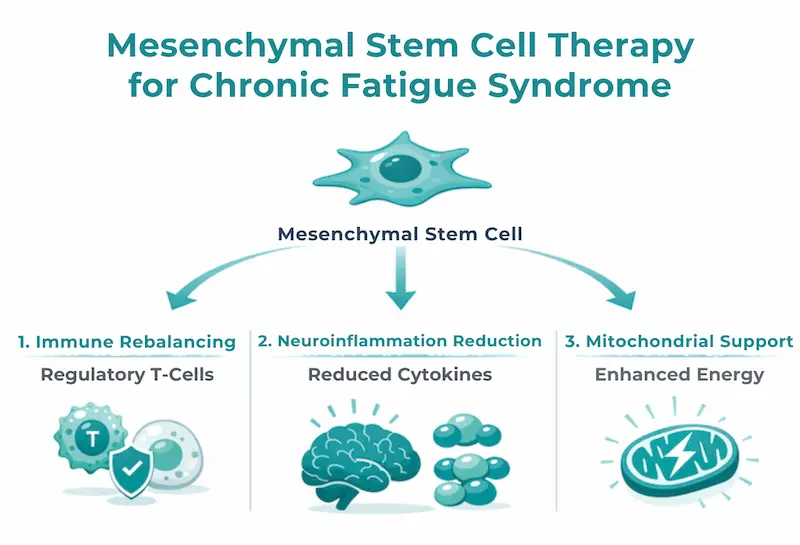
Mechanism 1: Rebalancing the Immune Response in ME/CFS
The immune dysfunction in ME/CFS is not simply a matter of having too much inflammation or too little immune activity. Research suggests the problem is one of dysregulation — an immune system that is stuck in an aberrant state, producing chronic low-grade inflammatory signals while simultaneously failing at normal immune surveillance.
Mesenchymal stem cells (MSCs) are cells with a well-documented ability to regulate immune activity. When introduced into the body, they interact directly with the immune cells involved in this dysregulation — including T-cells, B-cells, and macrophages — secreting signaling molecules (cytokines) that shift the immune environment away from a pro-inflammatory state.
Importantly, MSCs also stimulate the activity of regulatory T-cells — sometimes called Tregs — whose function is essentially to police the rest of the immune system and prevent excessive, self-sustaining inflammatory responses. The parallels with rheumatoid arthritis are meaningful here: the same immunomodulatory mechanisms that show measurable reductions in disease activity markers in refractory RA patients operate through similar pathways in other autoimmune and neuroimmune conditions, including ME/CFS.
Mechanism 2: Reducing Neuroinflammation in Chronic Fatigue Syndrome
Neuroinflammation — inflammation within or surrounding the central nervous system — has been identified as a significant feature of ME/CFS in multiple research studies. Brain imaging in ME/CFS patients has shown patterns of glial cell activation consistent with a neuroinflammatory process, and the severity of neuroinflammation has been correlated with cognitive symptoms and fatigue severity.
MSCs release molecules that cross the blood-brain barrier and modulate the activity of microglia — the immune cells of the central nervous system. By reducing the neuroinflammatory signaling that contributes to the cognitive dysfunction, sleep disruption, and sensory hypersensitivity characteristic of ME/CFS, stem cells aim to address one of the more difficult-to-treat dimensions of the condition.
This is not an immediate effect. The process operates over weeks to months, which is why patients are cautioned that any noticeable changes in cognitive clarity or sensory tolerance are unlikely before the six to twelve week mark at the earliest.
Mechanism 3: Supporting Mitochondrial and Cellular Energy Function
One of the more compelling lines of research in ME/CFS points to abnormalities in cellular energy production. Mitochondria — the cellular structures that convert nutrients and oxygen into ATP, the energy currency of every cell — appear to function inefficiently in a subgroup of ME/CFS patients. This is not a metaphorical energy problem; it is a measurable impairment in oxidative phosphorylation, the biochemical process that generates most of the body’s usable energy.
MSCs secrete growth factors and other signaling molecules that support mitochondrial function and promote the survival of cells under metabolic stress. While this mechanism is the least directly studied in ME/CFS specifically, it represents a potentially relevant pathway given the central role that cellular energy dysfunction appears to play in the condition.
What the Clinical Evidence Shows for ME/CFS Stem Cell Therapy
The Current State of Clinical Research in ME/CFS
We want to be direct with you: the clinical evidence base for stem cell therapy in ME/CFS is significantly younger and thinner than for conditions like osteoarthritis or heart failure, where large randomized controlled trials have been completed and published. This does not mean the evidence is absent — but it does mean that the data available now comes from earlier-stage investigations, and that anyone telling you the evidence is well-established for ME/CFS specifically is not being accurate.
A 2024 study published in a peer-reviewed regenerative medicine journal (Vinski et al.) used a qualitative case study approach, gathering data through interviews, medical record reviews, and clinical observation of patients with ME/CFS who had undergone MSC therapy. The findings reported notable improvements in fatigue severity, cognitive function, memory, concentration, and daily functional capacity. Sleep disturbances, while reduced in severity, did not fully resolve in most participants. The authors were explicit that their findings are preliminary and that standardized, larger-scale controlled trials are needed to establish long-term efficacy.
The broader evidence for MSC therapy in conditions with overlapping immune dysfunction — rheumatoid arthritis, systemic lupus erythematosus, and post-viral syndromes — provides indirect but biologically relevant support for the mechanism of action in ME/CFS. In the Cx611 randomized controlled trial for refractory rheumatoid arthritis, published in the Annals of the Rheumatic Diseases in 2017 and involving 48 patients who had failed multiple biologic drugs, approximately one in three patients showed a clinically meaningful reduction in disease activity scores at 12 weeks — a finding that establishes MSCs can produce meaningful immune modulation in a comparable autoimmune inflammatory context.
What Honest Expectations Look Like for ME/CFS Patients
Because the ME/CFS-specific trial data is at an early stage, we draw on three converging sources when setting realistic expectations: the available ME/CFS case data, the broader MSC literature in autoimmune conditions, and the patterns we have observed in our own clinical experience over seven years.
The honest picture looks like this: A proportion of patients — our clinical experience suggests roughly 40 to 50 percent of those who pass our suitability assessment — report meaningful improvement in at least one domain of their ME/CFS symptoms within six months of treatment. Most commonly, this appears first as a reduction in the duration and intensity of post-exertional crashes, followed by modest improvement in cognitive clarity, and in some cases a gradual increase in sustainable activity tolerance.
Improvement, when it occurs, is partial and gradual — not dramatic. Most responding patients describe moving from a functional state where nearly any exertion triggers a multi-day crash, to one where crashes are less severe and recovery is faster. A substantial minority — we estimate 50 to 60 percent based on current data and clinical experience — do not achieve improvements that would be considered clinically meaningful.
We tell every patient this before any treatment proceeds. You deserve these numbers, not a curated highlight reel.
Autologous vs. Allogeneic MSCs for Chronic Fatigue Syndrome
Why Cell Source Is Particularly Relevant in ME/CFS
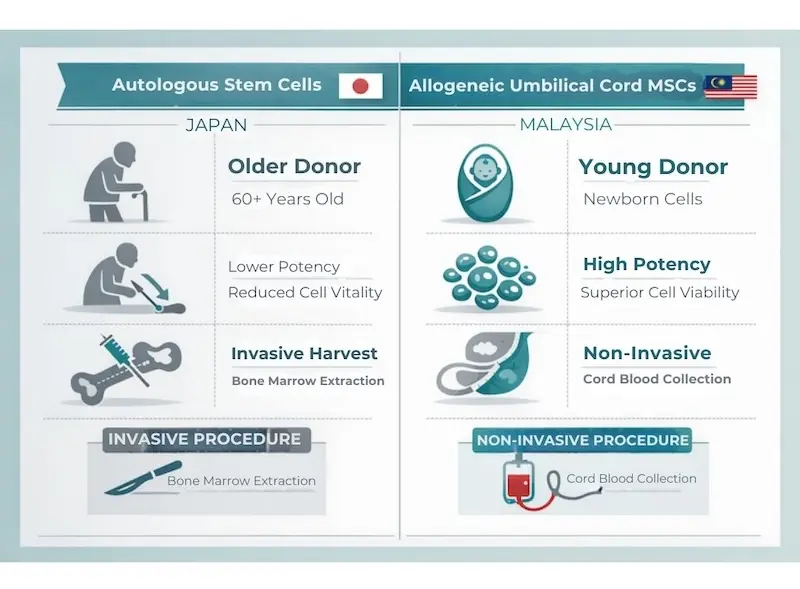
In Japan and some other countries, stem cell therapy is typically conducted using autologous cells — meaning cells harvested from the patient’s own body, usually from bone marrow or fat tissue, before being processed and reinfused. The benefit of this approach is the absence of immune rejection risk, since the cells are genetically the patient’s own.
However, for ME/CFS patients, the autologous approach has a specific and significant limitation. MSC therapy works primarily through immunomodulation — through the cell’s ability to regulate and calm an overactive or dysregulated immune system. In a patient whose immune system has been chronically dysregulated for years, the MSCs harvested from that same body may themselves reflect that disrupted environment. Research has demonstrated that MSCs from individuals with chronic inflammatory conditions show measurably reduced immunomodulatory capacity compared to those from healthy donors: lower output of anti-inflammatory cytokines, reduced ability to expand regulatory T-cells, and diminished overall potency.
For a condition in which the therapeutic goal is precisely to reset a long-standing immune dysregulation, using cells that have themselves been shaped by that same environment is a meaningful disadvantage.
The Allogeneic Umbilical Cord MSC Approach Used in Malaysia
We use allogeneic MSCs derived from the Wharton’s jelly layer of umbilical cord tissue donated by healthy mothers following consented deliveries. These cells come from newborns — they are among the youngest and most potent MSCs available — and they have not been exposed to decades of inflammatory signaling, pharmaceutical interventions, or the cellular aging that accompanies chronic illness.
Umbilical cord-derived MSCs have a particularly strong immunomodulatory profile compared to bone marrow or adipose-derived MSCs. They express lower levels of the surface proteins that trigger immune rejection, which means they can be administered to unrelated recipients without requiring donor matching in most cases. They are prepared in standardized, quality-verified batches, which allows for consistent dosing and confirmed cell viability before treatment.
For ME/CFS patients specifically, we believe the immunomodulatory potency of young allogeneic cord-derived MSCs represents a meaningfully different starting point from what an autologous harvest from a long-ill patient can provide.
Who Is — and Is Not — a Realistic Candidate for ME/CFS Stem Cell Therapy
ME/CFS Profiles That Tend to Respond to Stem Cell Therapy
Not every ME/CFS patient is an appropriate candidate for this treatment, and we assess this carefully before accepting anyone for a consultation.
The patients who show the clearest response share a profile: they have a confirmed ME/CFS or myalgic encephalomyelitis diagnosis meeting established diagnostic criteria (CDC 1994, International Consensus Criteria, or equivalent). Their condition has a demonstrable inflammatory or immune dysregulatory component, evidenced by elevated cytokines, activated immune cell populations, or documented post-viral onset. They have had the condition for more than six months and have not seen meaningful improvement with pacing, sleep management, and any other currently available supportive treatments. They are not currently in an acute crash or destabilized phase — treatment is most safely undertaken during a period of relative stability. Their overall health does not include active malignancy, uncontrolled autoimmune conditions requiring high-dose immunosuppression, or active systemic infection.
Post-COVID ME/CFS — where the condition developed following SARS-CoV-2 infection — is a particular area of interest. The immune activation patterns documented in post-COVID ME/CFS overlap substantially with those seen in other ME/CFS presentations, and the potential for MSC immunomodulation to address those patterns is a biologically plausible and clinically active area of ongoing observation.
ME/CFS Patients for Whom Stem Cell Therapy Is Unlikely to Be Appropriate
We actively advise against this treatment when the clinical picture does not support it.
Patients whose ME/CFS is extremely severe — those who are fully bed-bound and unable to tolerate any activity, including travel and minor procedural stress — may not be suitable candidates at the current level of stability. The physiological demands of travel to Malaysia and the procedure itself require a baseline of function that is not compatible with the most severe disease states.
Patients who have a primary psychiatric condition (rather than ME/CFS-associated cognitive and mood symptoms) that is driving their fatigue, or whose fatigue has a different identifiable cause that has not yet been adequately treated, should address that primary issue first.
Anyone seeking a guarantee of recovery, or who requires rapid improvement within weeks for professional or personal reasons, should understand clearly that this is not a treatment that works quickly, and that a meaningful proportion of patients do not respond to a degree that would be considered clinically significant. We will not proceed with treatment if we believe expectations are incompatible with what the data can support.
One Patient’s Account of ME/CFS Stem Cell Therapy in Malaysia
A woman in her early forties. ME/CFS for four years following a severe respiratory infection. Prior to onset, she had worked full-time as a project manager; by the time she reached us, she was working three hours per day on her best days, spending the rest of the time horizontal, and managing a cognitive impairment she described as “thinking through wet cement.”
She had followed a strict pacing protocol for two years and had tried low-dose naltrexone, vitamin D supplementation, and antihistamines with inconsistent and ultimately modest benefit. Her blood work showed elevated inflammatory cytokine markers. She traveled to Malaysia in mid-2024, accompanied by her partner, during what she described as a stable period in her condition.
The first eight weeks after treatment produced no notable change. She reported feeling slightly worse in the first two weeks — a mild, temporary worsening she was warned to expect. By week ten, she noticed that the recovery time following mild exertion had shortened. The crashes that previously lasted three to four days were, on several occasions, resolving in one. By the four-month mark, her cognitive symptoms had improved to the point where she was working five hours on most days. She described returning to short walks without triggering a crash as “something I had genuinely stopped believing was possible.”
At her six-month follow-up, she remained in the same improved state — not recovered, not symptom-free, but meaningfully more functional than before treatment. She continued her pacing protocol and described the combination as more effective than either approach alone. Her inflammatory markers showed a modest reduction compared to pre-treatment levels.
She did not stop pacing. She did not stop managing her activity carefully. This treatment did not give her her old life back. But for someone who had been managing a daily ceiling of three hours of function, the shift to five hours represented a qualitative change in her daily existence.
This is an anonymized account based on actual clinical experience. Individual outcomes vary and cannot be guaranteed.
What Recovery From the Procedure Looks Like in ME/CFS Patients
For most ME/CFS patients, the first two to four weeks following the infusion are not dramatically different from baseline — and some patients experience a temporary mild worsening during this period. This is expected and does not indicate treatment failure.
The first detectable changes, in patients who respond, typically appear between six and twelve weeks: changes in post-exertional recovery time, modest improvements in sleep quality, or subtle shifts in cognitive clarity. Patients should be specifically warned against attempting to test their new limits during the first three months. The biological process being set in motion requires time and is not well served by premature exertion.
Honest Risks and Limitations of Chronic Fatigue Syndrome Stem Cell Therapy
Known Side Effects in the ME/CFS Clinical Context
The safety profile of intravenous MSC therapy, across the broad clinical trial literature, has been consistently favorable. The most commonly reported immediate effects are mild fever in the 24 to 48 hours following infusion, transient fatigue, and occasional mild headache — effects consistent with the immune system’s recognition of and response to the donor cells, not an active infection. These typically resolve without treatment within one to three days.
For ME/CFS patients specifically, there is an important practical consideration: the days immediately following the infusion may involve a symptom flare that can resemble a mild crash. Patients are advised to budget genuine rest time for the week following treatment and to avoid any new physical or cognitive exertion during this period.
Immune rejection has not been observed as a significant clinical problem with allogeneic umbilical cord-derived MSCs in published trials, for reasons related to their low expression of the proteins that ordinarily trigger rejection responses.
What Stem Cell Therapy Cannot Do for ME/CFS
We want to be as clear about the limits as we are about the potential.
Stem cell therapy for ME/CFS is not a cure. It does not normalize the immune system permanently. It does not guarantee sustained improvement or eliminate the need for pacing and careful activity management. The duration of any benefits achieved is not yet known with certainty for ME/CFS, because the field is young and long-term follow-up data beyond two years is limited.
The evidence base is at an early stage. There are no large Phase III randomized controlled trials specifically for ME/CFS with MSC therapy yet. The existing clinical data comes from case studies and early-phase investigations, supported by mechanistic evidence from related autoimmune conditions. We believe this data supports a serious conversation about whether this treatment makes sense for your specific situation — but it does not yet support certainty about outcomes.
Approximately half of the patients we have seen with ME/CFS do not achieve improvements that would be considered clinically meaningful. We cannot currently predict with confidence who will and will not respond. The pre-treatment assessment provides useful information, but it does not produce certainty.
Finally, this treatment is not a substitute for good ME/CFS management. Patients who undergo MSC therapy and abandon pacing, sleep management, and the foundational principles of ME/CFS self-care are not setting themselves up well. The most positive outcomes we have observed have come from patients who treated MSC therapy as an addition to — not a replacement for — their existing management strategies.
FAQ About ME/CFS Stem Cell Therapy
Conventional treatments for ME/CFS work by managing symptoms — reducing pain, improving sleep, or allowing patients to better tolerate their existing limitations. MSC therapy works by attempting to address the immune dysregulation and neuroinflammation that research increasingly identifies as the biological source of the condition. It is not a symptom manager; it is a biological approach to the upstream problem. The distinction matters because it explains both why MSC therapy takes months to produce effects (it is working through slower biological processes than a pain medication) and why it may achieve changes that symptom-focused treatments cannot.
No. We do not ask patients to discontinue any current treatment before, during, or after MSC therapy. Decisions about medication should remain entirely with your treating physician. The stem cell infusion is designed to be additive to existing management, not a replacement for it.
We do not yet have definitive long-term data for ME/CFS specifically. In patients who respond, improvements observed at three to six months have generally been maintained in our follow-up observations at twelve months. Whether effects persist beyond that period, diminish, or whether re-treatment is beneficial are questions the field has not yet fully answered. We are honest about this uncertainty with every patient.
No. This is a self-pay treatment. In Malaysia, it is conducted under regulated medical practice as a self-funded intervention. We recommend that patients factor this clearly into their decision-making, alongside the realistic probability of benefit based on their specific profile.
Post-COVID ME/CFS is one of the presentations we see with increasing frequency, and the immune activation patterns documented in post-COVID ME/CFS overlap meaningfully with those in other ME/CFS presentations. The biological rationale for MSC therapy is as applicable to post-COVID ME/CFS as to ME/CFS arising from other viral triggers. We assess post-COVID ME/CFS patients using the same criteria as other ME/CFS presentations: confirmation of diagnosis, immune profile, stability of current condition, and absence of contraindications.
If You Are Looking for an Honest Conversation About Your Options
If you have been living with ME/CFS for years, have followed every available guidance, and are now asking whether there is something that addresses the underlying biology rather than just managing what comes out of it — we understand why that question has brought you here.
We offer free online consultations for exactly this kind of conversation. We will review your case, look honestly at whether your profile suggests you are a realistic candidate, and tell you directly if we believe this treatment is unlikely to be meaningful for your situation. You do not need to have made any decision before reaching out. Bring your history, your question, and your skepticism — all of them are welcome.
References
- Lim EJ, Ahn YC, Jang ES, Lee SW, Lee SH, Son CG. “Systematic review and meta-analysis of the prevalence of chronic fatigue syndrome/myalgic encephalomyelitis (CFS/ME).” Journal of Translational Medicine. 2020;18:100. https://doi.org/10.1186/s12967-020-02269-0
- Vinski D, et al. “Stem Cell Therapy for Chronic Fatigue Syndrome: A Promising Approach.” Journal of Wellness Science. 2024;3(11). https://doi.org/10.58344/jws.v3i11.1231
- Álvaro-Gracia JM, et al. “Intravenous administration of expanded allogeneic adipose-derived mesenchymal stem cells in refractory rheumatoid arthritis (Cx611): results of a multicentre, dose escalation, randomised, single-blind, placebo-controlled phase Ib/IIa clinical trial.” Annals of the Rheumatic Diseases. 2017;76(9):1612–1617. https://doi.org/10.1136/annrheumdis-2016-210498
- Monzón-Nomdedeu MB, Morten KJ, Oltra E. “Induced pluripotent stem cells as suitable sensors for fibromyalgia and myalgic encephalomyelitis/chronic fatigue syndrome.” World Journal of Stem Cells. 2021;13(8):1134–1150. https://doi.org/10.4252/wjsc.v13.i8.1134
- Graves BS, et al. “Chronic Fatigue Syndrome: Diagnosis, Treatment, and Future Direction.” Cureus. 2024;16:e70616. https://doi.org/10.7759/cureus.70616
- Marshall-Gradisnik S, Eaton-Fitch N. “Understanding myalgic encephalomyelitis.” Science. 2022;377:1150–1151. https://doi.org/10.1126/science.abo1261
- Maksoud R, et al. “Biomarkers for myalgic encephalomyelitis/chronic fatigue syndrome (ME/CFS): A systematic review.” BMC Medicine. 2023;21(1):189. https://doi.org/10.1186/s12916-023-02893-9
- Frontiers in Immunology. “Advances and clinical challenges of mesenchymal stem cell therapy.” 2024;15. https://doi.org/10.3389/fimmu.2024.1421854