
Tinnitus Stem Cell Therapy | Can Cells Quiet Persistent Ear Ringing?
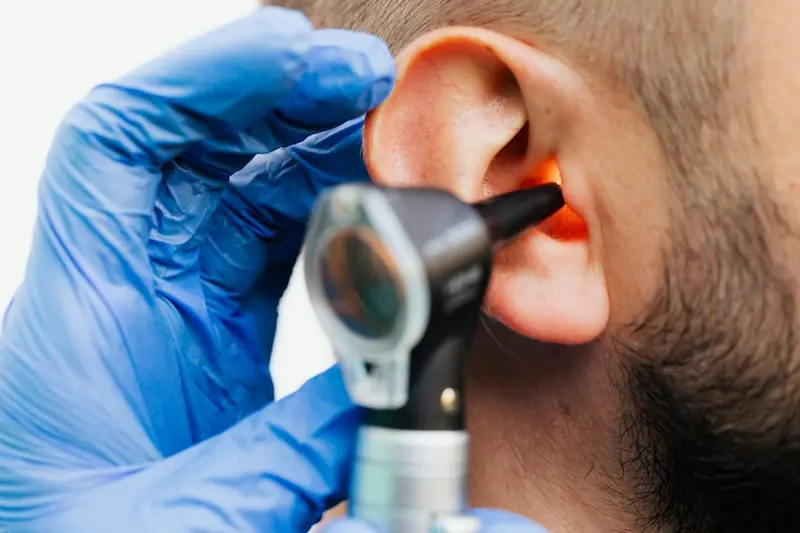
The room is quiet, but your ears are not. There is a high-pitched whine on the right side that has been there for two years. It is louder when you wake up. It gets worse when you are tired. You have learned to talk over it, sleep through it, work around it — but it never actually goes away.
If this is your daily reality, you are part of an enormous and largely under-recognised population. According to a systematic review and meta-analysis published in JAMA Neurology in 2022, approximately 740 million adults worldwide have experienced tinnitus, and around 120 million live with severe forms that meaningfully affect their quality of life. Despite the scale of the problem, no oral medication has been approved specifically for tinnitus. Sound therapy and cognitive behavioural therapy can help people cope, but they do not change what is happening inside the inner ear.
Stem cell therapy has been raised as a possible new direction. We want to be careful here — more careful than we are with some other conditions we cover. The clinical evidence for stem cell therapy specifically in tinnitus is meaningfully thinner than for, say, knee osteoarthritis or chronic low back pain. Most of the published research is preclinical. There is reason to take the biological rationale seriously, and there is also reason to be honest about how early this field is.
This article walks through what the research actually shows, where the biological logic is strongest, who is and is not a candidate, and where the limits are. We have been working in regenerative medicine in Malaysia for over seven years and have treated more than 200 patients across various conditions using allogeneic umbilical cord-derived mesenchymal stem cells. Our position is that some patients with tinnitus may be reasonable candidates for this approach — and that many are not. We will be specific about which is which.
Table of Contents
- Why Tinnitus Becomes So Difficult to Quiet
- The Real Limits of Current Tinnitus Treatments
- How Stem Cell Therapy Approaches Tinnitus Differently
- What the Research Currently Shows for Tinnitus Stem Cell Therapy
- Allogeneic vs. Autologous: Cell Source Considerations for Tinnitus
- Who Might Benefit from Tinnitus Stem Cell Therapy — and Who Probably Won't
- The Honest Risks and Limits of Tinnitus Stem Cell Therapy
- What Stem Cell Therapy Cannot Do for Tinnitus
- FAQ About Tinnitus Stem Cell Therapy
- Next Step
- References
Why Tinnitus Becomes So Difficult to Quiet
How the Inner Ear Damage Behind Tinnitus Develops
The inner ear contains a structure called the cochlea — a fluid-filled spiral the size of a pea, lined with roughly 25,000 sensory cells called hair cells. When sound vibrations reach the cochlea, hair cells convert those vibrations into electrical signals that travel along the auditory nerve to the brain. This is how hearing works.
These hair cells are remarkably sensitive and remarkably fragile. Loud noise, age, certain medications (called ototoxic drugs), infection, and reduced blood flow to the ear can all damage or kill them. Unlike skin cells or liver cells, human hair cells do not regenerate naturally. Once they die, they are gone.
The damage rarely stops at the hair cells alone. Surrounding tissue — the spiral ganglion neurons that carry signals to the brain, the stria vascularis that maintains the chemical environment of the cochlea, the supporting cells and tiny blood vessels — also takes hits. Inflammation rises in the cochlea following injury, and oxidative stress (a state where damaging molecules called free radicals overwhelm the body’s protective systems) compounds the damage over time.
When sensory cells die or become dysfunctional, the ear stops sending normal sound signals to the brain in certain frequency ranges. The brain notices the silence and, in many people, does something paradoxical: it starts generating sound where there should be none. This is one of the leading explanations for tinnitus — the brain “filling in” missing input from a damaged ear with phantom signals.
Why the Brain Keeps Generating Tinnitus After the Ear Heals
This is where tinnitus becomes especially stubborn. Even if the underlying cochlear damage stabilises, the brain’s altered processing patterns can persist. Neuroscientists describe this as central sensitisation — neural circuits that have learned to fire in a tinnitus pattern continue firing that way, even when the original peripheral trigger is no longer changing.
The implication for treatment is significant. A therapy that addresses inner ear inflammation and supports surviving cells might help tinnitus driven primarily by ongoing peripheral damage. The same therapy is far less likely to help tinnitus that has become a purely central nervous system phenomenon, where the cochlea has healed as much as it can and the ringing has become locked in at the brain level.
This is why we say — and we will keep saying — that tinnitus is not a single condition. It is a symptom that can arise from very different biological situations, and the situation matters enormously when considering whether stem cell therapy could plausibly help.
The Real Limits of Current Tinnitus Treatments
What Sound Therapy and CBT Can — and Cannot — Do for Tinnitus
The current standard of care for tinnitus is genuinely useful for many patients, and we want to acknowledge that before discussing its limits.
Sound therapy uses external sound — white noise, nature sounds, broadband noise generators, or hearing aids that amplify ambient sound — to reduce the perceived contrast between the tinnitus and the surrounding environment. Over time, the brain becomes less attentive to the tinnitus signal, a process called habituation. For many people, this meaningfully reduces the distress associated with tinnitus, even if the sound itself does not change.
Cognitive behavioural therapy works on the relationship between the patient and the tinnitus — addressing the anxiety, sleep disruption, and cognitive interference that often accompany severe tinnitus. CBT does not silence the ringing, but it can substantially reduce how much the ringing dominates daily life. Tinnitus retraining therapy combines elements of both.
These approaches share a common limitation. They work on perception and coping, not on the biological state of the inner ear. For someone whose tinnitus is driven by ongoing cochlear inflammation, ototoxic damage, or microvascular dysfunction, sound therapy and CBT do not address the underlying tissue problem. They make life more manageable. They do not change what is happening inside the ear.
Why Tinnitus Has No Approved Drug Treatment
Despite decades of research, no oral medication has been approved specifically for tinnitus by the U.S. Food and Drug Administration or the European Medicines Agency. Antidepressants, anticonvulsants, and benzodiazepines are sometimes prescribed off-label for severe tinnitus, particularly when anxiety or depression is prominent, but their effects on the tinnitus itself are modest and inconsistent.
The reason is partly that tinnitus is biologically heterogeneous, as discussed above. A drug designed to dampen central nervous system overactivity may help one patient and have no effect on another whose tinnitus is driven by peripheral damage. The variability has made traditional drug development extremely difficult.
This is the gap that has prompted interest in regenerative approaches. If conventional pharmaceuticals cannot reach the inner ear effectively, and if the biological state of the cochlea is part of the problem, the question becomes whether biological therapies — cells that release a complex cocktail of signalling molecules into the local environment — could do something that small molecules cannot.
That is the hypothesis. The evidence for whether it is true in humans with tinnitus is, as we will discuss, still developing.
How Stem Cell Therapy Approaches Tinnitus Differently
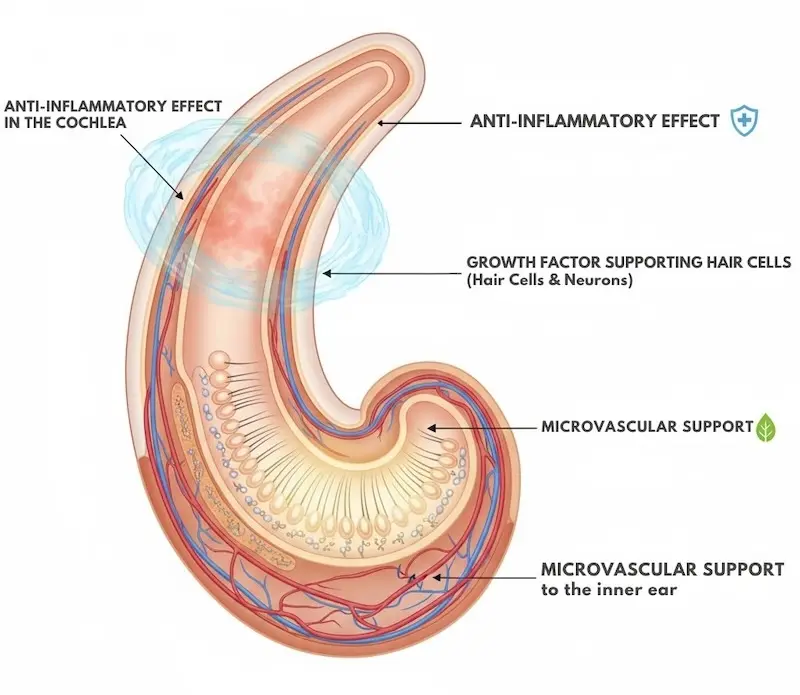
Three Mechanisms by Which MSCs May Affect Tinnitus
Mesenchymal stem cells, often abbreviated as MSCs, are not stem cells in the classical sense of being able to become any cell type. They are a specific population of cells with well-documented signalling properties. In animal studies of inner ear damage, three mechanisms have been most consistently described.
The first is anti-inflammatory action. The cochlea following noise trauma, ototoxic drug exposure, or infection enters an inflammatory state — immune cells migrate in, inflammatory cytokines rise, and tissue damage compounds. MSCs release signalling molecules that calm this inflammation, shifting the local immune environment from one driving further damage toward one supporting tissue maintenance. A 2021 study published in Frontiers in Cellular Neuroscience used RNA sequencing to show that human umbilical cord-derived MSCs injected into the cochleae of noise-exposed mice activated a broad gene expression pattern associated with tissue protection and inflammation control.
The second is paracrine support — the release of growth factors that support the survival of cells already under stress. Hair cells damaged but not yet dead, spiral ganglion neurons struggling after acoustic trauma, supporting cells under oxidative pressure: these populations may benefit from the trophic factors MSCs secrete. The mechanism is similar to what has been documented in MSC therapy for other conditions, including the inflammatory mechanisms that contribute to chronic autoimmune inflammation in rheumatoid arthritis.
The third is microvascular support. The inner ear depends on a delicate blood supply, and reduced cochlear perfusion has been implicated in some forms of tinnitus, particularly age-related and sudden-onset cases. MSCs release factors that support vascular health and may improve microcirculation in tissue that has been chronically under-supplied.
These three mechanisms do not, individually or together, regrow lost hair cells. They are about preserving and supporting what remains, calming the inflammatory environment that contributes to ongoing damage, and improving the conditions in which the cochlea functions. This distinction matters and we will return to it.
An Important Distinction: Stem Cells Cannot Regrow Hair Cells in Humans
This needs to be stated clearly because it is one of the most common misunderstandings in this field.
Some early stem cell research raised the possibility that transplanted cells could differentiate into new hair cells, replacing those lost to noise or age. In carefully controlled laboratory conditions and in some animal studies, partial differentiation has been achieved. In humans, with our current technology, reliable hair cell regeneration through stem cell therapy has not been demonstrated. Several research groups, including teams at Stanford and Rutgers, are working on this directly, but it remains experimental and is not what is offered in any clinical setting today, including ours.
What clinical stem cell therapy for tinnitus targets is different. It targets the inflammatory and microvascular environment of the inner ear, the survival of cells that are damaged but still alive, and the broader systemic factors — including chronic low-grade inflammation — that may contribute to tinnitus persistence. It does not promise hair cell regeneration. Anyone telling you it does is not being accurate about current science.
What the Research Currently Shows for Tinnitus Stem Cell Therapy
Preclinical Evidence in Cochlear Damage and Tinnitus Models
The strongest body of evidence for MSC therapy in inner ear conditions comes from animal studies. These are real findings, and they are worth taking seriously — but they are also not the same as proof that the therapy works in human tinnitus patients.
In studies using rats and mice exposed to noise sufficient to cause hearing loss, MSCs delivered via various routes have demonstrated protective effects on auditory function. Hair cell survival improves. Auditory brainstem response measurements (a standard test of how the auditory system processes sound) show better preserved hearing thresholds compared to control animals exposed to the same noise without MSC treatment.
A 2022 study published in Stem Cells International examined human embryonic stem cell-derived MSCs administered intravenously in rats exposed to severe noise trauma. The treated animals showed reduced threshold shifts on auditory brainstem response and better preserved cochlear morphology than untreated controls. Earlier work using bone marrow-derived MSCs delivered through trans-tympanic (across the eardrum) injection showed acceptable safety profiles in animal models without inducing inflammatory damage to the cochlea itself.
These findings establish biological plausibility. They do not establish clinical efficacy in humans with tinnitus, and we want to be clear about that distinction.
What the Limited Human Clinical Data Suggests
Compared to fields like cardiac stem cell therapy — where multiple randomised controlled trials with hundreds of patients have been published — the human data for stem cell therapy in tinnitus specifically is sparse.
Most published clinical reports on regenerative approaches in inner ear disease focus on sensorineural hearing loss rather than tinnitus as the primary outcome. Some smaller observational series and early-phase studies have included tinnitus severity questionnaires as secondary endpoints. The reported outcomes have been mixed: some patients have noted reductions in tinnitus loudness and distress in the months following MSC therapy, while others have shown no measurable change. Where improvements have been reported, they have generally been partial rather than complete, and the quality of evidence remains modest because of small sample sizes and the absence of controlled trial designs.
Harvard Stem Cell Institute and the International Society for Stem Cell Research have both stated publicly that there are currently no FDA-approved stem cell therapies for hearing loss or tinnitus, and that patients should be cautious about clinics making strong efficacy claims. We agree with that position. The honest framing is this: the biological rationale is reasonable, the preclinical evidence is encouraging, the early human signals are mixed, and rigorous large-scale clinical trials specifically targeting tinnitus have not yet been completed. That is where the field stands as of 2026.
This is meaningfully different from where the evidence stands for, say, knee osteoarthritis stem cell treatment, where multiple meta-analyses of randomised trials show consistent improvements in pain and function. Tinnitus is not at that stage of evidence, and we will not pretend it is.
Allogeneic vs. Autologous: Cell Source Considerations for Tinnitus
Why Cell Source Matters for Tinnitus Patients
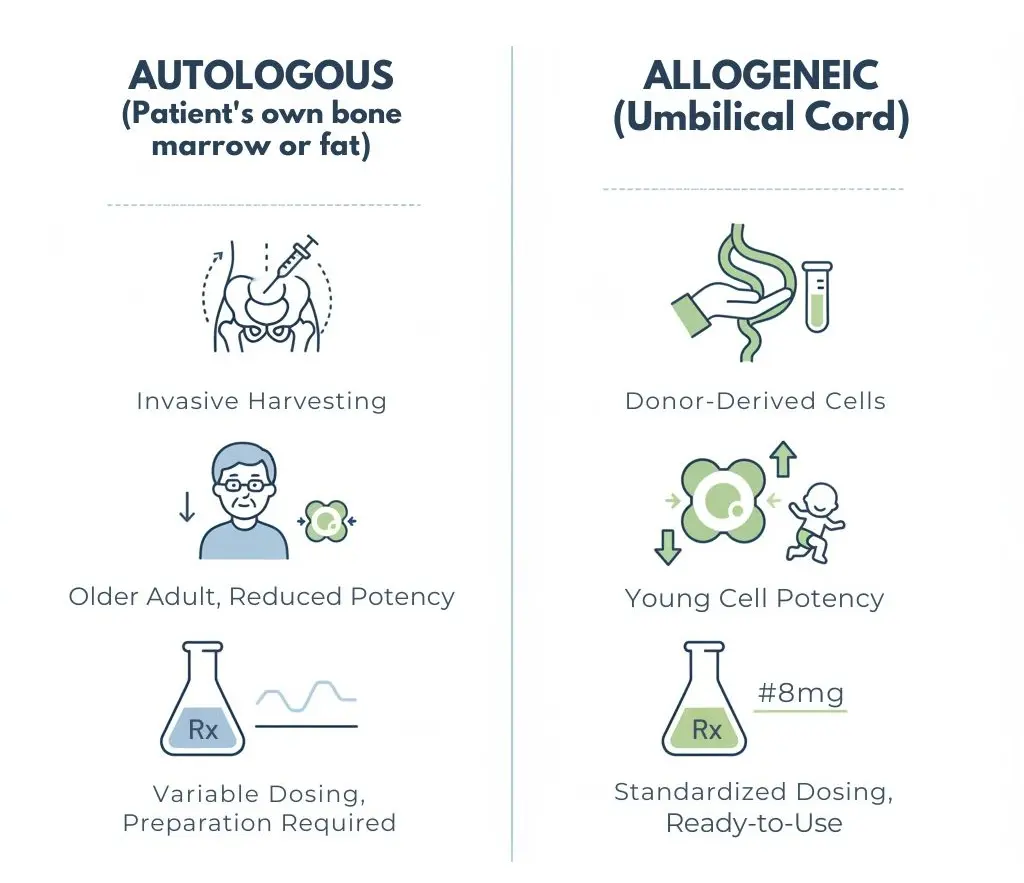
Stem cell therapy can use cells from the patient’s own body (autologous) or from a healthy donor (allogeneic). The distinction matters for tinnitus patients in some specific ways.
Autologous cells, typically harvested from a patient’s bone marrow or fat tissue, have the advantage of being immunologically identical to the patient — there is no risk of rejection. The disadvantages are practical and biological. The harvesting procedure is invasive. The cells must then be processed and expanded in a laboratory before use, which takes weeks. And critically for tinnitus, which is most common in adults over 50, the biological quality of the patient’s own MSCs declines with age. Older MSCs have reduced proliferative capacity, lower secretion of beneficial signalling molecules, and diminished anti-inflammatory potency. For a 65-year-old tinnitus patient, the cells available from their own bone marrow are genuinely less robust than the cells available from a healthy newborn cord donor.
Why We Use Allogeneic Umbilical Cord MSCs in Malaysia
The cells used in our protocol are derived from donated umbilical cord tissue (specifically the Wharton’s jelly layer surrounding the cord) collected at the time of healthy births with full donor consent. These cells are biologically young, highly active in their secretion of signalling molecules, and produced under controlled laboratory conditions in standardised batches.
Umbilical cord MSCs also have a useful immunological profile. They express low levels of the surface markers that ordinarily trigger immune rejection, which means rejection reactions in clinical use have been very rare. Across the broader MSC therapy literature — including the trials that exist for joint, cardiac, and autoimmune conditions — donor-derived umbilical cord MSCs have been shown to be well tolerated in adult recipients.
For tinnitus specifically, where the goal is to deliver cells with strong anti-inflammatory and trophic capacity into a system that may be dealing with chronic low-grade inflammation and aged microvasculature, the practical advantages of using young, potent, standardised donor cells are meaningful. Our Malaysia-based regulatory environment permits this approach within a structured medical practice framework.
That said, cell source is one variable among many in this field. Neither approach has been proven definitively superior for tinnitus specifically because the comparative head-to-head data does not yet exist. We use allogeneic cord MSCs because the available evidence and biological rationale favour it for our patient population, not because it has been definitively established as the best option.
Who Might Benefit from Tinnitus Stem Cell Therapy — and Who Probably Won’t
Tinnitus Profiles More Likely to Respond
We assess every patient for candidacy, and we will be candid here about the profiles where we think the biological logic is strongest.
Patients whose tinnitus has a clear association with recent or ongoing inner ear inflammation — for example, tinnitus following sudden sensorineural hearing loss, ototoxic medication exposure, or noise trauma within the past one to two years — are biologically more likely to benefit from an anti-inflammatory and supportive intervention. The cochlea may still be in a state where calming inflammation and supporting surviving cells could meaningfully change the trajectory.
Patients with tinnitus accompanying mild to moderate sensorineural hearing loss, where some hair cell function and significant viable cochlear tissue remains, are in a better biological position than those with profound, long-standing hearing loss. The therapy supports what is there. It does not bring back what is gone.
Patients with vascular or microcirculatory contributing factors — including those with controlled cardiovascular conditions where blood supply to the inner ear may be compromised — may benefit from the microvascular support that MSCs provide. The intersection between cardiovascular health and inner ear function is well-documented, and we have seen this overlap in our own clinical experience, similar to patterns we have observed in cardiac patients exploring regenerative approaches.
And patients who have realistic expectations matter enormously. The patients who tend to be best served by this treatment are those who understand that the goal is partial improvement of tinnitus loudness or distress over six to twelve months — not silence, not certainty, and not a quick result.
When We Honestly Advise Against Stem Cell Therapy for Tinnitus
There are tinnitus situations where we will tell a patient directly that we do not think this treatment is likely to help, and we want to be specific about which.
Patients with very long-standing tinnitus (more than five to ten years) where extensive central nervous system reorganisation has likely occurred are unlikely to benefit substantially. The peripheral mechanisms MSCs target may no longer be the dominant driver of the symptom.
Patients with profound bilateral hearing loss, where the cochlea has minimal viable sensory tissue remaining, do not have a biological substrate for this approach to work on. Cochlear implant evaluation is the more appropriate pathway in those cases.
Patients whose tinnitus is associated with conditions outside the inner ear — temporomandibular joint dysfunction, cervical spine issues, vascular tumours, or acoustic neuromas — need treatment of the underlying cause. Stem cell therapy will not address these.
Patients with active malignancy, severe systemic infection, or uncontrolled autoimmune disease have contraindications to MSC therapy that are independent of tinnitus.
And patients seeking a guaranteed cure or rapid silence will be poorly served by what this therapy realistically offers. We would rather have an honest conversation early than have a patient travel for treatment expecting an outcome the evidence cannot promise.
What Recovery After Tinnitus Stem Cell Therapy Looks Like
Patients should not expect immediate change. The first four to eight weeks after infusion typically feel no different than before treatment, and we tell every patient this in advance to prevent the discouragement that can otherwise set in.
When changes occur, they tend to emerge gradually between the second and sixth month. Patients who respond often describe the change as a reduction in the loudness of the tinnitus rather than its complete disappearance, or as a reduction in how much the tinnitus interferes with sleep and concentration. Some patients describe the emotional weight of the tinnitus lifting before the sound itself becomes quieter. Audiometric changes, when they occur, are typically modest and may take the full twelve months to become apparent.
A meaningful proportion of patients — based on the limited published data and our clinical experience — do not experience clear improvement. We do not currently have reliable predictors for who will and will not respond, and patients deserve to know this before deciding to proceed.
The Honest Risks and Limits of Tinnitus Stem Cell Therapy
Known Side Effects
The safety profile of intravenous allogeneic MSC therapy across the broader clinical literature has been generally favourable. The most commonly reported effects are mild and self-limiting: transient low-grade fever within the first 24 to 48 hours, mild fatigue, and occasional headache. These effects are thought to reflect the immune system’s recognition of donor cells and typically resolve without specific intervention.
Serious adverse events directly attributable to allogeneic MSC infusion have been uncommon in the published trials across multiple conditions, though cohort sizes specifically for tinnitus remain small. As with any cell therapy, theoretical risks include allergic reaction, infection at the infusion site, and longer-term effects that cannot yet be ruled out due to limited follow-up duration. We monitor patients in our program at regular intervals and contribute to the growing record of post-treatment outcomes.
For tinnitus patients with concurrent conditions — particularly those with significant cardiovascular disease, kidney impairment, or active autoimmune conditions — additional pre-treatment evaluation is required.
What Stem Cell Therapy Cannot Do for Tinnitus
The boundaries of this treatment matter as much as the potential.
Stem cell therapy cannot regenerate hair cells that have already died. If your tinnitus is associated with severe, long-standing sensorineural hearing loss where most of the cochlea’s sensory cells are gone, this treatment will not bring those cells back.
It cannot reliably silence tinnitus. The most realistic outcome for patients who respond is a reduction in loudness or distress, not a return to perceived silence.
It cannot address tinnitus arising from causes outside the inner ear — middle ear pathology, vascular abnormalities, mass lesions, jaw or neck-driven tinnitus, or tinnitus from medications still being taken.
It cannot replace ongoing audiological care. Patients who pursue stem cell therapy should continue working with their ENT specialist or audiologist, particularly if hearing aids or sound therapy are part of their existing management.
And it cannot be promised in terms of durability. The longest follow-up data in this field generally extends only one to two years. Whether benefits, if they occur, last beyond that, and whether re-treatment is appropriate or beneficial, are questions the field has not yet answered.
If you are seeking a guaranteed silence or rapid resolution, this is not the treatment for you. If you are looking for a biologically grounded option that may modestly improve a difficult situation, with realistic expectations and ongoing care alongside it, the conversation may be worth having.
FAQ About Tinnitus Stem Cell Therapy
Sound therapy and CBT work on perception and habituation — helping the brain pay less attention to the tinnitus signal. Stem cell therapy attempts to address the underlying biological state of the inner ear, including inflammation, cellular stress, and microvascular health. They are not substitutes for each other. Many patients who pursue stem cell therapy continue using sound therapy alongside it.
Yes. Hearing aids and stem cell therapy address different aspects of the condition. Hearing aids amplify external sound to compensate for hearing loss, which often reduces tinnitus perception. Stem cell therapy targets the cochlear environment. There is no biological reason they cannot be used together, and many patients benefit from continuing their hearing aid use throughout the stem cell treatment timeline.
The first four to eight weeks usually feel no different than before treatment. Changes, when they occur, typically emerge gradually between months two and six. The full effect, if any, may take up to twelve months to develop. Patients who notice no change at six months have generally not gone on to show significant changes at one year.
There is currently no FDA-approved or EMA-approved stem cell therapy specifically for tinnitus. Our treatment in Malaysia is conducted within Malaysia’s regenerative medicine framework as a regulated medical practice. Patients should understand the regulatory context of any country where they are considering this treatment, and we are happy to discuss this in detail during consultation.
Honest answer: we don’t have reliable long-term data to answer this with certainty. The longest published follow-up in the broader MSC therapy literature extends two to three years. For tinnitus specifically, that data is even more limited. Patients should not assume permanent improvement, and ongoing audiological care remains important regardless of treatment response.
Next Step
If you have read this far, you are likely someone who has lived with tinnitus long enough to be cautious about claims and careful about decisions. We respect that.
We offer free online consultations for tinnitus patients considering this option. The purpose of that conversation is to look at your specific situation honestly and tell you whether we think you fall within the profile where stem cell therapy might reasonably help — or whether you do not. If our honest assessment is that this treatment is unlikely to be meaningful for your case, we will tell you that. You are not committing to anything by reaching out other than the conversation itself.
References
- Jarach CM, Lugo A, Scala M, et al. “Global prevalence and incidence of tinnitus: a systematic review and meta-analysis.” JAMA Neurology. 2022;79(9):888–900. https://doi.org/10.1001/jamaneurol.2022.2189
- Scala M, Jarach CM, Garavello W, et al. “Urgent support is needed for more tinnitus research.” Journal of Global Health. 2025. https://doi.org/10.7189/jogh.15.03001
- Peyvandi AA, Roozbahany NA, Peyvandi H, et al. “Critical role of SDF-1/CXCR4 signaling pathway in stem cell homing in the deafened rat cochlea after acoustic trauma.” Neural Regeneration Research. 2018;13(1):154–160. https://doi.org/10.4103/1673-5374.224382
- Peyvandi AA, Abbaszadeh HA, Roozbahany NA, et al. “Deferoxamine promotes mesenchymal stem cell homing in noise-induced injured cochlea through PI3K/AKT pathway.” Cell Proliferation. 2018;51(2):e12434. https://doi.org/10.1111/cpr.12434
- Pyykkö I, Zou J, Schrott-Fischer A, Glueckert R, Kinnunen P. “An overview of nanoparticle based delivery for treatment of inner ear disorders.” Methods in Molecular Biology. 2016;1427:363–415. https://doi.org/10.1007/978-1-4939-3615-1_21
- Warnecke A, Harre J, Staecker H, et al. “Extracellular vesicles from human multipotent stromal cells protect against hearing loss after noise trauma in vivo.” Clinical and Translational Medicine. 2020;10(8):e262. https://doi.org/10.1002/ctm2.262
- Kwak SH, Lim JO, Baek SH, et al. “The protective effects of human embryonic stem cell-derived mesenchymal stem cells in noise-induced hearing loss of rats.” Stem Cells International. 2022;2022:5524993. https://doi.org/10.1155/2022/5524993
- Bermingham-McDonogh O, Reh TA. “Regulated reprogramming in the regeneration of sensory receptor cells.” Neuron. 2011;71(3):389–405. https://doi.org/10.1016/j.neuron.2011.07.015
- Park YH. “Stem cell therapy for sensorineural hearing loss, still alive?” Journal of Audiology and Otology. 2015;19(2):63–67. https://doi.org/10.7874/jao.2015.19.2.63
- Kanzaki S, Toyoda M, Umezawa A, Ogawa K. “Application of mesenchymal stem cell therapy and inner ear regeneration for hearing loss: a review.” International Journal of Molecular Sciences. 2020;21(16):5764. https://doi.org/10.3390/ijms21165764