

Peripheral Neuropathy Stem Cell Therapy | Targeting Nerve Damage, Not Just Pain Signals

The first thing you notice at night, when the house is finally quiet, is the burning. A slow, steady heat across the soles of your feet that no blanket and no position seems to ease. During the day, it is different. Your feet feel thick, distant, as though there is a layer of foam between your skin and the floor. You miss buttons on shirts because your fingertips no longer give you the feedback they once did. You drop a coin and have to look at it instead of feeling it in your palm.
If this is your experience, you are part of an estimated 190 million people worldwide living with some form of peripheral neuropathy. Roughly 2.4% of the global population is affected, and that figure rises to nearly 8% in adults over the age of 55. The single most common cause is diabetes — between 60% and 70% of people with type 1 or type 2 diabetes will eventually develop diabetic peripheral neuropathy. Other causes include chemotherapy, autoimmune conditions, vitamin deficiencies, alcohol-related damage, and a substantial number of cases where no clear cause is ever identified.
The standard treatment story is well known to anyone who has lived with this condition for more than a year or two. You begin with one medication for the nerve pain. The dose is adjusted upward over time. A second medication is added. Eventually you may also be taking a topical agent and an antidepressant repurposed for chronic pain. None of these address the underlying problem — damaged nerve fibers, lost blood supply to the small vessels feeding those nerves, and a chronic low-grade inflammatory environment. They address only the pain signals the nerves are sending.
This article is for people who have reached the point of asking whether anything can engage the underlying nerve damage rather than just the symptoms. We will go through what is currently known about stem cell therapy for peripheral neuropathy — including specific numbers from peer-reviewed clinical trials and meta-analyses, who the available evidence suggests is a realistic candidate, and where the honest limits of this approach lie.
Our team has been working in regenerative medicine in Malaysia for more than seven years, with over 200 patients treated across multiple conditions. We are direct about who this treatment is unlikely to help, and we do not describe it as a cure.
Table of Contents
- Why Damaged Peripheral Nerves Don't Repair Themselves Easily
- Where Standard Peripheral Neuropathy Treatments Reach Their Ceiling
- The Three Ways Stem Cells Engage Damaged Peripheral Nerves
- What Clinical Studies Have Reported on Peripheral Neuropathy Stem Cell Therapy
- Cell Source Matters: Why Allogeneic Cord MSCs Are Used in Malaysia for Peripheral Neuropathy
- One Patient's Six-Month Journey With Peripheral Neuropathy Stem Cell Therapy
- Who Is and Is Not a Candidate for Peripheral Neuropathy Stem Cell Therapy
- Honest Risks and What Stem Cell Therapy Cannot Do for Peripheral Neuropathy
- FAQ About Peripheral Neuropathy Stem Cell Therapy
- If You're Weighing Your Options for Peripheral Neuropathy
- References
Why Damaged Peripheral Nerves Don’t Repair Themselves Easily
The Slow, Limited Biology of Peripheral Nerve Repair
Peripheral nerves do, in principle, have a capacity to regenerate that central nervous system tissue does not. After an acute injury such as a clean nerve cut, axons can sprout from the proximal stump and grow along the path laid down by Schwann cells — the support cells of the peripheral nervous system — toward their original targets. In a young person with good blood supply and a small gap, this process can be effective.
The trouble is that most peripheral neuropathy is not a clean acute injury. It is a slow, diffuse, length-dependent process driven by chronic metabolic stress, microvascular insufficiency, or sustained immune dysregulation. The nerves are not being cut; they are being eroded over years from the longest fibers inward — which is why symptoms typically start in the toes and move upward, and why the longest sensory fibers (those reaching to the soles of the feet) are usually the first to fail.
When the supporting environment is sick — when the small blood vessels (vasa nervorum) feeding the nerves are damaged, when oxidative stress is high, when the local inflammatory tone is chronically elevated — the Schwann cells cannot maintain the growth-permissive environment that axon regrowth requires. Repair signals fade. Axons that try to grow do not find an intact substrate to grow along. Over time, fiber loss accumulates faster than fiber repair.
How the Loss of Small Nerve Fibers in Peripheral Neuropathy Becomes Self-Reinforcing
Intraepidermal nerve fiber density — the number of small sensory fibers reaching into the skin — is one of the most precise measures of peripheral neuropathy severity. In diabetic peripheral neuropathy and several other forms, this density steadily declines, often years before symptoms become severe.
The decline is self-reinforcing. As small fibers die, the local production of growth factors and protective signals also falls. The remaining fibers receive less trophic support and become more vulnerable. Blood flow to the nerves, already compromised, deteriorates further because the signals that normally maintain capillaries in the perineural tissue are weakened. This is the underlying biology that explains why peripheral neuropathy tends to progress steadily despite good blood sugar control, and why the structural picture rarely improves on conventional treatment alone.
Where Standard Peripheral Neuropathy Treatments Reach Their Ceiling
What Anticonvulsants and Antidepressants Can — and Cannot — Do for Peripheral Neuropathy
The pharmacological mainstay of peripheral neuropathy management consists of medications that modulate how pain signals are transmitted and processed: gabapentin and pregabalin (originally developed as anticonvulsants), duloxetine (an antidepressant), and various topical agents such as capsaicin or lidocaine patches. For some patients, particularly in the early years of the condition, these medications meaningfully reduce burning, tingling, and shooting pain.
They share, however, one important characteristic: they act on pain signaling, not on the nerves themselves. A nerve fiber that is dying continues to die while gabapentin is in your system. The medication makes the pain it generates feel less intense, but it does not slow fiber loss, restore blood supply to the nerve, or stimulate the local repair processes. This is why, for many patients, the dose creeps upward over the years — not because the medication has become weaker, but because the underlying neuropathy has continued to progress.
Side effects also accumulate. Dose-dependent drowsiness, cognitive blunting, weight gain, dizziness, and dependency risk are all documented with gabapentinoids. Duloxetine can affect blood pressure and produce withdrawal symptoms when stopped. These effects are tolerable for many patients, but they affect quality of life in their own right.
Why Tight Glucose Control Helps but Doesn’t Reverse Diabetic Peripheral Neuropathy
For patients whose neuropathy is driven by diabetes, the cornerstone advice is tight glycemic control. This is not wrong advice — landmark trials including the DCCT have shown that intensive glucose management substantially reduces the incidence of new peripheral neuropathy in type 1 diabetes, and slows progression in established cases.
What good glucose control does not reliably do is reverse damage that has already occurred. By the time a patient has clinically significant peripheral neuropathy with reduced nerve conduction velocity and reduced intraepidermal nerve fiber density, glycemic control protects against further deterioration but rarely restores lost function. The longer-standing the neuropathy, the wider this gap tends to be.
This intersection between diabetes and microvascular damage extends well beyond the nerves. Many patients with long-standing type 2 diabetes face simultaneous challenges with cardiac function and microvascular health — the same biological context in which approaches like stem cell therapy for heart failure have been actively studied. The two conditions often share an underlying microvascular and inflammatory profile.
The Three Ways Stem Cells Engage Damaged Peripheral Nerves
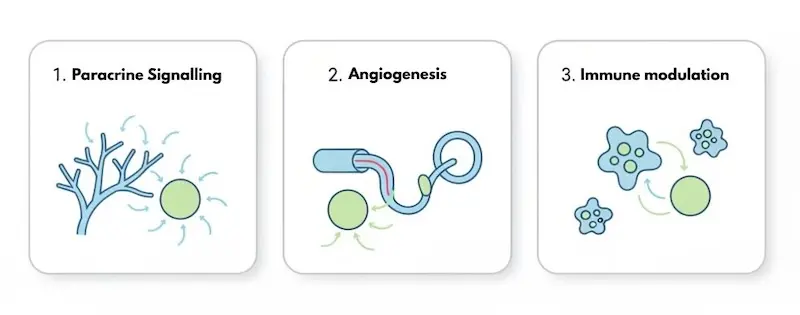
Paracrine Signaling and Neurotrophic Support in Peripheral Neuropathy
Mesenchymal stem cells, commonly abbreviated as MSCs, are the cell type used in most clinical research on peripheral neuropathy. They are not nerve cells, and the older idea that they would simply transform into new nerve fibers and rebuild lost circuitry has not been supported by the evidence accumulated over the past two decades.
What MSCs do appears to be different and arguably more interesting. They release a broad spectrum of signaling molecules — neurotrophic factors such as nerve growth factor (NGF), brain-derived neurotrophic factor (BDNF), and glial cell-derived neurotrophic factor (GDNF), along with various cytokines and exosomes carrying genetic regulatory material. These signals are precisely the molecules that support Schwann cell function, axonal survival, and the local repair environment around damaged nerves.
In animal models of diabetic peripheral neuropathy, this paracrine signaling has been associated with measurable increases in intraepidermal nerve fiber density and improved axon morphology. In clinical studies, it correlates with the changes in nerve conduction velocity discussed in the next section.
Restoring Blood Supply to Peripheral Nerves Through Angiogenesis
The second mechanism is angiogenesis — the formation of new small blood vessels. This matters enormously in peripheral neuropathy because the nerves rely on a network of microvessels (the vasa nervorum) that is often the first thing to fail in diabetic, vasculitic, and several other forms of the condition. Once blood supply to a nerve falls below a certain level, the nerve cannot maintain itself regardless of what other therapies are tried.
MSCs secrete vascular growth factors that recruit and organize new capillaries in tissue. In published preclinical studies, MSC treatment in diabetic neuropathy has been associated with significant increases in sciatic nerve blood flow and capillary-to-muscle fiber ratio. The clinical relevance is straightforward: restoring blood supply gives the remaining nerve tissue the metabolic support it needs to function and, where possible, to repair.
Reducing Inflammation in the Peripheral Nerve Environment
Chronic low-grade inflammation contributes to peripheral nerve damage in essentially every cause of peripheral neuropathy — metabolic, autoimmune, and traumatic. The signals from activated immune cells damage neighboring nerve fibers and disrupt the supporting tissue.
MSCs are well-documented immune modulators. They shift macrophage activity from a pro-inflammatory profile toward a tissue-repair profile, suppress excessive T-cell activation, and reduce local production of inflammatory cytokines such as TNF-alpha and interleukin-6. The mechanisms overlap considerably with how stem cell therapy for rheumatoid arthritis engages immune dysregulation, even though the target tissues differ. In peripheral neuropathy, the result is a less hostile local environment for the surviving nerve fibers.
These three mechanisms do not act independently. The same cells deliver neurotrophic support, vascular signals, and immune modulation simultaneously — which is part of why MSC therapy has been investigated across so many neuropathy subtypes.
What Clinical Studies Have Reported on Peripheral Neuropathy Stem Cell Therapy
Meta-Analysis Data on Nerve Conduction Recovery in Peripheral Neuropathy
The most comprehensive recent review of human clinical evidence is a systematic review and meta-analysis by Alizadeh and colleagues, published in Stem Cell Research & Therapy in 2024. The analysis screened 5,431 records and included seven controlled human trials, primarily focused on diabetic peripheral neuropathy. The cell types studied were bone marrow-derived mononuclear cells and umbilical cord-derived mesenchymal stem cells, administered mainly via intramuscular injection into the calves of affected lower limbs.
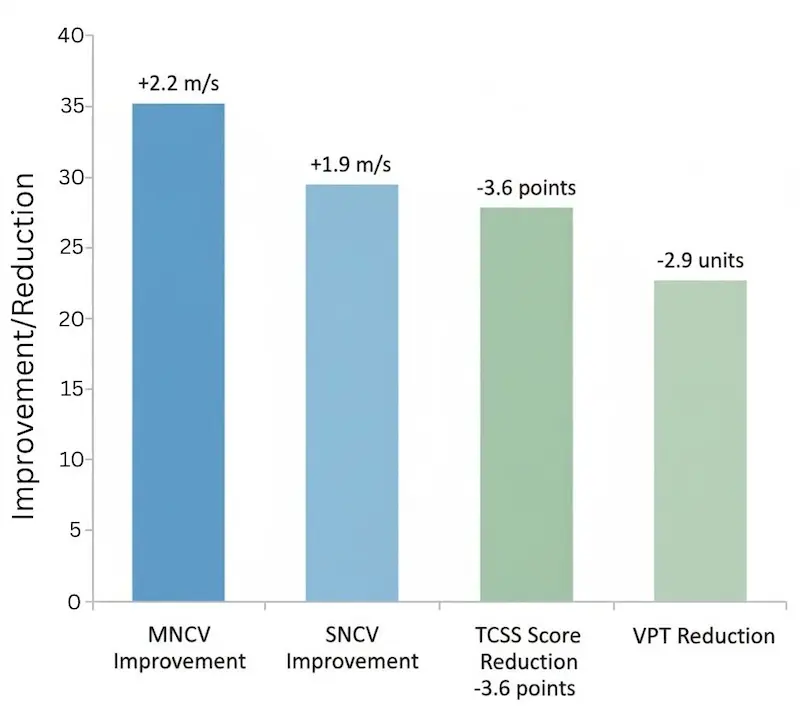
The pooled findings were specific. Motor nerve conduction velocity — a direct electrophysiological measure of how efficiently signals travel along a motor nerve — improved by a weighted mean difference of 2.2 m/s (95% confidence interval 1.6 to 2.8 m/s) compared to controls. Sensory nerve conduction velocity improved by a weighted mean difference of 1.9 m/s (95% confidence interval 1.1 to 2.6 m/s). The Toronto Clinical Scoring System, a standardized 0-to-19 measure of peripheral neuropathy severity that combines symptoms, reflexes, and sensory testing, decreased by a weighted mean difference of 3.6 points (95% confidence interval -5.0 to -2.2). Vibration perception threshold — a measure of large-fiber sensory function — decreased by 2.9 units (95% confidence interval -4.0 to -1.8).
In plain terms, the average treated patient in these trials showed measurable improvements in how their nerves conducted electrical signals and how they perceived sensation, not just in how they reported their pain.
Longer-Term Outcomes and Specific Trials on Diabetic Peripheral Neuropathy
A randomized controlled trial conducted at Nanyang Medical College in China enrolled 112 patients with type 2 diabetes and peripheral neuropathy, dividing them into a treatment group receiving bone marrow mesenchymal stem cell therapy and a conventional therapy control group. At three-year follow-up, the symptom effective rate was 84% in the treated group compared with 43% in controls. Average limb nerve conduction velocity was 52.75 m/s in the treated group compared with 41.32 m/s in controls.
A separate randomized study published in Stem Cell Research & Therapy in 2024 followed patients with type 2 diabetes receiving combined bone marrow mesenchymal stem cell and mononuclear cell therapy out to eight years. The longer-term follow-up addressed one of the field’s open questions — whether early gains hold up over time — and reported sustained benefits in glycemic control and complications related to diabetes.
A smaller study on neuropathic trigeminal pain reported a reduction in mean pain score from 7.5 to 4.3 on a 0-to-10 scale at six months following stem cell injection, accompanied by reduced reliance on antineuropathic pain medications.
What Realistic Improvement Looks Like in Peripheral Neuropathy Stem Cell Therapy
We want to be specific about what these numbers actually mean for a person living with peripheral neuropathy, because vague or selective reporting helps no one.
An MNCV improvement of 2.2 m/s is biologically meaningful — it represents partial recovery of electrical conduction along a damaged nerve — but it does not represent return to normal. A TCSS reduction of 3.6 points typically corresponds to moving a patient from “moderate” to “mild” severity, or from “mild” to “minimal,” depending on starting point. The pattern across most studies is gradual improvement that becomes detectable between three and six months and continues to develop through the first year.
Not every patient responds. Based on the trials included in the Alizadeh meta-analysis and our own clinical experience, a meaningful minority of treated patients — somewhere in the range of 20 to 30 percent — do not achieve clinically significant improvement. We cannot yet reliably predict in advance which patients will fall into the responder versus non-responder group, although several pre-treatment factors discussed below appear to matter.
Cell Source Matters: Why Allogeneic Cord MSCs Are Used in Malaysia for Peripheral Neuropathy
Autologous Bone Marrow MSCs for Peripheral Neuropathy and Their Limits
In Japan, the regenerative medicine regulatory framework primarily permits autologous stem cell therapy — meaning cells harvested from the patient’s own bone marrow or fat tissue, processed, and then re-administered. The immunological advantage is straightforward: there is no rejection concern because the cells are genetically the patient’s own.
The disadvantage, particularly in peripheral neuropathy, is that the patient’s own cells reflect their underlying health status. The bone marrow MSCs of a 65-year-old with twenty years of poorly controlled type 2 diabetes are functionally compromised compared with those of a healthy young donor. They produce fewer growth factors, have lower proliferative capacity, and show reduced potency in the very signaling pathways — neurotrophic support, angiogenesis, anti-inflammatory action — that peripheral neuropathy treatment relies on. This is not theoretical; multiple comparative studies have documented these reductions in MSCs from patients with established metabolic disease.
Allogeneic Umbilical Cord MSCs in Malaysia: What Changes for Peripheral Neuropathy
The cells we use in our Malaysia-based program are allogeneic umbilical cord-derived MSCs. They come from the Wharton’s jelly layer of donated umbilical cords from healthy newborns, with full donor consent at the time of delivery. These cells are biologically young, have not been exposed to the cumulative metabolic and inflammatory stressors that affect adult tissue-derived cells, and demonstrate measurably higher production of the growth factors and signaling molecules most relevant to nerve repair.
Umbilical cord MSCs also have the practical advantage of being prepared in standardized, quality-controlled batches. Each preparation is tested for viability, potency, and contaminants before use, which means the dose a patient receives is defined and consistent rather than dependent on the variable yield of bone marrow aspiration. Their low immunogenicity — meaning they express low levels of the surface markers that ordinarily trigger immune rejection — has been documented across a wide range of trials, including those involving repeated infusions.
For a peripheral neuropathy patient whose own marrow is operating in the context of decades of metabolic disease, this difference in cell source is not just technical. It directly affects the quality and quantity of the signals that reach the damaged nerve tissue.
One Patient’s Six-Month Journey With Peripheral Neuropathy Stem Cell Therapy
A man in his early sixties, diagnosed with type 2 diabetes for eighteen years, had developed progressive peripheral neuropathy over the previous seven years. By the time he consulted us in 2025, his symptoms included near-constant burning in both feet from the ankles down, numbness across the soles severe enough that he had begun to misstep on uneven surfaces, and night pain that woke him most nights. He was taking pregabalin at near-maximum dose and duloxetine, with limited relief. His HbA1c was reasonably controlled at 7.2%. His TCSS score at evaluation was 13, in the moderate-to-severe range.
He was clear-eyed before treatment: he had read the meta-analysis data, understood that response was not guaranteed, and was not expecting miracles. He proceeded with allogeneic umbilical cord-derived MSC therapy delivered both intravenously and via intramuscular injection into the calves of both lower legs over a one-week visit to Malaysia.
The first month produced little perceptible change, which we had warned him to expect. Around week ten, he reported that his night pain was less consistent — some nights he slept through, others he did not. By the four-month mark, he described the burning in his feet as “less hot,” and his pregabalin dose had been reduced under his rheumatologist’s supervision. At the six-month follow-up, his TCSS score had decreased to 9. Nerve conduction studies showed modest but measurable improvement in sural sensory conduction velocity. He continued his diabetes management without modification.
He did not return to having normal sensation in his feet. He still uses pregabalin, at a lower dose. The improvement, in his words, was “less about being free of symptoms and more about getting back below the threshold where every day is dominated by them.”
This account is anonymized and reflects one patient’s experience with consent. Individual results vary considerably, and a substantial minority of patients with similar baseline profiles do not experience comparable improvement.
Who Is and Is Not a Candidate for Peripheral Neuropathy Stem Cell Therapy
Profiles That Tend to Respond to Peripheral Neuropathy Stem Cell Therapy
The patients in our program who tend to show the clearest benefit share several characteristics. They have a confirmed diagnosis of peripheral neuropathy — most often diabetic, but increasingly also chemotherapy-induced, idiopathic, or related to chronic inflammatory conditions — established for at least six months. They have moderate symptom severity, typically with TCSS scores in the 6–14 range, where there is still meaningful nerve tissue to support and protect.
They are not in acute medical instability. For diabetic patients, glycemic control is reasonably consistent (HbA1c generally below 8.5%), because actively uncontrolled hyperglycemia continues to damage nerves faster than any treatment can repair them. They are willing to accept a gradual timeline — typical first changes between three and six months — rather than expecting immediate relief. And they understand that conventional treatment is not paused: pregabalin, duloxetine, antidiabetic medications, and other ongoing management remain in place under their primary physician’s direction.
Patients with chemotherapy-induced peripheral neuropathy who have completed their oncology treatment and are in remission represent another responsive profile, particularly when the symptoms emerged within the prior two years.
When Peripheral Neuropathy Stem Cell Therapy Is Unlikely to Help
There are situations in which we advise against this treatment because the likely benefit does not justify the cost, travel, and time involved.
Patients with very advanced peripheral neuropathy, where loss of protective sensation has already progressed to ulceration or where motor weakness is severe enough to affect walking, generally have too little remaining nerve tissue to expect meaningful structural recovery. The conversation at that stage is more appropriately about wound care, podiatric protection, and prevention of further damage.
Patients with poorly controlled blood glucose — HbA1c above approximately 9% — are not good candidates until their diabetes is brought under tighter control, because the underlying driver of nerve damage remains active. Patients with active malignancy, uncontrolled systemic infection, or active autoimmune flares should not undergo MSC therapy until those conditions are stabilized.
Hereditary forms of peripheral neuropathy, such as Charcot-Marie-Tooth disease, have a different underlying biology — a genetic abnormality in nerve or myelin proteins — and there is currently insufficient evidence that MSC therapy meaningfully changes their trajectory.
Finally, patients who require rapid relief because of immediate professional or personal obligations are usually not well-matched to a treatment whose first noticeable effects typically take three months or more to emerge.
What Recovery and Follow-Up Look Like After Peripheral Neuropathy Stem Cell Therapy
Step four is the short post-treatment observation period. Most patients are comfortable returning to their accommodation the same day. Mild soreness at the intramuscular injection sites, occasional low-grade fever within the first 48 hours, and transient fatigue are the most commonly reported effects, and they typically resolve within a few days without medical intervention. Most patients can travel home within two to three days of the procedure.
Step five is structured follow-up. We conduct remote follow-up consultations at one month, three months, six months, and twelve months after treatment. At each follow-up, patients complete standardized assessments — pain scores, TCSS, and where available repeat nerve conduction studies — creating a documented record of their response over time. We do not encourage patients to make medication changes unilaterally during this period; any reduction in pregabalin, gabapentin, or other treatments should be discussed with the prescribing physician.
Honest Risks and What Stem Cell Therapy Cannot Do for Peripheral Neuropathy
Documented Side Effects in Peripheral Neuropathy Stem Cell Trials
Across published peripheral neuropathy stem cell trials, the safety profile has been generally favorable. The Alizadeh meta-analysis, which pooled outcomes from seven controlled human trials, reported that the most common complications were pain and swelling at the injection sites, both of which resolved within days. No serious adverse events were directly attributed to the cells across the included studies.
Allogeneic umbilical cord MSCs have low immunogenicity, meaning the rate of immune reactions to donor cells has been very low across thousands of patient-years of accumulated use in cardiac, autoimmune, and neurological indications. Mild transient fever in the 24–48 hours following infusion is reported in a minority of patients, reflecting the immune system’s recognition of the donor cells rather than an active infection.
Long-term safety data beyond five years remains relatively limited in peripheral neuropathy specifically, although the longest follow-up studies in adjacent fields have now extended to eight years without emergent safety signals. We disclose this directly to every patient: the field is approximately fifteen years into clinical-stage research, which is enough to identify common and intermediate-term risks but not enough to claim certainty about decade-plus outcomes.
What Peripheral Neuropathy Stem Cell Therapy Cannot Do
This section matters as much as any other.
Stem cell therapy cannot regrow nerve fibers in a foot where small-fiber density has fallen below a critical threshold. Once peripheral nerves have been almost entirely lost — as in advanced diabetic neuropathy with established neuropathic foot ulceration — the biology has moved beyond the window in which MSC therapy is most likely to provide benefit.
It cannot replace blood sugar control. For patients with diabetic peripheral neuropathy, glycemic management remains the cornerstone of preventing further nerve damage, and stem cell therapy is an addition to it, not a substitute. We do not accept patients who plan to discontinue their antidiabetic medications, and we do not adjust those medications ourselves.
It cannot reverse pain that is being driven by structural problems outside the nerves themselves — such as severe spinal stenosis compressing nerve roots, or significant lumbar disc disease causing radicular symptoms that mimic peripheral neuropathy. Patients whose primary problem turns out to be lumbar in origin may be better served by approaches discussed in our article on stem cell therapy for low back pain, which engages a different anatomical pathway.
And it cannot guarantee response. Approximately one in four to one in three patients with otherwise suitable clinical profiles do not experience significant improvement. We do not yet have reliable biomarkers that predict response in advance. Patients who enter the process understanding this are better positioned to evaluate their own outcome honestly when it emerges.
FAQ About Peripheral Neuropathy Stem Cell Therapy
Gabapentin and pregabalin modulate how pain signals are transmitted through the nervous system. They reduce the felt intensity of pain without affecting the underlying nerve damage. Stem cell therapy attempts to engage the underlying tissue — the damaged nerves, their blood supply, and the local inflammatory environment — through paracrine signaling, angiogenesis, and immune modulation. The two approaches address different layers of the problem and are not interchangeable; in our program, patients typically continue their conventional medications under their physician’s direction.
The largest body of clinical evidence covers diabetic peripheral neuropathy. There is also growing data on chemotherapy-induced peripheral neuropathy, idiopathic small fiber neuropathy, and certain inflammatory neuropathies, with smaller studies and case series suggesting benefit through similar mechanisms. We assess each non-diabetic case individually and are direct when the evidence base for a particular condition is thinner than for diabetic forms.
Most patients spend approximately one week in Malaysia. The treatment itself, including intravenous infusion and intramuscular injections, is completed in a single day. The remainder of the visit covers pre-treatment assessment, observation, and post-treatment recovery before flying home.
No. Maintaining your existing diabetes management during and after treatment is essential, because uncontrolled hyperglycemia continues to damage peripheral nerves regardless of any other therapy. Any medication changes should be made only by your prescribing physician based on glucose monitoring data.
Published studies have followed treated patients out to three years routinely and, in some cases, eight years, with sustained or stable improvements in nerve conduction and symptom scores reported across these intervals. The optimal interval, if any, for repeat treatment in peripheral neuropathy is not yet definitively established. We discuss this with each patient at the twelve-month follow-up based on their individual trajectory.
If You’re Weighing Your Options for Peripheral Neuropathy
If you have read this far, you are probably someone who has already lived with peripheral neuropathy long enough to know what current medications can and cannot do — and who is genuinely trying to assess whether something different makes sense for your specific situation. That position is more common than it sometimes feels, and the questions you are asking are reasonable ones.
We offer free online consultations for this kind of conversation. The goal is not to push you toward treatment but to look at your specific picture — your recent labs, your nerve conduction studies if you have them, your medication history — and tell you honestly whether we think you fall within the range where this approach has shown evidence of benefit. If the honest answer is that you do not, we will say so. You do not need to have made any decisions before reaching out.
References
- Alizadeh SD, Jahani S, Rukerd MRZ, Tabrizi R, Masoomi R, Banihashemian SZ, et al. “Human studies of the efficacy and safety of stem cells in the treatment of diabetic peripheral neuropathy: a systematic review and meta-analysis.” Stem Cell Research & Therapy. 2024;15(1):442. https://doi.org/10.1186/s13287-024-04033-3
- Alizadeh SD, Hassan Zadeh Tabatabaei MS, Rukerd MRZ, Tabrizi R, Masoomi R, Banihashemian SZ, et al. “The safety and efficacy of stem cell therapy for diabetic peripheral neuropathy in animal studies: A systematic review and meta-analysis.” Neuroscience. 2025;566:49–59. https://doi.org/10.1016/j.neuroscience.2024.12.035
- Li Y, Yue G, Yu S, Cheng X, Cao Y, Wang X. “Evaluating the efficacy of mesenchymal stem cells for diabetic neuropathy: A systematic review and meta-analysis of preclinical studies.” Frontiers in Bioengineering and Biotechnology. 2024;12:1349050. https://doi.org/10.3389/fbioe.2024.1349050
- Wu Z, Huang S, Li S, et al. “Bone marrow mesenchymal stem cell and mononuclear cell combination therapy in patients with type 2 diabetes mellitus: a randomized controlled study with 8-year follow-up.” Stem Cell Research & Therapy. 2024;15(1):339. https://doi.org/10.1186/s13287-024-03907-w
- Zhou JY, Zhang Z, Qian GS. “Mesenchymal stem cells to treat diabetic neuropathy: a long and strenuous way from bench to the clinic.” Cell Death Discovery. 2016;2:16055. https://doi.org/10.1038/cddiscovery.2016.55
- Hakim M, Kurniani N, Pinzon R, Tugasworo D, Basuki M, Haddani H, et al. “A Review on Prevalence and Causes of Peripheral Neuropathy and Treatment of Different Etiologic Subgroups with Neurotropic B Vitamins.” Journal of General Practice. 2018.
- Lu Y, Xing P, Cai X, Luo D, Li R, Lloyd C, et al. “Prevalence and Risk Factors for Diabetic Peripheral Neuropathy in Type 2 Diabetic Patients From 14 Countries: Estimates of the INTERPRET-DD Study.” Frontiers in Public Health. 2020;8:534372. https://doi.org/10.3389/fpubh.2020.534372
- Montagnoli TL, Santos AD, Sudo SZ, Gubert F, Vasques JF, Mendez-Otero R, et al. “Perspectives on Stem Cell Therapy in Diabetic Neuropathic Pain.” Neurology International. 2024;16(5):933–944. https://doi.org/10.3390/neurolint16050070
- Hopf A, Schaefer DJ, Kalbermatten DF, Guzman R, Madduri S. “Schwann Cell-Like Cells: Origin and Usability for Repair and Regeneration of the Peripheral and Central Nervous System.” Cells. 2020;9(9):1990.