
Long COVID Stem Cell Therapy | Can the Fatigue and Brain Fog Actually Improve?
The morning starts later than it used to. By the time the coffee is finished, the brain has already begun to fog. A 20-minute work meeting feels like running a half-marathon. The walk to the mailbox that you used to do without thinking now ends in a sit-down to catch your breath. And every time you try to push through, the next day pays the price.
If that pattern sounds familiar, you are among the estimated 65 million people worldwide living with Long COVID — the multisystemic condition that follows acute COVID-19 infection in roughly 36% of cases globally. Among hospitalized COVID-19 patients, the rate is 44%; among non-hospitalized patients, 29%. The condition does not appear to be resolving on its own at a population level — studies tracking patients between one and two years post-infection report prevalence rates of 47%, higher than at earlier follow-up.
Most Long COVID patients who come to us have already done the work. They have been through rehabilitation programs, tried symptom-directed medications, adjusted their diet, paced their activity, and worked with multiple specialists. They have improved from their worst point — but they have plateaued. The fatigue is still there. The cognitive symptoms have not fully cleared. They are functioning, but at 50% or 60% of who they used to be.
This article is written for people in that position: those who have done the conventional work and are now asking whether anything else exists that could address the underlying biology, not just manage symptoms. We will walk through what the current clinical trial data actually shows, how stem cell therapy is thought to work in Long COVID, who tends to respond and who does not, and where the honest limits are.
Our clinical team has been working in regenerative medicine in Malaysia for over seven years, with more than 200 patients treated using allogeneic umbilical cord-derived mesenchymal stem cells. We do not believe this treatment is right for every Long COVID patient, and we will explain why.
Table of Contents
- Why Long COVID Persists Long After the Virus Is Gone
- The Three Leading Biological Theories Behind Long COVID
- Where Conventional Long COVID Care Reaches Its Limits
- How Mesenchymal Stem Cells Address Long COVID's Root Biology
- What Clinical Trial Data Shows About Long COVID Stem Cell Therapy
- Comparing Cell Sources: Why Allogeneic Cord MSCs for Long COVID
- Who Tends to Respond to Long COVID Stem Cell Therapy
- A Long COVID Patient's Account of Recovery After Stem Cell Therapy
- Honest Risks and Limitations of Long COVID Stem Cell Therapy
- FAQ About Long COVID Stem Cell Therapy
- Ready to Talk About Your Long COVID Recovery Options
- References
Why Long COVID Persists Long After the Virus Is Gone
The Biology of Why Long COVID Symptoms Don’t Self-Resolve
Long COVID is not an active infection. In most patients, the virus itself was cleared months or years ago. What remains is a state of biological dysregulation — multiple systems in the body that responded to the acute infection and never fully reset to their pre-infection baseline.
Think of the body’s response to a serious infection like a citywide emergency response. Sirens activate, traffic lights change, hospitals shift into surge mode. In a normal infection, when the threat passes, the systems stand down — sirens silence, hospitals demobilize, traffic returns to normal. In Long COVID, something fails in this stand-down process. The immune system remains in a low-grade alert state. Blood vessels remain partially constricted or damaged at the microscopic level. The mitochondria — the small structures inside each cell that produce energy — operate below their normal capacity. The autonomic nervous system, which regulates heart rate and blood pressure without conscious input, behaves erratically.
Each of these systems has a feedback loop with the others. An immune system stuck in alert mode releases inflammatory signals that further damage blood vessels. Damaged blood vessels reduce oxygen delivery to mitochondria, worsening energy production. Reduced energy production stresses the autonomic nervous system. The dysregulation reinforces itself.
How Long COVID Differs From Recovery After Other Viral Infections
After a typical flu or a head cold, the body returns to baseline within one to three weeks. The acute symptoms resolve, the immune system stands down, energy returns, and life continues. The body’s recovery systems handle the situation without requiring any special intervention.
Long COVID is fundamentally different. The damage is not localized to a single tissue that can heal — it is diffuse, occurring at the level of cellular signaling across multiple organ systems simultaneously. A single patient may have fatigue (mitochondrial and immune dysfunction), brain fog (microvascular and inflammatory effects in the central nervous system), shortness of breath (lung tissue damage plus cardiovascular effects), heart palpitations (autonomic dysfunction), and joint pain (immune-driven inflammation), all from one infection. There is no biological mechanism in the body that resets all of these systems together. This is why so many patients improve to a point and then stop improving.
The Three Leading Biological Theories Behind Long COVID
Theory 1: Viral Persistence and Lingering Inflammation in Long COVID
Some researchers believe that small reservoirs of SARS-CoV-2 — either the live virus or fragments of viral proteins and genetic material — persist in tissues throughout the body for months or years after the initial infection. Even when active replication has stopped and standard tests show no detectable virus in the bloodstream, these reservoirs may continue to provoke the immune system, keeping the inflammatory cycle going.
This theory helps explain why many Long COVID patients show measurable inflammation on blood tests long after their acute illness has resolved.
Theory 2: Immune Dysregulation and Autoimmunity in Long COVID
A second theory holds that the immune system, after mounting a vigorous defense against a novel virus, fails to properly demobilize. It remains in an activated state, producing inflammatory cytokines (chemical messengers between immune cells that drive inflammation) continuously. In a subset of patients, the dysregulation goes further and produces autoantibodies — antibodies that mistakenly target the patient’s own healthy tissues. This is similar to what happens in established autoimmune diseases, where the immune system’s misidentification of self-tissue drives chronic damage.
For patients with this profile, the immune dysregulation in Long COVID shares mechanistic features with conditions like rheumatoid arthritis, where chronic immune activation against joint tissue produces persistent symptoms.
Theory 3: Microvascular Damage and Microclots in Long COVID
The third leading theory focuses on the blood vessels themselves. COVID-19 is now well established as a vascular disease, not purely a respiratory one. Many Long COVID patients have been shown to have microscopic blood clots (microclots) circulating in their bloodstream and damage to the endothelium — the single-cell layer that lines the inside of every blood vessel.
When blood flow is impaired at the level of the smallest vessels (capillaries), tissues throughout the body receive less oxygen and fewer nutrients than they need. This can explain a constellation of Long COVID symptoms: brain fog (poor cerebral perfusion), exercise intolerance (poor muscle oxygenation), cold extremities (poor peripheral circulation), and the post-exertional malaise that follows even mild physical activity.
These three theories are not mutually exclusive. In most Long COVID patients, all three appear to be operating to some degree, in varying combinations. This is one reason why a single drug targeting one pathway is unlikely to address the full clinical picture, and why a treatment approach that acts on multiple pathways simultaneously may be biologically more appropriate.
Where Conventional Long COVID Care Reaches Its Limits
The Symptom-Management Approach for Long COVID
There is currently no medication approved specifically to treat Long COVID itself. The clinical approach in conventional medicine is symptom management — addressing each complaint as it appears, while supporting the patient’s overall recovery as best as possible.
For fatigue, the approach involves pacing strategies and energy conservation. For postural orthostatic tachycardia syndrome (POTS) — a common Long COVID feature where the heart rate spikes on standing — salt loading, compression garments, and sometimes beta-blockers are used. For brain fog, cognitive rehabilitation exercises and optimization of sleep are recommended. For joint and muscle pain, over-the-counter anti-inflammatory medication. For breathlessness, pulmonary rehabilitation and breathing retraining. For mood disturbance, counseling and sometimes antidepressants.
Each of these interventions is useful for managing the corresponding symptom. None of them addresses the underlying biological dysregulation that is producing the symptoms in the first place.
Why Long COVID Patients Plateau Despite Best Care
The most common pattern we see among patients who come to our clinic is this. They were severely affected in the early months. They engaged seriously with rehabilitation. They worked with knowledgeable specialists. They made progress. And then, sometime between six months and two years after their acute illness, the progress stopped. The remaining symptoms — usually a combination of fatigue, brain fog, and post-exertional malaise — proved resistant to further intervention.
This is not because the medical system has failed them. It is because conventional medicine, at this point in the evolution of Long COVID care, is genuinely doing what it can. There is no approved drug to broadly reset chronic immune activation. There is no medication that repairs microvascular damage across organ systems. There is no intervention to restore mitochondrial function at scale. The symptomatic approach has a ceiling, and many patients have hit it.
This is the gap that stem cell therapy is being researched to address. Not as a replacement for current care, but as a biologically active intervention that targets the underlying dysregulation directly.
How Mesenchymal Stem Cells Address Long COVID’s Root Biology
Mechanism 1: Resetting Immune Dysregulation in Long COVID
Mesenchymal stem cells (MSCs) — the type of cell used in our treatment program — are not drugs in the conventional sense. They do not bind to a single receptor or block a single inflammatory protein. They function as biological signaling hubs that release dozens of regulatory molecules simultaneously, with the net effect of restoring balance to dysregulated tissue environments.
In a Long COVID patient with chronic immune activation, MSCs released into the circulation migrate toward sites of active inflammation. Once there, they interact directly with the immune cells that have remained in their activated state. Specifically, they suppress the activity of overactive T-cells and B-cells (the immune cells most involved in driving chronic inflammation) while stimulating regulatory T-cells (Tregs) — a specialized cell population whose role is essentially to tell the rest of the immune system to stand down.
This bidirectional effect, suppressing the attack cells while amplifying the restraining cells, represents an attempt to reset immune balance rather than simply blocking inflammation downstream. The same biological logic underlies the use of MSCs in autoimmune conditions like rheumatoid arthritis stem cell therapy, where immune dysregulation is the core driver of disease.
Mechanism 2: Supporting Microvascular Repair in Long COVID
MSCs secrete a broad range of growth factors and tiny vesicles called exosomes that carry signaling cargo to surrounding cells. Several of these factors specifically support endothelial cells — the cells lining the inside of blood vessels — and stimulate the formation of new microscopic blood vessels through a process called angiogenesis.
For Long COVID patients with documented microvascular dysfunction and small-vessel damage, the potential consequence is improved capillary blood flow over time. As oxygen and nutrient delivery to tissues recovers, symptoms originating in poor tissue perfusion — fatigue with mild exertion, cognitive slowing, exercise intolerance, cold extremities — can show measurable improvement.
This vascular support mechanism overlaps significantly with what has been studied in cardiac stem cell therapy for heart failure, where MSCs promote vascular recovery in heart tissue that is alive but poorly perfused.
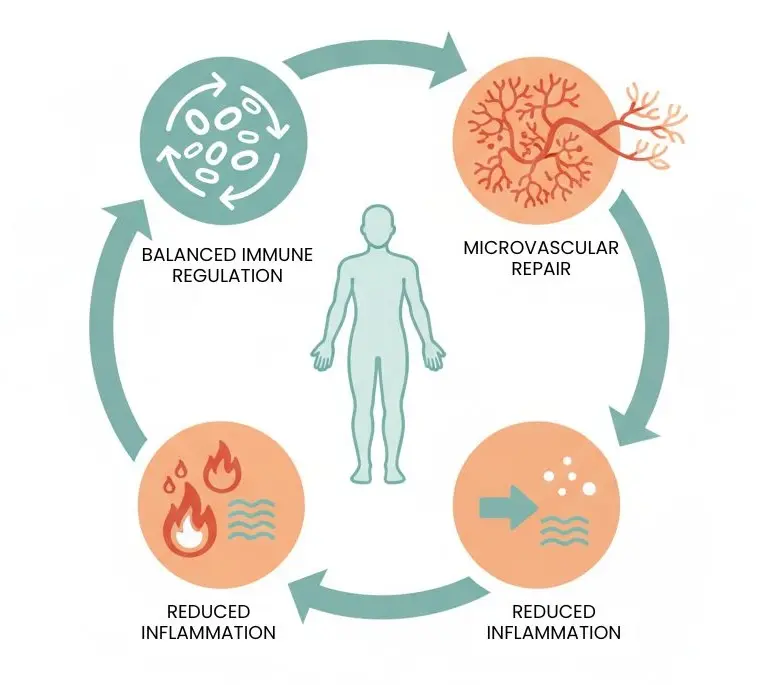
Mechanism 3: Reducing Systemic Inflammation in Long COVID
The third major mechanism is direct anti-inflammatory action. MSCs release molecules that suppress the local production of pro-inflammatory cytokines — TNF-alpha, interleukin-6, interleukin-1 — the same proteins that drive chronic inflammation across Long COVID’s many symptom domains. They also influence macrophages (a type of immune cell present throughout body tissues), shifting them away from a tissue-damaging “attack” state toward a tissue-repair “cleanup and rebuild” state.
The clinical consequence is a reduction in the overall inflammatory tone of the body. This can translate to reduced joint and muscle pain, reduced cognitive symptoms, reduced fatigue, and improved tolerance for daily activity.
What distinguishes MSCs from conventional pharmaceuticals is that they do not act through a single pathway. They release dozens of signaling molecules simultaneously, addressing multiple aspects of Long COVID’s biology in parallel. For a condition where three separate mechanisms appear to be driving symptoms, this multi-pathway approach is mechanistically well-aligned.
What Clinical Trial Data Shows About Long COVID Stem Cell Therapy
Trials of MSC Therapy in Post-COVID Recovery
The clinical evidence for MSC therapy in Long COVID is younger than for many other indications — because Long COVID itself was only recognized starting in 2020 — but it is not absent. Several controlled trials have now been completed and published in peer-reviewed journals.
The most extensively followed trial is a randomized, double-blind, placebo-controlled study conducted at the PLA General Hospital in China (NCT04288102). One hundred patients with severe COVID-19 were randomized to receive either three infusions of allogeneic umbilical cord MSCs (n=65, 4 × 10⁷ cells per dose on days 0, 3, and 6) or placebo (n=35), in addition to standard of care.
At one-year follow-up, 17.9% of patients in the UC-MSC group had complete resolution of lung consolidative lesions on imaging, while none of the placebo group patients had reached that level of recovery.
At the three-year follow-up published in Stem Cell Research & Therapy in 2025, the investigators reported that MSC treatment offered potential benefits for lung recovery and improved quality of life in patients experiencing Long COVID symptoms, with long-term safety confirmed over the full three-year monitoring window.
The same investigators also reported, with appropriate honesty, that at the two-year mark some of the efficacy benefits had attenuated compared to earlier follow-up, while safety remained intact. This kind of transparency about how the effects evolve over time is exactly what patients deserve to know before making a treatment decision.
The StemCyte Phase IIa Trial for Post-COVID Fatigue
A separate Phase IIa randomized controlled trial conducted in the United States evaluated human umbilical cord blood (HPC, cord blood) infusion specifically for post-COVID fatigue. The trial enrolled 30 participants, with 20 receiving cord blood treatment and 10 receiving placebo. At follow-up, 85% of patients in the treatment group reported complete relief from fatigue symptoms compared to 20% in the placebo group, and both primary and secondary endpoints were met. The treatment-emergent adverse event rate in the treatment group was 10%, with no severe adverse events; in the placebo group, the rate was 20%, with all events unrelated to treatment.
This is the most direct trial-level data to date addressing Long COVID fatigue specifically, and while the sample size is small, the magnitude of the difference between treatment and placebo is striking.
Additional trials are underway. A multistage Phase II trial registered as NCT06492798 is currently evaluating umbilical cord MSC therapy in Long COVID patients with symptoms scored against standardized criteria at 28 days, 12 weeks, and 24 weeks after treatment. Other registered trials are evaluating MSC-derived exosomes for specific Long COVID symptoms including chronic cough and neurological sequelae.
What These Numbers Mean for Long COVID Patients
We want to be careful about what the available data does and does not show.
The combined evidence suggests that MSC therapy in Long COVID and post-COVID contexts is generally safe. Across hundreds of patients treated in published trials, no consistent pattern of serious treatment-related adverse events has been reported, even at follow-up periods extending to three years. The available efficacy data shows meaningful improvements in fatigue, exercise tolerance, lung function, and quality of life, with the largest documented effect being the StemCyte fatigue trial’s 85% versus 20% comparison.
The evidence also has clear limitations. Most published trials are small (under 100 patients each) or single-center. Long COVID is a heterogeneous condition — patients with predominantly fatigue may respond differently from those with predominantly neurological or respiratory symptoms. The optimal cell dose, frequency of administration, and timing relative to symptom onset are still being investigated. And not every patient responds. Based on the current data and our own clinical experience, an honest estimate is that 50 to 70 percent of Long COVID patients show clinically meaningful improvement after MSC therapy, while 30 to 50 percent experience limited or no benefit. We cannot reliably predict in advance which patients will fall into which group.
Anyone presenting this treatment with greater certainty than that is overstating what the evidence supports.
Comparing Cell Sources: Why Allogeneic Cord MSCs for Long COVID
The Problem With Autologous Cells in Long COVID Patients
Stem cell therapy can be structured in two main ways. In autologous therapy, cells are harvested from the patient’s own body (usually bone marrow or fat tissue), processed, and reinfused. In allogeneic therapy, cells come from a healthy donor source. The distinction matters more for Long COVID than for many other conditions.
In Japan and several other regulatory frameworks, autologous stem cell therapy is the standard pathway. The principal advantage is the elimination of any rejection risk — the cells are genetically the patient’s own. The principal disadvantage for Long COVID patients is biological. A patient with active Long COVID has been living in a state of chronic inflammation, immune dysregulation, and often documented microvascular dysfunction for months or years. The stem cells available in that patient’s body have been exposed to this dysregulated environment throughout. Multiple research studies have demonstrated that MSCs harvested from individuals with chronic inflammatory conditions show measurably reduced proliferative capacity, altered signaling profiles, and diminished immunomodulatory function compared to MSCs from healthy donors.
There is also a practical consideration. The harvest procedure — typically a bone marrow aspiration or liposuction — is invasive, requires recovery, and is particularly burdensome for Long COVID patients who are already operating at significantly reduced energy reserves. For many of our patients, the prospect of an invasive procedure before treatment is itself a barrier.
Why Allogeneic Umbilical Cord MSCs Make Sense for Long COVID
The approach used in our Malaysia clinic is allogeneic, using MSCs derived from the umbilical cord tissue of healthy newborns delivered by consented donors. The cells are sourced from Wharton’s jelly — the gelatinous tissue inside the umbilical cord that is naturally rich in mesenchymal stem cells.
These cells are biologically young, highly proliferative, and characterized by particularly potent immunomodulatory and growth factor secretion profiles. They have not been exposed to decades of cumulative environmental stressors, immune challenges, or — importantly for Long COVID — months or years of chronic inflammation and dysregulation. They bring a healthy, fully functional immunomodulatory signal from outside the patient’s existing biological state.

Umbilical cord MSCs also express low levels of the surface markers (specifically major histocompatibility complex class II proteins) that typically trigger immune rejection, making them well-tolerated by recipients without the need for immunosuppression. They are produced in quality-controlled batches with verified cell viability and potency before each infusion, which means dosing consistency can be maintained across patients in a way that is more difficult with autologous harvests.
For Long COVID patients in particular — many of whom are exhausted, immunologically dysregulated, and looking to avoid additional procedural burden — the practical and biological case for allogeneic umbilical cord MSCs is straightforward.
Who Tends to Respond to Long COVID Stem Cell Therapy
Long COVID Profiles Most Likely to Benefit
Based on the available clinical trial data and our clinical experience, the patients who tend to respond best to MSC therapy for Long COVID share several characteristics. Their symptoms have persisted for at least three to six months after the acute COVID-19 infection — meeting the WHO clinical definition for Long COVID. Their primary symptoms include some combination of fatigue, post-exertional malaise, brain fog, breathlessness, or autonomic dysfunction (such as POTS or temperature regulation problems). There is evidence of chronic low-grade inflammation on laboratory testing (elevated C-reactive protein, ESR, or D-dimer), or documented autonomic dysfunction, or imaging findings consistent with persistent COVID-related changes. They have engaged with conventional management — rehabilitation, pacing, symptom-directed medications — and reached a plateau. They are in reasonable overall health aside from the Long COVID picture.
Younger patients (under 65) tend to have somewhat better responses, likely because their underlying tissues retain greater regenerative capacity. Patients whose Long COVID developed after a moderate-to-severe acute COVID-19 infection often have more pronounced inflammatory features, which is the pattern that MSC therapy is mechanistically best suited to address.
When Long COVID Stem Cell Therapy Is Not Appropriate
There are situations where we advise against this treatment, or where we will tell a prospective patient honestly that we do not think they are likely to benefit.
Patients with an active or recent COVID-19 infection should not undergo MSC therapy until the acute phase has fully resolved — typically a wait of at least six to eight weeks.
Patients with active malignancy, severe uncontrolled organ failure, or uncontrolled autoimmune disease are excluded due to safety concerns.
Patients whose symptoms turn out to be fully explained by a separate diagnosable condition — undiagnosed sleep apnea, anemia, thyroid disease, or another underlying medical issue — should have those conditions addressed first, before considering regenerative therapy.
Patients with mild Long COVID symptoms that are already well-managed by current strategies may not gain enough benefit from MSC therapy to justify the time and cost involved.
Patients seeking a guaranteed cure or rapid relief — within days or a couple of weeks — should reconsider. The realistic expectation is gradual improvement over months, and a meaningful minority of patients show limited response. We will not encourage anyone to proceed with mismatched expectations.
A Long COVID Patient’s Account of Recovery After Stem Cell Therapy
Why One Patient Decided to Try Long COVID Stem Cell Therapy
A woman in her early forties contracted COVID-19 in late 2022. Her acute illness was moderate — she required outpatient management but was not hospitalized. As her acute symptoms resolved, she expected to return to her work as a graphic designer and her active life. Instead, what followed was eighteen months of cognitive symptoms that made sustained creative work impossible, breathlessness on minimal exertion, muscle aches after the lightest physical activity, and a fatigue unlike anything she had experienced before — not tiredness that sleep resolved, but a deeper depletion that did not respond to rest.
She worked with three specialists over those eighteen months, completed a Long COVID rehabilitation program at a major hospital, trialed several medications for symptom management, and made significant lifestyle adjustments. She improved from her worst point in the early months but had clearly plateaued. Her self-assessed functional capacity was approximately 60% of her pre-COVID baseline. Her ability to work was significantly limited, and her cognitive symptoms were the hardest part of her day-to-day life.
She came to our clinic in Malaysia in early 2025. Before accepting her for treatment, we reviewed her complete medical record, confirmed elevated inflammatory markers consistent with ongoing immune activation, and verified that no other diagnosis was explaining her symptoms. She was a reasonable candidate. We were direct with her in the consultation: we could not predict her individual response, and we did not promise specific outcomes.
How Recovery Unfolded Over Six Months for One Long COVID Patient
She received three infusions of allogeneic umbilical cord MSCs over a one-week period during her stay in Malaysia. The infusions were uneventful, with mild fatigue and a low-grade temperature on the first night that resolved without intervention.
The first four weeks after treatment, she reported no significant change. This is typical, and we had explained the expected latency period to her before treatment. By the second month, she described her morning energy as “different — still tired, but not the same kind of tired.” By the four-month mark, she was able to work for four to five continuous hours without the post-exertional crash that had previously followed any sustained mental effort. At the six-month follow-up, her self-assessed functional capacity had moved from 60% to approximately 80% of her pre-COVID baseline. Her cognitive symptoms had improved meaningfully — she could read for extended periods, hold complex client conversations without fatigue, and had resumed creative work she had stopped attempting.
She has not returned fully to her pre-COVID baseline. She still paces her activity. Some symptoms persist at a reduced level. But the change has been meaningful — the difference, in her words, between living a constrained life and a much fuller one.
This is an anonymized account of one patient’s experience, shared with consent. Outcomes vary significantly between patients, and not all patients experience this level of improvement.
What Recovery After Long COVID Treatment Looks Like
The recovery profile is qualitatively different from what patients are used to with conventional Long COVID interventions. There is no immediate dramatic relief, which can be unsettling for patients accustomed to medications that produce same-day effects. The biological processes set in motion by MSC therapy — immune recalibration, microvascular support, mitochondrial signaling, inflammation reduction — unfold over weeks to months, not hours.
Most patients describe the first four to six weeks as relatively uneventful. Some report mild improvements in sleep quality or morning energy early on; many notice no clear change initially. The most consistent reports of meaningful improvement appear between months two and four post-treatment. Cognitive symptom improvement often appears in this window, followed by exercise tolerance gains. Where serial inflammatory markers are followed, measurable improvements often appear by three to six months. The full effects continue to develop over six to twelve months.
Patients should plan to remain in Malaysia for approximately five to seven days for the treatment cycle, depending on the number of infusions scheduled and individual recovery in the immediate post-infusion period.
Honest Risks and Limitations of Long COVID Stem Cell Therapy
Known Side Effects of MSC Therapy in Long COVID
The safety profile of MSC therapy in published trials has been generally favorable. Across the cumulative published data from COVID-19 and Long COVID-related clinical trials involving several hundred patients, no consistent pattern of serious treatment-related adverse events has been reported.
The most commonly reported effects are mild and self-limiting. A low-grade fever in the 24 to 48 hours following infusion is reported by approximately 10 to 20 percent of patients — thought to reflect the immune system’s recognition of and response to the donor cells, not an active infection. Transient fatigue, mild muscle aches, occasional headache, and minor infusion-site discomfort are also commonly reported. These typically resolve without specific intervention.
Rare risks include allergic reactions (uncommon with umbilical cord-derived cells given their low immunogenicity) and infusion-related complications. All infusions in our clinic are performed under direct physician supervision with immediate availability of standard medical resources.
Long-term safety data extending beyond three years for Long COVID specifically remains limited, simply because the condition itself is relatively new and the trial follow-up windows have not yet had time to extend further. We disclose this transparently to every patient.
What Stem Cell Therapy Cannot Do for Long COVID
We want to be specific about boundaries because vagueness on this point serves no one.
Stem cell therapy cannot replace permanently damaged or scarred tissue. If significant pulmonary fibrosis (scarring of lung tissue) has developed during the acute or post-acute COVID phase, the underlying structural damage is unlikely to be reversed by stem cells — though inflammation in surrounding viable tissue may be addressed.
It cannot eliminate symptoms in 100 percent of patients. Based on current clinical trial data and our own clinical experience, somewhere between 30 and 50 percent of Long COVID patients treated with MSC therapy show limited or no clinically meaningful improvement. We cannot reliably predict in advance which patients will fall into which group, although the pre-treatment assessment provides some indication.
It cannot eliminate the need for pacing, lifestyle management, and continued medical follow-up. Stem cell therapy is designed to work alongside conventional Long COVID care, not as a replacement for it. Patients should plan to continue with their existing rehabilitation strategies and specialist follow-up.
It cannot guarantee durable improvement at every time horizon. The two-year follow-up data from the largest Long COVID-relevant MSC trial showed that some of the earlier improvements partially attenuated by year two, though safety remained intact and three-year benefits in selected outcomes were documented. Whether repeat treatment at later intervals could maintain or extend benefits is an open research question.
It cannot work as fast as some patients hope. For patients in severe daily distress looking for relief within weeks rather than months, the gradual timeline of MSC therapy may be poorly matched to their needs.
These are not reasons to dismiss MSC therapy for Long COVID. They are the context in which the available evidence should be read, and the framework within which any prospective patient should weigh whether this treatment is right for them.
FAQ About Long COVID Stem Cell Therapy
We typically recommend waiting at least three to six months after the acute illness has resolved. Long COVID is defined clinically as symptoms persisting beyond three months post-infection, and treatment during the acute or early post-acute phase is generally not appropriate. The minimum interval is typically six to eight weeks of full resolution of acute symptoms.
MSC therapy specifically for Long COVID has not yet received full regulatory approval in any major jurisdiction, as the clinical trial data is still maturing. In Malaysia, the treatment is conducted under regulated medical practice frameworks. Patients should understand that this is not equivalent to a fully approved indication and should weigh that context in their decision-making.
Available trial data shows benefits documented at one and three years post-treatment, with some attenuation seen at the two-year mark in selected outcomes. Long-term durability is still being studied. Some patients may benefit from repeat treatment after twelve to twenty-four months; this is a decision made individually based on clinical response.
Yes — and importantly, no medications should be discontinued in preparation for or following stem cell therapy without consulting your treating physicians. MSC therapy is designed to work alongside existing care, not replace it. Decisions about medication adjustment should remain with the prescribing physicians who know your case.
Many Long COVID patients have symptoms that overlap significantly with myalgic encephalomyelitis/chronic fatigue syndrome (ME/CFS) — particularly post-exertional malaise, fatigue, and cognitive dysfunction. The available data is most directly applicable to patients with documented post-COVID etiology rather than longstanding pre-COVID ME/CFS, though the underlying immune and microvascular mechanisms appear to overlap. Patients with predominantly ME/CFS-like Long COVID symptoms have been included in available trials and have shown response patterns similar to other Long COVID profiles.
Ready to Talk About Your Long COVID Recovery Options
If you have spent months or years managing Long COVID, worked through the conventional options, and reached a plateau that feels permanent, you may be looking for something that addresses the underlying biology rather than just managing symptoms.
We offer free online consultations to discuss your specific case. We will review your symptom history, your treatment record, and your relevant test results — and tell you honestly whether your situation falls within the range where stem cell therapy has shown evidence of benefit, or whether it does not. If we do not think this treatment is right for you, we will say so directly.
You do not need to have made any decisions beforehand. The consultation is just a conversation about what your options actually are.
References
- Hou Y, Gu T, Ni Z, Shi X, Ranney ML, Mukherjee B. “Global Prevalence of Long COVID, Its Subtypes, and Risk Factors: An Updated Systematic Review and Meta-analysis.” Open Forum Infectious Diseases. 2025;12(9):ofaf533. https://doi.org/10.1093/ofid/ofaf533
- Shi L, Yuan X, Yao W, et al. “Long-term outcomes of mesenchymal stem cell therapy in severe COVID-19 patients: 3-year follow-up of a randomized, double-blind, placebo-controlled trial.” Stem Cell Research & Therapy. 2025;16:78. https://doi.org/10.1186/s13287-025-04148-1
- Shi L, Huang H, Lu X, et al. “Human mesenchymal stem cell therapy in severe COVID-19 patients: 2-year follow-up results of a randomized, double-blind, placebo-controlled trial.” eBioMedicine. 2023;92:104600. https://doi.org/10.1016/j.ebiom.2023.104600
- Zhu R, Yan T, Feng Y, et al. “One-year follow-up study after patients with severe COVID-19 received human umbilical cord mesenchymal stem cells treatment.” Stem Cell Research & Therapy. 2022;13(1):318. https://doi.org/10.1186/s13287-022-02991-0
- Soler Rich R, Rius Tarruella J, Melgosa Camarero MT. “Expanded mesenchymal stem cells: a novel therapeutic approach of SARS-CoV-2 pneumonia (COVID-19). Concepts regarding a first case in Spain.” Med Clin (Barc). 2020;155(7):318–319. https://doi.org/10.1016/j.medcli.2020.06.018
- Bligh R. “Safety and Efficacy of Bone Marrow Mesenchymal Stem Cell Extracellular Vesicles in Long COVID Patients: A Case Series.” Journal of Stem Cells Research, Development & Therapy. 2024. https://doi.org/10.24966/SRDT-2060/100075
- Kabat M, Bobkov I, Kumar S, Grumet M. “Mesenchymal Stem Cell-Based Therapies in the Post-Acute Neurological COVID Syndrome: Current Landscape and Opportunities.” Pharmaceuticals. 2024;17(1):126. https://doi.org/10.3390/ph17010126
- National Institutes of Health. ClinicalTrials.gov. “Effectiveness and Safety of Mesenchymal Stem Cell Therapy in Long COVID Patients.” NCT06492798. https://clinicaltrials.gov/study/NCT06492798
- National Institutes of Health. ClinicalTrials.gov. “Treatment with Human Umbilical Cord-derived Mesenchymal Stem Cells for Severe Corona Virus Disease 2019 (COVID-19).” NCT04288102. https://clinicaltrials.gov/study/NCT04288102