
Liver Cirrhosis Stem Cell Therapy | Can Scarred Liver Recover Without Transplant?

The fatigue that no amount of sleep seems to fix. The waist of your trousers that needs to be loosened week by week — not from weight gain in the usual sense, but from fluid quietly collecting in your abdomen. The bruise on your arm that appeared after barely brushing against the kitchen counter. The mild but persistent itch on your shins that no cream seems to settle.
If your hepatologist has told you that your liver shows established cirrhosis, you may already recognise these signs. You may also recognise the framing that tends to follow: this is a chronic, progressive condition, the medications can manage symptoms and slow decline, and the only structural answer is transplant — if and when you become sick enough to qualify, and only if a donor liver becomes available in time.
You are not alone in that conversation. An estimated 122 million people worldwide live with cirrhosis, and chronic liver disease causes roughly 1.32 million deaths globally each year. In the Asia-Pacific region especially, the combination of chronic hepatitis B, hepatitis C, alcohol-related disease, and rapidly rising metabolic dysfunction-associated steatohepatitis (often called MASH) means the patient population continues to grow.
This article is written for people who have already had the standard conversation and are now asking a more specific question: is there a credible biological option that can support a damaged liver — without simply waiting on a transplant list? We will go through what mesenchymal stem cells appear to do inside cirrhotic livers, what randomised clinical trials have actually measured, who tends to respond, and where the honest limits are. We have been working in regenerative medicine in Malaysia for over seven years, with more than 200 patients treated across multiple conditions. We do not believe stem cell therapy is right for everyone with cirrhosis, and we will be specific about why.
Table of Contents
- Why Liver Cirrhosis Does Not Reverse on Its Own
- Where Standard Liver Cirrhosis Treatments Hit Their Ceiling
- What Stem Cell Therapy Aims to Do in Liver Cirrhosis: Three Mechanisms
- Cell Source Matters: Autologous vs Allogeneic for Liver Cirrhosis
- What Clinical Data Shows for Liver Cirrhosis Stem Cell Therapy
- Who Is — And Is Not — A Candidate for Liver Cirrhosis Stem Cell Therapy
- A Patient's Experience with Liver Cirrhosis Stem Cell Therapy in Malaysia
- Honest Risks and Limitations of Liver Cirrhosis Stem Cell Therapy
- FAQ About Liver Cirrhosis Stem Cell Therapy
- Where to Go From Here
- References
Why Liver Cirrhosis Does Not Reverse on Its Own
How Healthy Liver Tissue Becomes Fibrotic in Liver Cirrhosis
The liver is famous for one thing in popular biology: its ability to regenerate. Surgeons can remove up to two-thirds of a healthy liver, and within months, the remaining tissue typically grows back to functional size. This regenerative power is real, and it is one of the reasons living-donor liver transplants are even possible.
What most discussions leave out is what happens to that regenerative capacity once cirrhosis is established. In liver cirrhosis, repeated injury — from viral infection, alcohol, fat accumulation, autoimmune attack, or other causes — triggers a wound-healing response that does not switch off. Specialised cells called hepatic stellate cells, which normally rest quietly in the liver, become activated and begin producing collagen — the fibrous protein that creates scar tissue. Over years, scar tissue progressively replaces functional liver tissue. The liver’s architecture changes: smooth, organised lobules give way to nodules surrounded by bands of fibrosis. Blood flow through the liver becomes obstructed, leading to portal hypertension. The remaining functional liver cells, called hepatocytes, become increasingly cut off from the blood supply they need to do their work.
This is the central problem of liver cirrhosis. The liver’s famous regenerative power has not disappeared — it has been overwhelmed and redirected. Instead of building functional tissue, the body is building scar.
Why the Liver’s Famous Regenerative Power Fails in Liver Cirrhosis
Once cirrhosis is established, several things make spontaneous reversal extremely difficult.
The fibrotic environment itself is hostile to hepatocyte regeneration. Scar tissue produces signalling molecules that suppress the activity of remaining liver cells. Inflammation persists at low intensity, continuing to drive stellate cell activation and additional collagen deposition. The structural disruption — the nodular architecture, the altered blood flow — means even when hepatocytes do divide, they often cannot organise into properly functioning tissue.
There is also a feedback loop very similar to the one that drives chronic disease in other organs. Damaged tissue produces inflammatory signals; inflammation drives further damage; damaged tissue produces more inflammation. Without an intervention that targets multiple parts of this loop simultaneously, the liver’s biology continues moving in one direction: more fibrosis, less function, gradual decompensation.
This is why standard medical treatment for liver cirrhosis — even when fully optimised — typically aims at slowing progression and managing complications rather than reversing the underlying scarring.
Where Standard Liver Cirrhosis Treatments Hit Their Ceiling
What Cirrhosis Medications Actually Do — and Do Not Do
The medications used in liver cirrhosis are genuinely useful for what they are designed to do, and we want to be clear about that before discussing their limits.
For viral hepatitis-related cirrhosis, antiviral therapy can suppress the underlying viral driver of liver injury — entecavir or tenofovir for hepatitis B, direct-acting antivirals for hepatitis C. For autoimmune hepatitis, immunosuppressive medication can quiet the autoimmune attack. For alcohol-related disease, complete abstinence can stop further injury. For ascites, diuretics help the body clear retained fluid. For hepatic encephalopathy, lactulose and rifaximin reduce the absorption of ammonia and other toxins from the gut. For oesophageal varices, beta-blockers and endoscopic banding reduce bleeding risk.
Each of these has clinical value. What none of them does, on its own, is reverse established fibrosis. They create conditions in which the cirrhotic liver can function with less ongoing injury — but the fibrotic architecture, the lost hepatocyte mass, and the impaired regeneration remain in place. Many patients on optimised medical management still see their MELD score drift upward over years.
This is not a criticism of medical management. It is a description of its mechanism — and the gap that explains why so many compliant, well-managed patients eventually find themselves in a transplant evaluation conversation.
When Transplant Is Recommended for Liver Cirrhosis — and Why Many Cannot Wait
Liver transplantation is, for end-stage cirrhosis, the single most effective treatment. A successful transplant replaces a failing organ with a healthy one and can transform survival outcomes. We do not minimise this.
The practical reality is harder. Donor livers are scarce. Waiting list times in many countries stretch into years. Patients are listed by MELD score, meaning a patient with moderate decompensation may wait considerably longer than someone in critical decline. Many patients deteriorate or die while waiting. After transplant, recipients require lifelong immunosuppression, with the cumulative risks that brings: infection, kidney injury, secondary cancers, cardiovascular complications. Some patients are not transplant candidates at all — due to age, comorbidities, ongoing alcohol use, or other clinical factors that the transplant evaluation team determines.
This leaves a substantial group of patients in an uncomfortable middle space. Their cirrhosis is real and progressive. Their MELD score is too high to ignore but not high enough to prioritise on the waiting list. Their hepatologist has run through the conventional toolkit. They are looking for something that addresses the underlying biology of fibrosis itself — and it is this group that most often begins exploring whether stem cell therapy is a credible option.
What Stem Cell Therapy Aims to Do in Liver Cirrhosis: Three Mechanisms
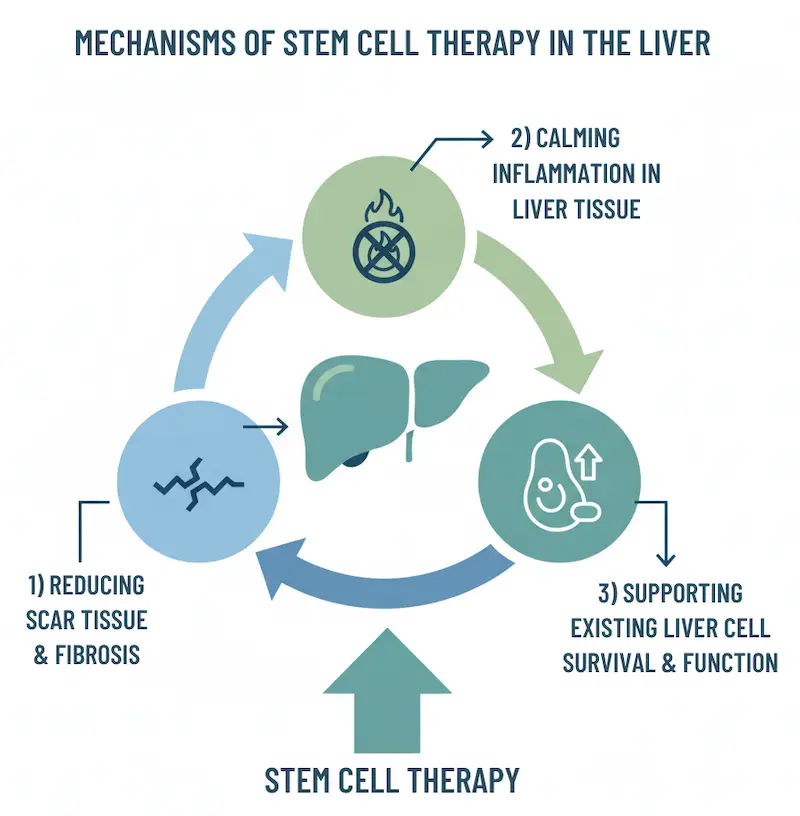
The most important framing to set first is what mesenchymal stem cells (MSCs) — the cell type used in the great majority of liver cirrhosis trials — do not do. They do not transform themselves into new hepatocytes and rebuild the liver. Early enthusiasm in the field included that idea, but two decades of accumulated evidence have not supported it as a meaningful clinical mechanism. MSCs transplanted into a cirrhotic liver remain MSCs; they do not reliably differentiate into functioning liver cells.
What the research has identified instead are three indirect but biologically significant mechanisms.
Reducing Fibrosis Through Anti-Scarring Signals in Liver Cirrhosis
The first mechanism, and the one most directly relevant to cirrhosis specifically, is anti-fibrotic signalling. MSCs release a range of signalling molecules — proteins called cytokines and growth factors, plus small membrane-bound packets called exosomes — that interact with the activated hepatic stellate cells responsible for producing collagen.
Research has demonstrated that MSCs can shift activated stellate cells toward an inactive state, reduce their collagen production, and increase the activity of enzymes that break down existing fibrotic tissue. The clinical translation, in patients who respond, can be measurable reduction in fibrosis on biopsy, on elastography (a non-invasive measure of liver stiffness), or on imaging-based fibrosis scores. This is not the same as full reversal of cirrhosis. It is a partial reduction in active fibrogenesis — a shift in the balance between scar formation and scar breakdown — that may slow or in some cases modestly reverse the trajectory.
Modulating Inflammation in the Cirrhotic Liver
The second mechanism is anti-inflammatory and immunomodulatory. The cirrhotic liver carries chronic, low-grade inflammation that continues to drive stellate cell activation regardless of whether the original injury (a viral infection, alcohol exposure) is still present. MSCs secrete signals that shift the local immune environment from pro-inflammatory to regulatory, suppressing the activity of inflammatory immune cells while supporting cells with reparative function. The mechanism overlaps significantly with the immunomodulatory effects of MSCs studied in rheumatoid arthritis and other autoimmune-driven conditions.
For a cirrhotic liver, the practical consequence is that the inflammatory engine driving ongoing fibrogenesis can be partially turned down — which both slows new scar formation and creates a more favourable environment for the remaining hepatocytes to survive and function.
Supporting Hepatocyte Survival and Liver Regeneration in Liver Cirrhosis
The third mechanism is paracrine support of remaining hepatocytes. MSCs secrete hepatocyte growth factor (HGF) and other proteins that promote the survival, function, and limited proliferation of hepatocytes that are still alive but stressed. They also support angiogenesis — the growth of new small blood vessels — which improves perfusion of areas of the liver that have been functionally compromised by altered blood flow.
In simple terms: stem cells are not building a new liver, but they may help the existing one work harder and survive longer. The same paracrine support principle has been studied in cardiac tissue, where similar mechanisms appear in heart failure stem cell therapy — different organ, overlapping biology.
Cell Source Matters: Autologous vs Allogeneic for Liver Cirrhosis
Why Autologous Stem Cells Have Limitations in Advanced Liver Cirrhosis
Stem cell therapy for liver cirrhosis can be structured in two fundamentally different ways. The first is autologous — using cells harvested from the patient’s own bone marrow or fat tissue. The second is allogeneic — using cells from a healthy donor.
The autologous approach is the standard in Japan’s regenerative medicine framework. Its primary advantage is the absence of any immune rejection concern: the cells are genetically the patient’s own. Its limitation, particularly relevant in liver cirrhosis, is that the cells reflect the patient’s overall health state. In a person who has lived with chronic liver disease for years or decades, the bone marrow MSCs available for harvesting often show measurably reduced potency — lower proliferative capacity, reduced secretion of beneficial signalling molecules, diminished anti-fibrotic activity. Several studies have specifically shown that MSCs from patients with established liver disease perform less well in laboratory assays than MSCs from healthy young donors.
The harvest procedure itself is also more demanding for liver cirrhosis patients. Bone marrow aspiration is invasive. Patients with advanced cirrhosis often have coagulation abnormalities, thrombocytopenia (low platelets), and other factors that make any invasive procedure carry additional risk.
Allogeneic Umbilical Cord MSCs as Used in Malaysia for Liver Cirrhosis
The allogeneic approach we use in Malaysia is based on MSCs derived from donated umbilical cord tissue — specifically the Wharton’s jelly layer surrounding the cord, collected at the time of healthy delivery with full donor consent. These cells are biologically young, highly proliferative, and characterised by particularly potent anti-inflammatory and anti-fibrotic activity. Because they have low immunogenicity — they express low levels of the surface markers that ordinarily trigger rejection — they are immunologically tolerated by recipients without the rejection problems that limit other forms of allogeneic cell therapy.
Practically, this means cells can be prepared in standardised, quality-tested batches with measurable potency before each treatment is administered. There is no harvesting procedure for the patient. There is no need to wait weeks for autologous expansion. And the biological starting point — the potency and viability of the cells reaching the cirrhotic liver — is meaningfully higher than what an adult patient with chronic liver disease can typically provide from their own tissue.
This is not a theoretical preference. In Phase I and II clinical trials of allogeneic umbilical cord MSCs in liver cirrhosis, including the Shi et al. trial published in Hepatology in 2012, the cells have been delivered safely and with measurable clinical effect. The choice of source has direct implications for what arrives at the target tissue.
What Clinical Data Shows for Liver Cirrhosis Stem Cell Therapy
Key Trial Results in Liver Cirrhosis Stem Cell Research
The clinical trial evidence for stem cell therapy in liver cirrhosis is more developed than many patients realise. Trials have been running since the mid-2000s, and several randomised, controlled studies have now been published in peer-reviewed hepatology journals.
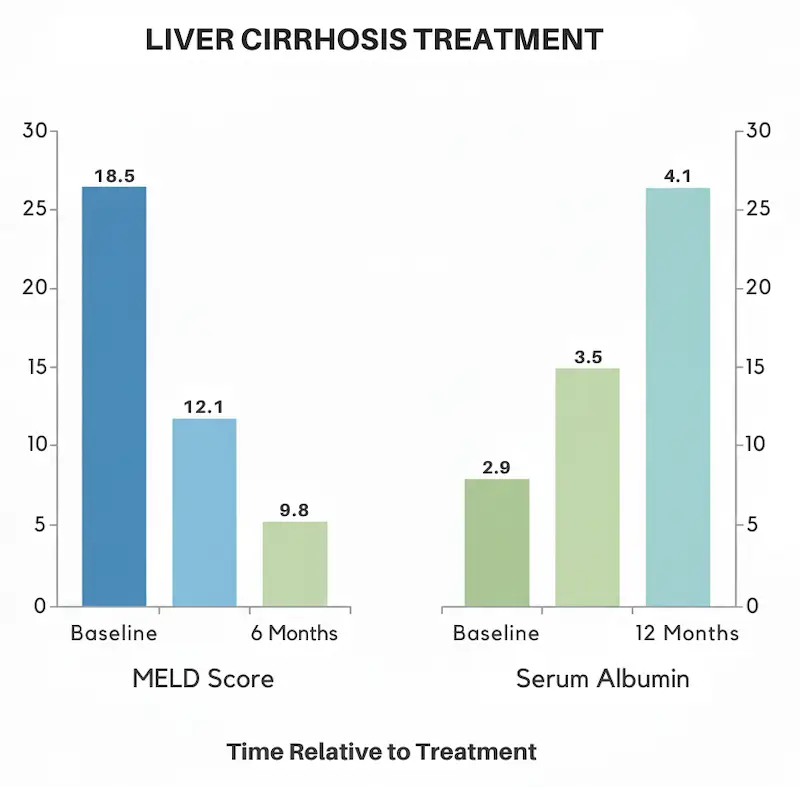
The Shi et al. trial (Hepatology, 2012) is one of the most directly relevant. The study enrolled 45 patients with decompensated liver cirrhosis related to chronic hepatitis B and randomised them to receive umbilical cord-derived MSC infusions or saline control, on top of standard medical care. At 12, 24, 36, 48, and 72 weeks of follow-up, the MSC group showed significant improvements in MELD scores compared to controls. Serum albumin — a key marker of hepatic synthetic function — increased measurably in the treated group. Total bilirubin decreased. Quality of life scores improved. No serious adverse events were attributed to the cell infusions.
The Lin et al. trial (Hepatology, 2017) extended the evidence base in a more challenging patient group. The study enrolled 56 patients with hepatitis B-related acute-on-chronic liver failure — a subset of cirrhosis patients in particularly high-risk decompensation — and randomised them to allogeneic bone marrow MSC therapy or standard care. Twenty-four week survival was significantly higher in the MSC group than in controls (73.2% vs 55.6%). Liver function markers improved more in the treated group, and infection rates were lower. This is a particularly notable result because acute-on-chronic liver failure carries very high short-term mortality with conventional management alone.
The Suk et al. trial (Hepatology, 2016) used autologous bone marrow MSCs in 72 patients with alcoholic cirrhosis, randomised to one or two MSC injections versus control. Histological assessment of liver biopsies showed reduction in fibrosis stage in patients receiving cell therapy that was not seen in controls. Child-Pugh scores improved more in the treated group.
Several systematic reviews and meta-analyses synthesising these and other trials have reported broadly consistent findings: improvements in MELD scores, increases in serum albumin, reductions in total bilirubin, and acceptable safety profiles when allogeneic or autologous MSCs are used in cirrhosis.
What MELD Score Changes Mean for Liver Cirrhosis Patients
We want to be specific about what these numbers mean in practice.
The MELD score (Model for End-Stage Liver Disease) is a standardised measure that combines bilirubin, INR (a clotting measure), and creatinine to estimate three-month mortality risk in cirrhosis. A MELD of 10 corresponds to roughly a 6% three-month mortality risk; a MELD of 20 corresponds to roughly 20%; a MELD of 30 to over 50%. Each point of MELD reduction, particularly in the moderate-to-high range, corresponds to a measurable shift in survival probability.
In the trials cited, MELD reductions of 1.5 to 4 points were observed across follow-up periods of 6 to 12 months in MSC-treated groups, exceeding what control groups achieved. These are not transformative numbers. They are meaningful numbers. For a patient sitting at MELD 14, a sustained shift to MELD 11 over twelve months — combined with improved albumin, reduced ascites, and better functional status — can represent a substantively different daily life.
What the trials have not shown is normalisation of liver function, elimination of the need for ongoing antiviral or other therapy, or reversal of advanced cirrhosis to a non-cirrhotic state. The improvements have been incremental rather than curative. We believe patients deserve these specific numbers rather than a curated highlight reel.
Who Is — And Is Not — A Candidate for Liver Cirrhosis Stem Cell Therapy
Liver Cirrhosis Profiles That Tend to Respond Well
Based on the published evidence and our clinical experience over seven years, the patients who tend to show the clearest response to MSC therapy share a recognisable profile.
The underlying cause of cirrhosis matters less than the stage and the active disease drivers. Patients with hepatitis B-related cirrhosis on effective antiviral suppression, hepatitis C-related cirrhosis after viral cure with direct-acting antivirals, alcohol-related cirrhosis with confirmed abstinence, and metabolic dysfunction-associated cirrhosis with active lifestyle management all fall within the populations studied in published trials.
Stage of cirrhosis is more critical. Patients with Child-Pugh class A or early class B cirrhosis — meaning compensated or early-decompensated disease with reasonable preserved synthetic function — tend to respond more clearly than those at advanced Child-Pugh C with multiple decompensation events. MELD scores in the range of approximately 10 to 18 represent the most studied and most responsive segment. Below 10, the disease is mild enough that conventional management may be sufficient; above 18, the patient is typically in the territory where transplant evaluation is the more urgent priority and stem cell therapy is unlikely to substitute for it.
Stability at the time of treatment is also important. MSC therapy is not an emergency intervention. It is not appropriate for someone currently hospitalised with acute decompensation, active variceal bleeding, severe hepatic encephalopathy, or systemic sepsis. The treatment is designed to support a stable cirrhotic liver, not to rescue an acutely failing one — with the partial exception of acute-on-chronic liver failure cases that have been studied in specific protocols like Lin et al. 2017.
When Stem Cell Therapy Is Not Suitable for Liver Cirrhosis
We advise against proceeding when the clinical picture suggests the patient is unlikely to benefit, or when a different pathway is more appropriate.
End-stage cirrhosis with very high MELD score, multiple decompensation events, and clear transplant urgency is a situation where MSC therapy is unlikely to meaningfully change the trajectory and where transplant evaluation should be the priority. Active hepatocellular carcinoma — liver cancer arising from cirrhosis — is a contraindication; the immunomodulatory effects of MSCs raise theoretical concerns about supporting cancer cell survival, and tumour-directed treatment must take priority. Active uncontrolled viral replication (HBV or HCV without antiviral suppression), ongoing alcohol use in alcohol-related cirrhosis, or active autoimmune flare without immunosuppressive control all need to be addressed before stem cell therapy is considered. Severe coagulopathy, active systemic infection, and pregnancy are also exclusions.
We also take time to discuss whether a patient’s expectations are realistic before any treatment proceeds. Stem cell therapy will not restore a heavily fibrotic liver to a non-cirrhotic state. It is not a substitute for transplant when transplant is what the disease stage demands. It is, more accurately framed, an attempt to slow fibrogenesis, modulate inflammation, and support remaining hepatic function — and for patients for whom that is a meaningful and valued goal, it is worth a detailed conversation.
A Patient’s Experience with Liver Cirrhosis Stem Cell Therapy in Malaysia
A Decompensated Liver Cirrhosis Case After Years of Hepatitis Management
A man in his late fifties had been living with chronic hepatitis B for over fifteen years and had been diagnosed with cirrhosis seven years before consulting us. He had been on entecavir antiviral therapy throughout, with viral load suppressed below the limit of detection on regular testing. Despite this, his liver function had been gradually deteriorating. His MELD score had drifted from 8 to 13 over three years. His ascites had begun requiring increasing doses of diuretics. He had developed mild peripheral oedema. His Child-Pugh score had moved from class A to early class B. His hepatologist had recently raised the conversation about beginning transplant evaluation.
He was not yet sick enough to be high on a waiting list, but the trajectory was clear. He was a senior professional with significant work obligations, and the prospect of spending years of declining function while waiting was not one he was prepared to accept passively. After reviewing the published trial evidence and consulting with our team, he decided to pursue allogeneic umbilical cord MSC therapy in Malaysia in 2024. Before accepting him for treatment, we reviewed his recent imaging, laboratory panel, hepatology summary, and treatment history. He was clear-eyed about the uncertainty of outcome and did not enter the process expecting a cure.
How Recovery Unfolded Over Twelve Months for This Liver Cirrhosis Patient
The first month produced no noticeable change — a period he described as quietly discouraging. By month three, he reported that his abdominal swelling had stabilised and that his diuretic dose had been able to be reduced rather than increased. By month six, his MELD score had moved from 13 to 11. His serum albumin had improved from 2.9 to 3.4 g/dL. His total bilirubin had reduced modestly. He described his energy as recognisably better — not transformed, but enough that he had stopped scheduling rest periods into his afternoons.
At the twelve-month mark, his MELD remained at 10, and his hepatologist documented that the decompensation trajectory of the previous three years had paused. He continued his entecavir without modification — that decision remained, correctly, with his treating hepatologist — and he had not required further escalation of diuretics. His ascites was no longer clinically apparent. He remains in follow-up. His cirrhosis has not been reversed, and transplant remains a future possibility depending on long-term progression. But his trajectory had shifted.
This is an anonymised account based on actual clinical experience. Individual results vary and cannot be guaranteed for all patients.
Recovery and Follow-Up After Liver Cirrhosis Stem Cell Treatment
The recovery from MSC infusion is considerably less demanding than the recovery from any liver-directed surgical procedure. Most patients return to normal activity within a few days. There is no incision, no anaesthesia recovery, and no procedure-specific physical restriction other than the general recommendation to avoid alcohol entirely and to maintain existing medications without modification.
Follow-up consultations are scheduled at three months, six months, and twelve months post-treatment. We ask patients to repeat their liver function panel, MELD components, and where appropriate, liver elastography or imaging at these intervals. These provide objective data on response — or non-response. Patients also complete standardised quality-of-life and symptom assessments at each follow-up, creating a documented record of their trajectory.
The most important thing we communicate about the recovery period is patience. Unlike a diuretic adjustment — which can produce noticeable change within days — MSC therapy works through a slower biological process. Cells need time to engraft, to begin modulating the inflammatory and fibrogenic environment, and to support hepatocyte function. Most patients who respond begin to notice changes between weeks 8 and 16. Expecting meaningful change within the first two to four weeks is likely to produce frustration and inaccurate early conclusions.
Honest Risks and Limitations of Liver Cirrhosis Stem Cell Therapy
Known Side Effects in Liver Cirrhosis Stem Cell Trials
The safety profile of allogeneic MSC infusion in liver cirrhosis trials has been generally favourable across multiple published studies. The Shi 2012 trial reported no serious treatment-related adverse events across 45 patients followed for up to 72 weeks. The Lin 2017 trial similarly found no serious adverse events attributable to the cells, with infection rates actually lower in the treated group.
The most commonly reported effects following MSC infusion are mild and self-limiting: a low-grade fever in the 24 to 48 hours after infusion, transient fatigue, and occasional mild headache. These are thought to reflect the immune system’s recognition of the donor cells and resolve without specific intervention. Immune rejection has not emerged as a clinical problem with allogeneic umbilical cord MSCs across the cirrhosis trial literature, consistent with their low immunogenicity.
There are several theoretical risks that warrant honest mention. Patients with cirrhosis often have coagulation abnormalities and altered immune function due to the disease itself, and pre-treatment laboratory assessment is essential to identify any factors that would increase procedural risk. Patients with advanced cirrhosis and significantly elevated portal pressures need particular pre-treatment evaluation. Long-term safety data beyond three years remains limited because the field is relatively young at the clinical scale, and we disclose this honestly to every patient before treatment.
What Stem Cell Therapy Cannot Do for Liver Cirrhosis
We want to be specific about the boundaries because vagueness serves no one.
Stem cell therapy cannot reverse end-stage cirrhosis. A liver in which the great majority of functional tissue has been replaced by fibrosis and regenerative nodules cannot be biologically rebuilt by infused MSCs. The window in which MSC therapy is most likely to provide meaningful benefit is before this endpoint is reached — in patients with substantial remaining hepatic function and active disease processes that can still be modulated.
It cannot eliminate the need for ongoing medical management. Patients with hepatitis B-related cirrhosis must continue antiviral therapy. Patients with autoimmune hepatitis must continue immunosuppression as directed by their hepatologist. Patients with alcohol-related cirrhosis must maintain abstinence. The treatment is additive, not substitutive.
It cannot resolve hepatocellular carcinoma, decompress oesophageal varices, or repair structural complications of portal hypertension. These require their specific interventions — surgical, endoscopic, or interventional — which may need to be addressed before or alongside any consideration of stem cell therapy.
It cannot guarantee improvement. Based on the published evidence and our clinical experience, a meaningful proportion of cirrhosis patients receive MSC therapy and do not show measurable improvement. We do not currently have reliable predictors of which individual patients will and will not respond, though baseline disease severity, underlying cause, and stability are part of the assessment. Patients who enter the process with realistic expectations are better positioned to assess their response fairly and to make informed decisions about next steps.
If you are in acute decompensation requiring hospitalisation, or if your hepatology team has concluded that you need active transplant evaluation now, MSC therapy is not the appropriate intervention. It is suited to a particular window in the disease course, not to every situation.
FAQ About Liver Cirrhosis Stem Cell Therapy
A transplant replaces the failing liver with a healthy donor organ; stem cell therapy does not replace any tissue and does not address structural damage at that scale. MSC therapy aims to slow fibrogenesis, modulate inflammation, and support remaining hepatic function in a cirrhotic liver that is still producing meaningful work. The two are not interchangeable. For end-stage cirrhosis where transplant is indicated, MSC therapy does not substitute. For earlier-stage cirrhosis where the patient is not yet a transplant candidate, MSC therapy may provide an option for slowing decline.
Yes. Patients are explicitly instructed to continue all existing medications without modification. Decisions about medication adjustment must remain with the treating hepatologist. We do not ask any patient to stop antivirals, immunosuppressants, diuretics, or other prescribed therapies in connection with stem cell treatment — and any patient told otherwise should be cautious about that recommendation.
Published trials have followed patients for periods up to two years, with measurable improvements in liver function markers sustained across that period in those who responded. Whether benefits persist beyond three to five years, and whether re-treatment is appropriate at any interval, are open questions in the current evidence base. We discuss this honestly during initial consultation.
In most countries, regenerative therapies for liver cirrhosis are not covered by national health insurance and are paid out of pocket. We can discuss specifics during consultation, but realistic financial planning is part of the decision-making process.
Yes — and it should be. MSC therapy is designed to work alongside, not instead of, conventional management. Antivirals continue. Lifestyle measures continue. Hepatology follow-up continues. The treatment is not an isolated intervention.
Where to Go From Here
If you have read to this point, you are likely someone who has already had several conversations with your hepatology team and is genuinely trying to assess whether stem cell therapy makes sense for your specific situation.
We offer free online consultations for exactly this kind of conversation. The purpose is not to sell treatment — it is to look at your case honestly, with your recent labs and imaging, and tell you whether we think you are a realistic candidate. If our honest assessment is that this treatment is unlikely to be meaningful for your situation, we will say so. You do not need to have made any decisions before reaching out, and you do not commit to anything by having the conversation.
References
- Shi M, Zhang Z, Xu R, et al. “Human mesenchymal stem cell transfusion is safe and improves liver function in acute-on-chronic liver failure patients.” Stem Cells Translational Medicine. 2012;1(10):725–731. https://doi.org/10.5966/sctm.2012-0034
- Lin BL, Chen JF, Qiu WH, et al. “Allogeneic bone marrow-derived mesenchymal stromal cells for hepatitis B virus-related acute-on-chronic liver failure: A randomized controlled trial.” Hepatology. 2017;66(1):209–219. https://doi.org/10.1002/hep.29189
- Suk KT, Yoon JH, Kim MY, et al. “Transplantation with autologous bone marrow-derived mesenchymal stem cells for alcoholic cirrhosis: Phase 2 trial.” Hepatology. 2016;64(6):2185–2197. https://doi.org/10.1002/hep.28693
- Mohamadnejad M, Alimoghaddam K, Mohyeddin-Bonab M, et al. “Phase 1 trial of autologous bone marrow mesenchymal stem cell transplantation in patients with decompensated liver cirrhosis.” Archives of Iranian Medicine. 2007;10(4):459–466.
- Kharaziha P, Hellström PM, Noorinayer B, et al. “Improvement of liver function in liver cirrhosis patients after autologous mesenchymal stem cell injection: a phase I-II clinical trial.” European Journal of Gastroenterology & Hepatology. 2009;21(10):1199–1205. https://doi.org/10.1097/MEG.0b013e32832a1f6c
- Zhang Z, Lin H, Shi M, et al. “Human umbilical cord mesenchymal stem cells improve liver function and ascites in decompensated liver cirrhosis patients.” Journal of Gastroenterology and Hepatology. 2012;27 Suppl 2:112–120. https://doi.org/10.1111/j.1440-1746.2011.07024.x
- Liu Y, Dong Y, Wu X, et al. “The assessment of mesenchymal stem cells therapy in acute on chronic liver failure and chronic liver disease: a systematic review and meta-analysis of randomized controlled clinical trials.” Stem Cell Research & Therapy. 2022;13(1):204. https://doi.org/10.1186/s13287-022-02882-4
- GBD 2017 Cirrhosis Collaborators. “The global, regional, and national burden of cirrhosis by cause in 195 countries and territories, 1990–2017: a systematic analysis for the Global Burden of Disease Study 2017.” The Lancet Gastroenterology & Hepatology. 2020;5(3):245–266. https://doi.org/10.1016/S2468-1253(19)30349-8
- Tsuchiya A, Takeuchi S, Watanabe T, et al. “Mesenchymal stem cell therapies for liver cirrhosis: MSCs as ‘conducting cells’ for improvement of liver fibrosis and regeneration.” Inflammation and Regeneration. 2019;39:18. https://doi.org/10.1186/s41232-019-0107-z