

Herniated Disc Stem Cell Therapy | Can a Bulging Disc Shrink Without Surgery?
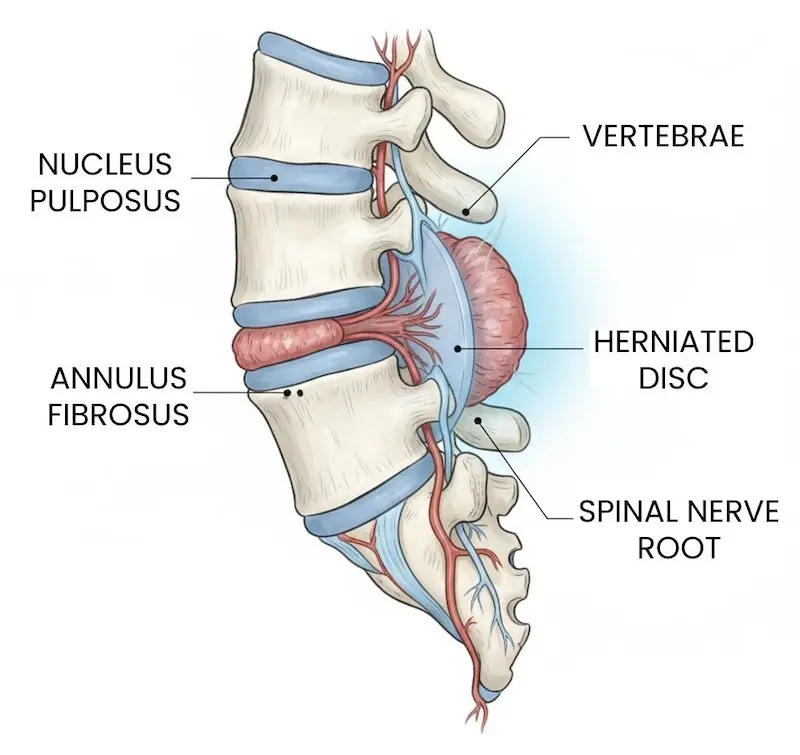
A sharp line of pain runs from your lower back, through one buttock, and down the back of your leg. Sitting makes it worse. So does a cough, a sneeze, or bending to lift something as light as a kettle. Maybe there is numbness in your foot now, or a pins-and-needles feeling that will not settle, or a leg that feels oddly weak when you climb stairs. These are the signatures of a herniated disc — a slipped or ruptured disc pressing on a nerve in your spine.
If this is your daily experience, you are in a very large group. Lumbar disc herniation affects roughly 1% to 3% of people, and it is the most common structural reason that a nerve in the lower back becomes painfully compressed. Around 95% of these herniations happen at the two lowest spinal levels, where the spine carries the most load. Many people travel the familiar route first — anti-inflammatory tablets, physiotherapy, a steroid injection — and for some that is enough. For others, the pain outlasts the treatments, and the next conversation is with a spine surgeon.
This article is for people weighing that decision. We will explain what herniated disc stem cell therapy actually involves, what the clinical studies show in real numbers, why some herniated discs shrink on their own (and why that matters for your choice), who is a genuine candidate, and where the evidence still has hard limits. Our team has worked in regenerative medicine in Malaysia for more than seven years, treating over 200 patients with allogeneic (donor-derived) umbilical cord mesenchymal stem cells. We do not call this a cure, and we will be just as clear about what it cannot do as what it might.
Table of Contents
- What a Herniated Disc Is — and Why Not Every Herniated Disc Behaves the Same
- The Limits of Standard Herniated Disc Treatment Before Surgery
- How Stem Cell Therapy Works on a Herniated Disc
- Allogeneic Umbilical Cord vs Autologous Cells for Herniated Disc Treatment
- What the Clinical Data Shows for Stem Cell Treatment of Herniated Discs
- Who Is — and Is Not — a Good Candidate for Herniated Disc Stem Cell Therapy
- Honest Risks and Limitations of Herniated Disc Stem Cell Therapy
- FAQ About Herniated Disc Stem Cell Therapy
- Ready to Think Through Your Herniated Disc Options?
- References
What a Herniated Disc Is — and Why Not Every Herniated Disc Behaves the Same
How a Herniated Disc Compresses the Nerve and Triggers Sciatica
Between each pair of bones in your spine sits a disc. Picture a small jam doughnut: a tough fibrous ring on the outside (the annulus fibrosus) and a soft, gel-like center (the nucleus pulposus). The disc works as a shock absorber, letting you bend and twist without grinding bone on bone.
A herniated disc happens when that soft center pushes through a weak spot or tear in the outer ring. Two things then cause pain. First, the bulging material can physically press on a nearby spinal nerve — most often the nerve that runs down the leg, which is why a back problem produces leg symptoms (sciatica). Second, the leaked disc material is chemically irritating; it sets off inflammation around the nerve root that makes the nerve hypersensitive, so it fires pain signals even at rest.
This is the key difference between a herniated disc and ordinary back stiffness. The trouble is not only mechanical pressure — it is an inflamed, chemically angry environment around a trapped nerve.
Why Some Herniated Discs Shrink on Their Own and Others Turn Chronic
Here is something most clinic websites leave out, and it should shape any decision you make. Herniated discs can resorb by themselves. The body recognizes the displaced disc material as something foreign and gradually breaks it down, and the bulge can genuinely shrink over weeks to months.
The likelihood depends on the type of herniation. A large systematic review found spontaneous regression rates of 96% for sequestrated discs (where a fragment has broken away), 70% for extrusions, 41% for protrusions, and 13% for bulges, with complete resolution in 43% of sequestrated discs. Counterintuitively, the more dramatic-looking herniations are often the most likely to disappear on their own.
This is exactly why the standard advice for a fresh herniation is to wait and manage conservatively first. Many people’s acute symptoms settle within four to six weeks. Stem cell therapy is not for that person. It becomes a reasonable conversation only when the herniation has not resorbed, the pain has become chronic, and conservative treatment has stopped helping — a genuinely different situation from a recent injury.
The Limits of Standard Herniated Disc Treatment Before Surgery
What Painkillers, Physiotherapy, and Epidural Injections Do for a Herniated Disc
The conventional treatment ladder for a herniated disc is well established and genuinely useful up to a point. Anti-inflammatory medication reduces the chemical irritation around the nerve and can make daily life bearable while the body does its own repair work. Physiotherapy strengthens the muscles that support the spine, improves movement patterns, and reduces the load that keeps the disc irritated. An epidural steroid injection delivers a concentrated dose of anti-inflammatory medicine right beside the inflamed nerve root, often buying weeks to a few months of relief.
What none of these do is change the disc itself. They turn down the volume on inflammation and pain; they do not restore the disc’s structure or stop a degenerating disc from declining further. For a chronic, non-resolving herniation, the same injection given repeatedly tends to deliver less each time, and long-term anti-inflammatory use carries its own risks to the stomach and heart. This is the same biological ceiling faced in broader lumbar disc degeneration that drives chronic low back pain, where regenerative approaches are being studied for similar reasons — you can read our detailed look at stem cell therapy for chronic low back pain for how the disc environment is targeted.
When Surgery Is Offered for a Herniated Disc — and Why Many Want Another Option
When conservative care fails and pain persists, the usual surgical option is a microdiscectomy: a surgeon removes the portion of disc material pressing on the nerve. In well-selected patients it can relieve leg pain quickly and effectively, and for certain emergencies it is the only correct answer.
But it is still surgery. It carries the risks of any spinal operation, a recovery period, and the possibility of re-herniation at the same level or accelerated wear at neighboring levels over time. It also removes tissue rather than restoring it — the disc is not made healthier by the procedure. Many people in their forties, fifties, and sixties find themselves in an uncomfortable middle: their leg pain is real and limiting, their MRI explains it, but they are not ready to accept an operation, and their injections and physiotherapy are no longer doing much. It is this specific group that most often starts asking whether stem cell therapy offers a credible biological alternative.
How Stem Cell Therapy Works on a Herniated Disc
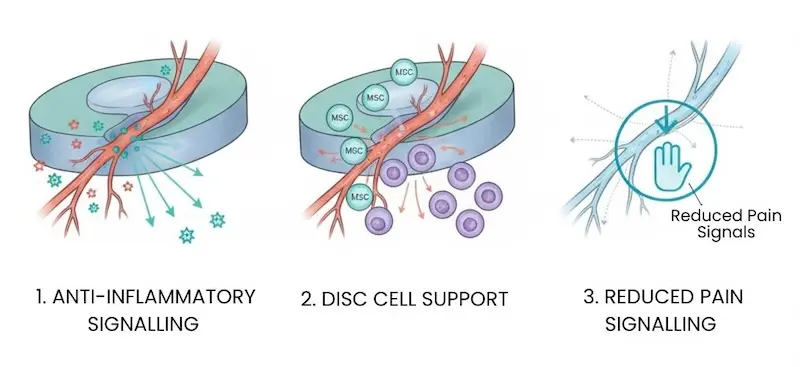
Mesenchymal stem cells, usually shortened to MSCs, are not painkillers and they do not simply turn into new disc tissue and rebuild a slipped disc. They work more like a repair coordinator: they release signaling molecules that change the local environment and instruct the body’s own cells. For a herniated disc, three actions matter most.
Reducing the Inflammation Around the Herniated Disc and Nerve Root
Much of the pain from a herniated disc comes from inflammation, not just pressure. MSCs release signaling proteins called cytokines (think of them as chemical messages between cells) that shift the area around the disc and nerve from an inflamed, irritated state toward a calmer one. By lowering the chemical signals that make the trapped nerve hypersensitive, this can reduce pain in a way many patients describe as more sustained and qualitatively different from a steroid injection.
Supporting Disc Cells and the Question of Bulge Reduction in Herniated Discs
The cells that keep the disc’s center plump and hydrated are slowly dying or struggling in a degenerated, herniated disc. MSCs have been shown to support the survival and activity of these cells and to encourage production of the proteins that give the disc its cushioning. In some patients this can translate into measurable changes on MRI — better disc hydration and, in some studies, a reduction in the size of the disc bulge itself. This is the structural hope behind the treatment, though, as we discuss below, it does not happen for everyone.
Modulating the Pain Signals Driven by a Herniated Disc
Chronic pain is partly a nervous-system phenomenon: nerves that have been irritated for a long time become sensitized and amplify signals. Research suggests MSCs can dampen this sensitization in the nerve roots beside a damaged disc. This helps explain why some people report pain improvement that seems greater than the modest structural change visible on their scans.
Allogeneic Umbilical Cord vs Autologous Cells for Herniated Disc Treatment
Not all stem cell treatments are the same, and the cell source has real consequences for a herniated disc.
Why Autologous Stem Cells for a Herniated Disc Have Limits
In Japan and several other countries, most clinics use autologous cells — taken from the patient’s own bone marrow or fat. The advantage is obvious: your own cells carry no rejection risk. The drawback is biological age. The stem cells of a 60-year-old with several degenerating lumbar discs are, on average, fewer in number and weaker in repair signaling than those of a young, healthy donor. The very people most likely to need disc repair tend to have the least capable cells to harvest, and the harvesting itself (a marrow draw or liposuction) is an extra invasive step.
The Allogeneic Umbilical Cord MSC Approach Used in Malaysia for Herniated Disc
We use allogeneic MSCs from donated umbilical cord tissue — specifically the Wharton’s jelly layer — collected after healthy, consented deliveries. These are among the youngest and most active MSCs available, with strong repair and anti-inflammatory signaling. Because they carry low levels of the markers that normally trigger immune rejection, reactions are rare, and they can be prepared in consistent, quality-checked doses so that potency is verified before treatment. These are the same allogeneic cord-derived cells we use for conditions such as knee osteoarthritis, chosen for the same reasons of cell youth and consistency. For a herniated disc, this matters because the quality and quantity of the cells reaching the disc environment directly affect what is biologically possible.
What the Clinical Data Shows for Stem Cell Treatment of Herniated Discs
Key Trials on Intradiscal MSC Therapy for Disc Herniation
The evidence here is younger than for surgery, but it is more specific than most marketing suggests. Several points are worth knowing honestly.
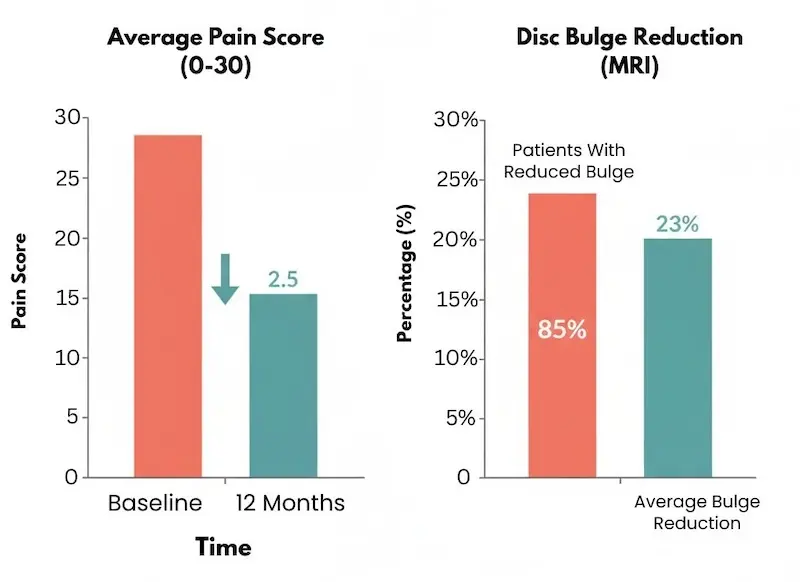
The most herniation-relevant data comes from a study by Centeno and colleagues, published in the Journal of Translational Medicine in 2017. Patients with disc-related radicular (nerve) pain received intradiscal injections of culture-expanded autologous MSCs and were followed for up to six years. Of the patients who had follow-up MRI scans, 85% showed a reduction in the size of their disc bulge, with an average reduction of 23%, alongside significant improvements in pain and function. This is the kind of structural change — the bulge actually getting smaller — that patients most want to hear about, though it came from an observational registry rather than a controlled trial.
A prospective study by Pettine and colleagues in the journal Stem Cells followed 26 patients with discogenic low back pain who received injections of their own bone marrow concentrate. At 12 months, their average pain score on a 0-to-10 scale fell from 6.1 to 2.5, with a meaningful share of patients showing improvement in disc health on standardized MRI grading.
The most methodologically rigorous design to date is a randomized controlled trial by Noriega and colleagues, published in Transplantation in 2017. Patients with disc degeneration received either a single intradiscal injection of allogeneic mesenchymal cells or a sham injection; at 12 months the treated group showed significantly better pain and disability scores than controls, along with MRI signs of improved disc hydration not seen in the control group. An earlier pilot by Orozco and colleagues, in the same journal, reported pain reduction beginning within three months and improved disc hydration on MRI at one year.
It is also fair to state the skeptical view that some spine surgeons hold: no large, long-term controlled trial has yet proven that stem cells reliably repair the torn outer ring of a herniated disc. The honest summary is that the data shows real pain and function benefits and, in some patients, real structural improvement — but it is still an emerging, not a settled, field.
What Realistic Improvement Looks Like After Herniated Disc Stem Cell Therapy
We want to be precise, because curated best-case stories do patients a disservice. Based on the published trials and our own experience, the realistic picture is this. Improvement, when it comes, is usually gradual — first noticeable changes typically appear somewhere between six and sixteen weeks, not in the first days. Pain reduction is more often partial than total; many people move from a 6 or 7 out of 10 down to a 3 or 4. Functional wins — sitting longer, sleeping through the night, walking further, using less medication — often arrive alongside or just before the pain change. MRI changes, where they happen, usually become visible around the six-to-twelve-month mark. And a meaningful minority of patients do not improve significantly. Anyone who promises certainty is not being straight with you.
Who Is — and Is Not — a Good Candidate for Herniated Disc Stem Cell Therapy
Herniated Disc Patients Who May Benefit from Stem Cell Therapy
Stem cell therapy for a herniated disc is most likely to help people whose situation fits a particular profile: a confirmed disc herniation on MRI with some disc height remaining (not a completely collapsed, end-stage disc); symptoms that have persisted for at least several months despite consistent conservative treatment, meaning the herniation has not resorbed on its own; pain that is genuinely disc-related rather than coming mainly from a different source such as the hip or sacroiliac joint; no surgical emergency; reasonable overall health, without active cancer, active infection, or uncontrolled autoimmune disease; and a realistic understanding that results emerge slowly over months and are not guaranteed.
When Herniated Disc Stem Cell Therapy Is the Wrong Choice
We actively advise against treatment when the clinical picture points elsewhere. Some signs are red flags that require prompt surgical attention, not stem cells: progressive weakness such as a foot that drops, or any loss of bladder or bowel control, which can signal serious nerve compression and needs urgent assessment. A large fragment causing severe, dense nerve compression is usually a job for decompression surgery, because stem cells cannot physically lift disc material off a crushed nerve. A recent herniation that has not yet had time to resorb naturally is also not a candidate — waiting and conservative care come first. And anyone needing fast relief for an imminent deadline or event is poorly matched to a treatment that works on a slow biological timeline. If your honest situation falls into these groups, we will tell you so.
Recovery and Follow-Up After Herniated Disc Stem Cell Treatment
Recovery is far lighter than after spinal surgery. We advise rest and avoiding heavy lifting, prolonged sitting, and high-impact activity for the first few weeks; a temporary increase in soreness during this window is expected and does not mean the treatment has failed. Most patients can travel home within two to three days, and return to office-based work within about a week, with moderate activity reintroduced over the following weeks under guidance. We then schedule follow-up at three, six, and twelve months, with a repeat MRI at twelve months to look objectively at any structural change, and standardized pain and function questionnaires at each visit to track your response over time. The single most important message about recovery is patience — the cells need time to calm inflammation and support the disc, so judging the outcome at three weeks is premature.
Honest Risks and Limitations of Herniated Disc Stem Cell Therapy
Known Side Effects of Intradiscal Stem Cell Injection
Across published studies, the safety profile of intradiscal MSC injection has been generally favorable. The most common effects are temporary: soreness at the injection site, a short-lived increase in back pain for one to two weeks, and occasionally a mild low-grade fever in the first day or two. The most serious concern with any injection into a disc — including standard steroid injections — is disc space infection (discitis), which is rare. We perform the procedure under strict sterile conditions with imaging guidance to minimize this risk, though no procedure can eliminate it entirely. Longer-term safety data beyond two to three years remains limited because the field is young, and we disclose this to every patient.
What Stem Cell Therapy Cannot Do for a Herniated Disc
We want to be specific about the boundaries. Stem cell therapy cannot physically pull a fragment of disc off a severely compressed nerve — that is what decompression surgery is for. It cannot rebuild a completely collapsed, end-stage disc. It cannot reverse a progressive neurological deficit, which is a surgical emergency. And it cannot guarantee improvement: a real proportion of treated patients do not get meaningfully better, and we do not yet have reliable ways to predict in advance who will respond. If you are in severe, rapidly worsening pain right now, intensified conservative care or a surgical opinion may be the more appropriate immediate path. These are not reasons to dismiss the treatment; they are the context in which it should be considered.
FAQ About Herniated Disc Stem Cell Therapy
In some patients, yes — imaging studies have shown reductions in disc bulge size after intradiscal MSC injection, and many herniations also shrink on their own over time. But it does not happen for everyone, and the change, when it occurs, is usually partial rather than complete. We treat bulge reduction as a hopeful possibility, not a promise.
A steroid injection calms inflammation quickly but temporarily, and does nothing to the disc itself. Stem cell therapy works more slowly, aiming to reduce inflammation and support the disc’s own cells over months. The trade-off is speed for a potentially more sustained, biological effect.
Possibly. Stem cell therapy is an attempt to avoid or delay surgery, not a replacement for it in every case. If your symptoms do not improve, or if a red flag such as progressive weakness develops, surgery remains available and may be the right choice.
The medical review happens remotely before travel. The in-person consultation and the injection itself are usually completed within a few days, and most patients travel home within two to three days of the procedure.
This is an out-of-pocket medical treatment performed in Malaysia and is generally not covered by insurance. We discuss the practical details transparently during the consultation.
Ready to Think Through Your Herniated Disc Options?
If you have read this far, you are probably someone who has already tried the usual treatments and is genuinely trying to work out whether stem cell therapy makes sense for your particular herniation. That is exactly the kind of conversation we are here for. We offer free online consultations where you can share your MRI, your treatment history, and your questions, and we will give you an honest read on whether you look like a realistic candidate — and if you are not, we will tell you why and what might suit you better. You do not need to have decided anything to reach out; the conversation itself is the first useful step.
References
- Centeno C, Markle J, Dodson E, et al. Treatment of lumbar degenerative disc disease-associated radicular pain with culture-expanded autologous mesenchymal stem cells: a pilot study on safety and efficacy. J Transl Med. 2017;15(1):197. https://doi.org/10.1186/s12967-017-1300-y
- Noriega DC, Ardura F, Hernández-Ramajo R, et al. Intervertebral disc repair by allogeneic mesenchymal bone marrow cells: a randomized controlled trial. Transplantation. 2017;101(8):1945–1951. https://doi.org/10.1097/TP.0000000000001484
- Pettine KA, Murphy MB, Suzuki RK, Sand TT. Percutaneous injection of autologous bone marrow concentrate cells significantly reduces lumbar discogenic pain through 12 months. Stem Cells. 2015;33(1):146–156. https://doi.org/10.1002/stem.1845
- Orozco L, Soler R, Morera C, Alberca M, Sánchez A, García-Sancho J. Intervertebral disc repair by autologous mesenchymal bone marrow cells: a pilot study. Transplantation. 2011;92(7):822–828. https://doi.org/10.1097/TP.0b013e3182198063
- Chiu CC, Chuang TY, Chang KH, Wu CH, Lin PW, Hsu WY. The probability of spontaneous regression of lumbar herniated disc: a systematic review. Clin Rehabil. 2015;29(2):184–195. https://doi.org/10.1177/0269215514540919
- Dydyk AM, Ngnitewe Massa R, Mesfin FB. Disc Herniation. StatPearls. Treasure Island (FL): StatPearls Publishing; 2023. https://www.ncbi.nlm.nih.gov/books/NBK441822/