

Atherosclerosis Stem Cell Therapy | Can Plaque Buildup Actually Be Reversed?
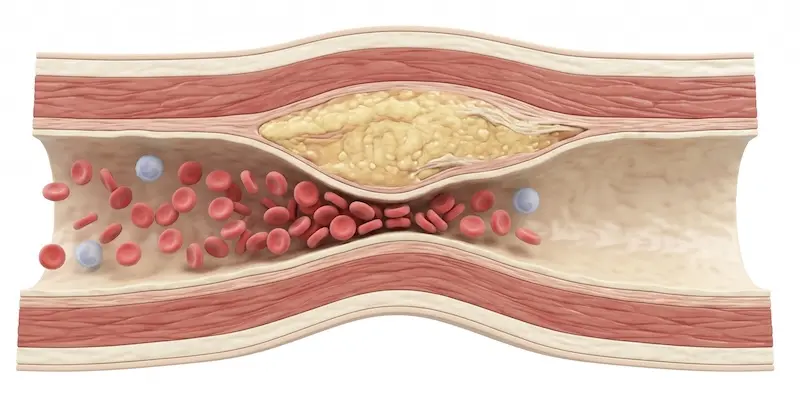
The report did not hurt. That was almost the strange part. There was no broken bone, no swollen joint, nothing you could point to. Just a word on a scan or a blood-test summary that you had to look up afterwards: atherosclerosis. Maybe it followed a scare — a tightness in the chest while walking up a slope, a cramp in the calf that came on after a certain distance and eased when you stopped. Maybe it was found on a routine check. Either way, the message was the same: the arteries that carry blood through your body are narrowing, and the process has probably been quietly underway for years.
If that describes you, you are among a very large group. Cardiovascular disease — most of which is driven by atherosclerosis — is the leading cause of death worldwide, responsible for an estimated 18.6 million deaths a year, with more than 500 million people living with some form of it. Most people who reach a diagnosis are handed the same plan: take a statin, control your blood pressure, change your diet, and if a vessel becomes dangerously narrow, have a stent placed or undergo bypass surgery. For many, that plan works well and is genuinely life-saving. For others, the numbers improve on paper while the underlying worry remains — and the natural question becomes whether anything actually addresses the process inside the artery wall itself.
In recent years, stem cell therapy has entered that conversation. Some clinics make it sound like a way to wash the pipes clean; some doctors dismiss it outright. We want to take a more useful path. In this article we explain what atherosclerosis really is, how stem cells are proposed to act on it, and — most importantly — we are honest about where the evidence is genuinely strong and where it is still early. We are a clinical team based in Malaysia with over seven years of experience and more than 200 patients treated using allogeneic (donor-derived) umbilical cord mesenchymal stem cells. We will not tell you this dissolves plaque, because it does not. What we can do is lay out, plainly and without hype, what this approach can and cannot offer.
Table of Contents
- What Atherosclerosis Actually Is, and Why Arteries Do Not Clear Themselves
- The Limits of Statins, Stents, and Bypass Surgery for Atherosclerosis
- How Stem Cell Therapy Targets Atherosclerosis Differently
- What the Research Actually Shows About Stem Cells and Atherosclerosis
- Allogeneic Umbilical Cord MSCs vs. Autologous Cells for Atherosclerosis
- Who Is, and Is Not, a Good Candidate for Atherosclerosis Stem Cell Therapy
- Honest Risks and Limitations of Atherosclerosis Stem Cell Therapy
- FAQ About Atherosclerosis Stem Cell Therapy
- What You Can Do Next
- References
What Atherosclerosis Actually Is, and Why Arteries Do Not Clear Themselves
How Plaque Builds Up in the Atherosclerosis Process
Picture the inside of an artery as a smooth, living tube. The innermost layer is called the endothelium — a single sheet of cells, only one cell thick, that lines the vessel and keeps blood flowing cleanly. In atherosclerosis, this lining becomes damaged and slightly leaky, often through years of high cholesterol, high blood pressure, smoking, or high blood sugar. Once the lining is injured, particles of LDL cholesterol (the kind often called “bad” cholesterol) slip into the artery wall and become chemically altered.
The body treats those altered particles as a threat. White blood cells called macrophages — the immune system’s clean-up crew — move into the wall and start swallowing the cholesterol. When they become overloaded, they swell into what scientists literally call foam cells, and these foam cells pile up to form the early streak of a plaque. Over years, this deposit grows, hardens, and narrows the channel. The trouble is that an artery wall, unlike a cut on your skin, has almost no way to reverse this on its own. There is no natural mechanism that scoops the deposit back out. The damage accumulates.
Why Atherosclerosis Is Driven by Inflammation, Not Just Cholesterol
For a long time, atherosclerosis was explained almost entirely as a plumbing problem — too much cholesterol clogging a pipe. That picture is now understood to be incomplete. Atherosclerosis is, at its core, an inflammatory disease. The plaque is not an inert clog; it is a living, inflamed site where immune cells release signalling molecules called cytokines (think of them as chemical messages that summon more immune cells and keep the reaction going).
This matters because inflammation creates a self-feeding loop. The more inflamed the plaque, the more immune cells arrive; the more immune cells, the more the wall is damaged and the more unstable the deposit becomes. And an unstable plaque is the truly dangerous kind — one that can crack open and trigger a clot, which is what causes most heart attacks and many strokes. So the real enemy in atherosclerosis is not only the size of the plaque, but how inflamed and unstable it is. This is the biology that stem cell therapy is being studied to influence.
The Limits of Statins, Stents, and Bypass Surgery for Atherosclerosis
What Statins and Risk-Factor Control Can, and Cannot, Do for Atherosclerosis
Statins are one of the most successful medications in modern medicine, and nothing here is a criticism of them. They lower LDL cholesterol, they modestly calm inflammation, and across millions of patients they clearly reduce heart attacks and strokes. Controlling blood pressure, stopping smoking, and managing blood sugar all add to that protection. For many people with atherosclerosis, this combination keeps the disease stable for decades.
What these tools do less of is address the inflammation that remains even when cholesterol is well controlled. Cardiologists now talk openly about residual inflammatory risk — the meaningful number of patients whose cholesterol numbers look excellent on treatment but whose arteries are still quietly inflamed, and who continue to have events anyway. This residual risk is precisely the gap that interests researchers in regenerative medicine, because it is a biological problem that current drugs only partly solve.
When Stents and Bypass Surgery Reach Their Limit in Atherosclerosis
When a single segment of artery becomes critically narrowed or blocked, mechanical solutions can be remarkable. A stent props the vessel open; bypass surgery reroutes blood around the blockage. In the right patient — especially someone with chest pain from a tight coronary artery, or someone in the middle of a heart attack — these procedures save lives and should never be delayed.
While a stent effectively treats a specific blockage, it does not cure the disease itself. Atherosclerosis is typically a diffuse condition that affects multiple blood vessels simultaneously. Because the underlying tendency to form plaque persists after a procedure, new narrowings can develop elsewhere, and the areas immediately surrounding a stent or bypass graft often become fresh problems over time. Furthermore, surgical interventions carry their own inherent risks and recovery demands.
For patients who have done everything right—optimizing their medication, adopting lifestyle changes, and perhaps already receiving a stent—it can be frustrating to face a genuine gap in treatments that address the biology of the entire arterial system rather than just a single segment. Over many years, narrowed coronary arteries can continuously starve the heart muscle, eventually leading to ischemic heart failure. This is exactly why managing the underlying disease process is so crucial well before it reaches that point.
How Stem Cell Therapy Targets Atherosclerosis Differently
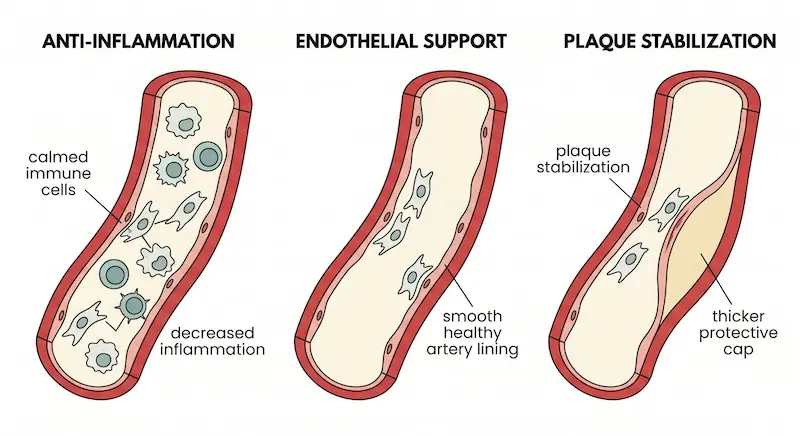
It is important to start with what mesenchymal stem cells (MSCs) do not do. They do not act like a drain cleaner that flushes existing plaque out of the artery. They do not turn into new artery and rebuild the vessel. Anyone who frames it that way is overselling it. What MSCs appear to do — based mostly on laboratory and animal research so far — is change the local environment of the artery wall through signalling, the way a mediator changes the temperature of a room rather than rebuilding the room. Three mechanisms are most relevant.
Mechanism One: Calming Inflammation in the Atherosclerotic Artery Wall
Mesenchymal Stem Cells (MSCs) are best understood as cellular communicators that “talk” directly to the immune system. They release molecules that shift immune cells inside an arterial plaque away from an aggressive, tissue-damaging state and toward a calmer, clean-up-and-repair state.
In practical terms, this immunomodulation works by:
- Calming the local environment: Nudging overloaded macrophages and foam cells out of “attack mode.”
- Targeting the root cause: Inflammation is the engine that drives atherosclerosis and keeps plaques unstable. By quieting this inflammation, MSCs theoretically slow the disease at its source, rather than simply lowering a cholesterol number.
This same signalling mechanism is exactly what makes MSCs a strong focal point for treating rheumatoid arthritis—another condition where the primary goal is to quiet an immune system that has become chronically overactive.
Mechanism Two: Supporting the Endothelium, the Artery’s Inner Lining, in Atherosclerosis
Remember that the whole process starts when the endothelium — that one-cell-thick lining — becomes damaged and leaky. MSCs secrete growth factors, which are chemical messengers that encourage neighbouring cells to survive and repair. In the context of atherosclerosis, these signals are thought to support the health and integrity of the endothelial lining, helping it stay smooth and less permeable to the cholesterol particles that begin the cascade. A healthier lining is, in essence, a wall that is harder for new plaque to take hold in.
Mechanism Three: Shifting Plaque Toward a More Stable State in Atherosclerosis
This is the mechanism that may matter most clinically, and it is also the most honest way to frame the goal. The danger of a plaque is not only its size but its instability — a thin, inflamed cap over a soft fatty core is the kind that ruptures and causes a heart attack. By reducing inflammation within the plaque, MSCs are proposed to encourage a more stable structure: a thicker, calmer fibrous cap and fewer inflammatory cells inside. The plaque does not disappear, but it may become less likely to crack. In a disease where the catastrophic event is a sudden rupture, making plaque safer is a meaningful aim in its own right, even when the plaque itself remains.
What the Research Actually Shows About Stem Cells and Atherosclerosis
Where the Atherosclerosis Evidence Is Strong, and Where It Is Still Preclinical
Here we have to be more careful than in some other conditions, and we would rather be honest than impressive. The strongest evidence that inflammation drives atherosclerotic events comes from a large human trial called CANTOS, published in 2017, which tested an anti-inflammatory antibody (canakinumab) in patients who had already had a heart attack. It found that targeting inflammation directly — without changing cholesterol at all — reduced the rate of further cardiovascular events. That trial did not use stem cells. What it established is the principle: calming arterial inflammation can change outcomes. This is the biological rationale that stem cell research is built on.
The evidence for MSCs acting on atherosclerosis specifically, however, is at an earlier stage. Most of it comes from laboratory studies and animal models. In mice bred to develop atherosclerosis, for example, infusions of mesenchymal stem cells have been shown to reduce the size and inflammatory content of plaques. These findings are consistent and encouraging, and they point in the same direction as the inflammation principle from CANTOS. But mice are not people, and a result in a mouse artery is a hypothesis about a human one, not a proof. There are not yet large, long-term randomised controlled trials in humans showing that MSC therapy reduces heart attacks or strokes in people with atherosclerosis. We tell every patient this directly, because a patient who is told otherwise cannot make a real decision.
Related Cardiovascular Trial Data Relevant to Atherosclerosis
Where the human data is more developed is in the broader cardiovascular use of MSCs, which is relevant because it tells us a great deal about safety. The POSEIDON trial, published in 2012, gave mesenchymal stem cells to patients with heart failure caused by coronary artery disease — that is, by the downstream consequences of atherosclerosis. It directly compared donor-derived cells against patients’ own cells, and importantly, it found no serious immune rejection from the donor cells and a generally favourable safety profile. This does not prove that stem cells treat atherosclerosis itself, but it gives reasonable confidence that infusing allogeneic MSCs in cardiovascular patients is well tolerated. So the honest summary is this: strong human evidence that inflammation matters, strong animal evidence that MSCs calm it, good human safety data for MSC infusion in cardiovascular patients, and not yet the large human efficacy trials in atherosclerosis specifically. That is the true picture, and it is the picture a patient deserves.
Allogeneic Umbilical Cord MSCs vs. Autologous Cells for Atherosclerosis
Why Your Own Cells May Be Compromised in Atherosclerosis
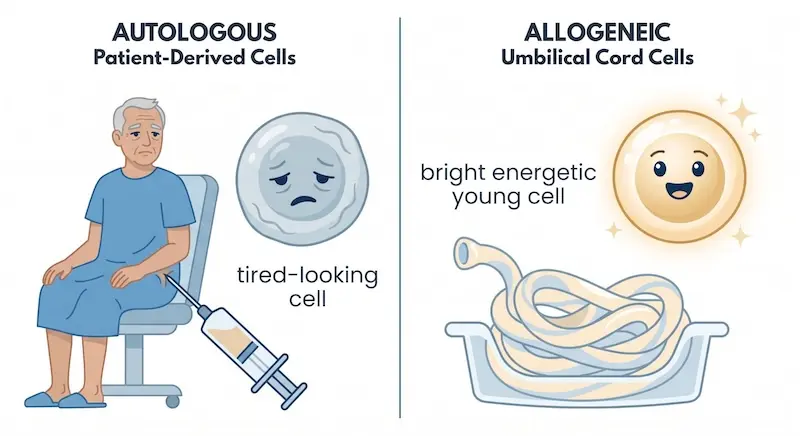
Stem cell therapy can use cells taken from the patient’s own body (autologous) or from a healthy donor (allogeneic). In Japan and several other countries, the regulatory framework favours autologous treatment, where cells are harvested from the patient’s own bone marrow or fat tissue. The clear advantage is that there is no risk of rejection, because the cells are genetically the patient’s own.
The drawback is particularly relevant for atherosclerosis. The people who need this most are typically older and already living with cardiovascular disease — and research has repeatedly shown that stem cells taken from older patients, and especially from patients with established cardiovascular disease, are measurably less potent. They multiply less readily and release fewer of the beneficial anti-inflammatory signals. In other words, the body whose arteries are already inflamed tends to provide the least capable cells to treat that inflammation.
The Allogeneic Umbilical Cord Approach Used in Malaysia for Atherosclerosis
The treatment we provide in Malaysia uses allogeneic mesenchymal stem cells drawn from donated umbilical cord tissue (specifically a layer called Wharton’s jelly), collected at the time of a healthy birth with full donor consent. These are among the youngest and most active MSCs available. They have not spent decades exposed to high cholesterol, high blood pressure, or the wear of a long life, so their anti-inflammatory signalling capacity is high.
They also have a quality that makes them practical and safe to use from a donor: low immunogenicity, meaning they are relatively “quiet” to the recipient’s immune system, which is why rejection reactions are very rare and why the POSEIDON trial saw no serious immune problems with donor cells. They can be prepared in standardised, quality-tested batches, so potency can be verified before each treatment. There is no need for any invasive procedure to harvest cells from the patient, and the treatment is delivered as an intravenous infusion, similar to a routine drip.
Who Is, and Is Not, a Good Candidate for Atherosclerosis Stem Cell Therapy
Atherosclerosis Profiles That May Benefit from Stem Cell Therapy
Because this is an emerging area, we are conservative about who we accept, and we say so. The patients for whom this approach is most reasonable to consider tend to share a profile: they have established atherosclerosis that is stable rather than in crisis; they are already on optimised conventional treatment, including a statin and blood-pressure control, taken consistently; and they are interested in addressing the residual inflammatory component of their disease rather than abandoning their existing medicine. Often they have markers of ongoing inflammation, such as an elevated high-sensitivity CRP (a simple blood test that measures inflammation in the body), despite well-controlled cholesterol. They understand that any benefit would be gradual, would work alongside their current care, and is not guaranteed.
When Atherosclerosis Stem Cell Therapy Is Not Appropriate
There are situations where we advise clearly against it. Anyone with an acute event — a heart attack, unstable chest pain, or a stroke in progress — needs emergency, established medical care, not an elective infusion; stem cells are not an emergency treatment. A critically narrowed artery that is causing symptoms usually needs a stent or bypass first, because no infusion can mechanically open a dangerously blocked vessel. Active cancer, active infection, and uncontrolled bleeding or clotting disorders are contraindications. And anyone hoping to use this as a reason to stop their statin or their blood-pressure medication is not a suitable candidate, because that is the opposite of how this should be used. We would rather turn someone away than let them trade proven treatment for an unproven one.
Recovery and Follow-Up After Atherosclerosis Stem Cell Therapy
Recovery is undemanding compared with any surgical procedure. The most commonly reported effects are mild and short-lived — a low-grade fever, tiredness, or a mild headache in the day or two after the infusion — and most patients are comfortable travelling home within two to three days. You are explicitly asked to continue every one of your existing cardiovascular medications without interruption; this treatment is designed to sit alongside conventional care, never to replace it. We arrange follow-up to track how you are doing and to review inflammatory markers and any imaging over the months that follow, because any biological effect would be expected to emerge gradually rather than overnight.
Honest Risks and Limitations of Atherosclerosis Stem Cell Therapy
Known Side Effects of Atherosclerosis Stem Cell Therapy
The safety profile of intravenous allogeneic MSC infusion, across cardiovascular trials, has been generally reassuring, and this is supported by the no-serious-rejection finding from the POSEIDON comparison. The usual reactions are temporary: mild fever, transient fatigue, and occasional headache, all consistent with a mild immune response to donor cells and resolving on their own. Because MSCs influence immune activity, anyone on other medications affecting the immune system requires careful review beforehand. As with any infusion, rare reactions are possible, which is why treatment takes place under medical supervision.
What Stem Cell Therapy Cannot Do for Atherosclerosis
We want to be as plain about the limits as about the possibilities. Stem cell therapy cannot dissolve or remove plaque that is already in your arteries. It cannot open a critically blocked vessel — that is what stents and surgery are for. It cannot replace your statin, your blood-pressure tablets, or your lifestyle changes, and it should never be used as a reason to stop them. And, most importantly, the human evidence for treating atherosclerosis specifically is still early and largely preclinical; there are not yet large long-term trials proving it prevents heart attacks or strokes. The most honest framing is that this is an attempt to calm the inflammatory process and support the artery wall, offered within an awareness of how much we do not yet know. For a patient who values that goal and understands that uncertainty, it can be worth a careful conversation. For a patient who wants a guarantee, it is not.
FAQ About Atherosclerosis Stem Cell Therapy
No. It does not act on existing plaque like a drain cleaner. The proposed benefit is calming the inflammation in and around plaque and supporting the artery lining, which in research is associated with more stable, less rupture-prone plaque rather than smaller plaque.
A statin mainly lowers cholesterol and modestly reduces inflammation across the whole body. MSCs are proposed to act through direct immune signalling at the level of inflamed tissue. They are intended to work alongside statins, not instead of them.
No, and you should not. We ask patients to continue all prescribed cardiovascular medication without interruption. Any changes to medication should only ever be made by the doctor managing your cardiovascular care.
There is strong human evidence that inflammation drives atherosclerotic events, and strong animal evidence that MSCs reduce arterial inflammation, plus good human safety data for MSC infusion in cardiovascular patients. What does not yet exist is large, long-term human trials proving it reduces heart attacks or strokes in atherosclerosis specifically. We disclose this to every patient.
Generally no. It is an elective treatment provided as private care in Malaysia and is not part of standard insured cardiovascular treatment.
What You Can Do Next
If you have read this far, you are most likely someone who is already doing the conventional things right and is genuinely trying to work out whether this makes sense for your particular situation — not someone looking for a miracle. That is exactly the kind of conversation we are glad to have. We offer free online consultations where you can share your history, your scans, and your questions, and we will give you an honest view of whether we think you are a reasonable candidate or whether, in your case, the more sensible path is to stay with your current care. You do not need to have decided anything to reach out; the conversation itself costs you nothing.
References
- Roth GA, Mensah GA, Johnson CO, et al. “Global Burden of Cardiovascular Diseases and Risk Factors, 1990–2019.” Journal of the American College of Cardiology. 2020;76(25):2982–3021. https://doi.org/10.1016/j.jacc.2020.11.010
- Libby P, Buring JE, Badimon L, et al. “Atherosclerosis.” Nature Reviews Disease Primers. 2019;5(1):56. https://doi.org/10.1038/s41572-019-0106-z
- Ridker PM, Everett BM, Thuren T, et al. “Antiinflammatory Therapy with Canakinumab for Atherosclerotic Disease (CANTOS).” New England Journal of Medicine. 2017;377(12):1119–1131. https://doi.org/10.1056/NEJMoa1707914
- Frodermann V, et al. “Mesenchymal stem cells reduce murine atherosclerosis development.” Scientific Reports. 2015;5:15559. https://doi.org/10.1038/srep15559
- Hare JM, Fishman JE, Gerstenblith G, et al. “Comparison of allogeneic vs autologous bone marrow–derived mesenchymal stem cells delivered by transendocardial injection in patients with ischemic cardiomyopathy: the POSEIDON randomized trial.” JAMA. 2012;308(22):2369–2379. https://doi.org/10.1001/jama.2012.25321
- Le Blanc K, Ringdén O. “Immunomodulation by mesenchymal stem cells and clinical experience.” Journal of Internal Medicine. 2007;262(5):509–525. https://doi.org/10.1111/j.1365-2796.2007.01844.x