

Multiple Sclerosis Stem Cell Therapy | Slowing Progression Without Chemotherapy

The morning starts with the same negotiation it has started with for months. Get up slowly. Test which leg is willing to bear weight today. Check whether the visual blur that started last Tuesday has improved, stayed the same, or quietly grown worse. By the time most people are out the door, you have already completed a full inventory of a nervous system that does not always tell you the truth about itself.
If multiple sclerosis is the background pattern of your life, you are part of a population of roughly 2.9 million people worldwide, according to the most recent update to the Atlas of MS. Somewhere in the world, someone is diagnosed every five minutes. Most of those people are now on a disease-modifying therapy — an interferon, glatiramer, a fumarate, a sphingosine modulator, an anti-CD20 antibody, or a JAK-related agent. These drugs have genuinely changed the trajectory of multiple sclerosis for many. They have also, for a significant proportion of patients, reached a ceiling — the relapses slow but the underlying progression continues, the fatigue stays, the side effects accumulate, and the conversation eventually shifts from “controlling the disease” to “what else is there?”
This article is written for the people asking that question. We will explain how stem cell therapy approaches multiple sclerosis biologically, what the clinical data actually shows — including the trials that did not work — and how mesenchymal stem cell treatment differs from the more aggressive HSCT (hematopoietic stem cell transplant with chemotherapy) that most people have heard about. We will be direct about who is likely to benefit, who is not, and where the honest limits of the current evidence sit. Our team has been working in regenerative medicine in Malaysia for over seven years, with more than 200 patients treated using allogeneic umbilical cord-derived mesenchymal stem cells. We do not believe stem cell therapy is right for everyone with multiple sclerosis, and we will say so when it is not.
Table of Contents
- Why Multiple Sclerosis Continues to Progress Even on Treatment
- The Ceiling of Multiple Sclerosis Disease-Modifying Therapy
- Two Very Different Stem Cell Approaches for Multiple Sclerosis
- How Mesenchymal Stem Cells Work in Multiple Sclerosis: Three Mechanisms
- What Clinical Trials Have Actually Shown for Multiple Sclerosis Stem Cell Therapy
- Who Tends to Respond to Multiple Sclerosis Stem Cell Therapy — and Who Does Not
- One Patient's Year With Multiple Sclerosis Stem Cell Therapy
- Honest Risks and Limitations of Multiple Sclerosis Stem Cell Therapy
- FAQ About Multiple Sclerosis Stem Cell Therapy
- A Conversation About Your Specific Multiple Sclerosis Case
- References
Why Multiple Sclerosis Continues to Progress Even on Treatment
The Autoimmune Damage Cycle in Multiple Sclerosis
Multiple sclerosis is not simply a problem of the nerves. It is a problem of the immune system, which mistakenly identifies myelin — the fatty insulation surrounding nerve fibers in the brain and spinal cord — as foreign tissue and attacks it. When the insulation around an electrical wire degrades, signals start to leak, slow down, or fail entirely. The same thing happens inside the central nervous system in multiple sclerosis. Vision falters because signals between the eye and the brain are disrupted. Limbs feel heavy because motor signals cannot reach muscles cleanly. Fatigue settles in because the nervous system has to work harder to do the same things it used to do effortlessly.
Once myelin is lost, the body attempts to repair it through specialized cells called oligodendrocytes, supported by oligodendrocyte precursor cells already present in the brain. Some remyelination does occur, especially in younger patients and during the relapsing-remitting phase of the disease. But this repair capacity has limits. With repeated attacks at the same sites, the local environment becomes increasingly inflammatory, hostile to repair, and eventually the underlying nerve fibers themselves — the axons — begin to die. Unlike myelin, axons cannot regenerate meaningfully in the human central nervous system. Once they are gone, the function they carried is gone.
This is the fundamental architecture of progressive disability in multiple sclerosis. Each inflammatory episode chips away at the system. Even when relapses appear to recover fully on the outside, microscopic damage often remains.
Why Remyelination Falls Short on Its Own in Multiple Sclerosis
The shift from relapsing-remitting multiple sclerosis to a progressive phase — secondary progressive MS — is what most patients fear, because it is the point at which steady decline replaces episodic attacks. Research over the past decade has shown that this transition is not driven primarily by new inflammatory lesions. It is driven by chronic, low-grade inflammation deep inside the brain and spinal cord, alongside ongoing failure to repair the damage that earlier attacks left behind.
What this means in practical terms is sobering. Disease-modifying therapy can dampen the immune attacks that produce new lesions. It can reduce relapses, and in many cases, it can reduce the number of new MRI findings substantially. What it does not do, in most patients, is fundamentally reset the immune system’s tendency to attack the nervous system, address the smoldering inflammation that drives progression, or stimulate the kind of repair signals that might help remyelination succeed where it has been failing. This biological gap is the space that stem cell research has been trying to occupy.
The Ceiling of Multiple Sclerosis Disease-Modifying Therapy
What DMTs and Biologics Can Realistically Do in Multiple Sclerosis
The current era of multiple sclerosis treatment is, on balance, the best era there has ever been. There are now more than fifteen approved disease-modifying therapies. For someone diagnosed with relapsing-remitting multiple sclerosis today, the prognosis is meaningfully better than it would have been twenty years ago. High-efficacy options like ocrelizumab, ofatumumab, and natalizumab have shown substantial reductions in relapse rates and new MRI lesion formation. For many patients, these drugs achieve what the field calls NEDA — no evidence of disease activity — for years at a time.
This success is real and it should not be minimized. Anyone considering additional therapy alongside DMTs is doing so in the context of treatments that genuinely help.
The honest counterpoint is that these therapies operate primarily by suppressing immune activity. They reduce the number and severity of attacks. They do not, in most cases, repair existing damage. They do not stop the underlying tendency of the immune system to mistake myelin for an enemy. And in a significant minority of patients, they do not adequately control disease progression even when used at high efficacy. The transition from relapsing-remitting to secondary progressive multiple sclerosis still occurs in a substantial proportion of patients over the long term, despite continuous DMT treatment.
When Multiple Sclerosis Drugs Lose Their Grip
Several patterns drive patients to look beyond their current DMT regimen. The first is breakthrough disease activity — new relapses or new MRI lesions despite full adherence to a high-efficacy therapy. The second is cumulative side effect burden. B-cell-depleting therapies increase infection risk over years of continuous use, particularly respiratory infections. Sphingosine modulators can affect heart rate, liver function, and macular health. Natalizumab carries a small but serious risk of progressive multifocal leukoencephalopathy, particularly in JC virus-positive patients. The risks are individually manageable but accumulate when a patient is on the same class of drug for a decade or more.
The third pattern is progression independent of relapse activity — the slow worsening of function that occurs even when MRI scans look stable. This is the most challenging aspect of multiple sclerosis to treat with current therapies. A patient may have had no new relapse in three years and no new lesion on imaging, yet still find that walking distance has shortened, fine motor control has declined, or cognitive processing has slowed. Conventional disease-modifying therapy has limited tools for this kind of progression, and many neurologists acknowledge as much directly with their patients.
This is the group for whom the stem cell conversation typically begins.
Two Very Different Stem Cell Approaches for Multiple Sclerosis
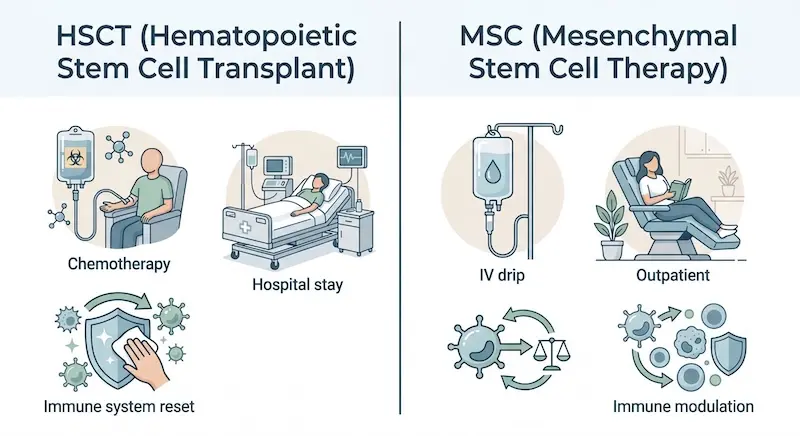
HSCT for Multiple Sclerosis: Powerful but Aggressive
The stem cell treatment for multiple sclerosis that most people have heard of is autologous hematopoietic stem cell transplant — abbreviated as aHSCT or simply HSCT. This is the procedure used in well-publicized cases such as actress Selma Blair’s, and it has been studied in research settings since the mid-1990s.
The mechanism is essentially an immune system reset. Hematopoietic stem cells — the precursors to all blood and immune cells — are harvested from the patient’s own bone marrow or blood. The patient then undergoes high-dose chemotherapy designed to eliminate the existing, malfunctioning immune system. After this wipe, the stored hematopoietic stem cells are returned to the body, where they reconstitute a new immune system. The hope is that the rebuilt immune system will not carry the same tendency to attack myelin.
For patients with aggressive, treatment-refractory relapsing-remitting multiple sclerosis, HSCT has produced striking results in published studies. Long-term suppression of disease activity in 70-80% of well-selected patients has been documented over four to five years of follow-up. The Mellon Center at the Cleveland Clinic and several other major centers participate in the ongoing BEAT-MS trial, which is directly comparing HSCT against high-efficacy disease-modifying therapy.
The trade-offs are significant. HSCT requires high-dose chemotherapy, prolonged hospitalization, and a period of severe immune suppression during which patients are vulnerable to infections. There is a small but real mortality risk associated with the procedure. Recovery takes months. And HSCT works best in younger patients with active inflammatory disease and lower disability scores — typically EDSS below 6, recent disease onset, and ongoing relapse activity. For patients who are older, more progressed, or who have a primary progressive form of the disease without active inflammation, HSCT is generally not considered an appropriate intervention.
Mesenchymal Stem Cell Therapy for Multiple Sclerosis: A Different Mechanism
Mesenchymal stem cells — abbreviated MSCs — are a fundamentally different type of cell, and the therapy that uses them works through a fundamentally different mechanism. MSCs are not blood-forming stem cells; they are stromal cells, found naturally in bone marrow, fat tissue, the umbilical cord, and placenta. They do not reset the immune system by replacing it. Instead, they release signaling molecules that modulate immune cell behavior, calm inflammation, and support tissue protection.
MSC therapy does not require chemotherapy. It does not eliminate the immune system. It does not require hospitalization in the way HSCT does. The procedure is an intravenous infusion, typically delivered on an outpatient basis. The trade-off in the other direction is that MSC therapy is generally not as dramatic in its effect as a successful HSCT. The biological mechanism is more incremental — a shift in the immune environment rather than a reset.
For many patients trying to make sense of stem cell options for multiple sclerosis, the most important distinction is this: HSCT is an aggressive immune reset using chemotherapy and the patient’s own blood stem cells. MSC therapy is a gentler immunomodulatory intervention using mesenchymal cells, typically from a donor source. They are not interchangeable, and one is not simply a weaker version of the other. They address different questions about how to influence the disease.
The treatment we offer in Malaysia is MSC therapy — specifically, allogeneic umbilical cord-derived MSCs. This is the approach the rest of this article will focus on.
How Mesenchymal Stem Cells Work in Multiple Sclerosis: Three Mechanisms
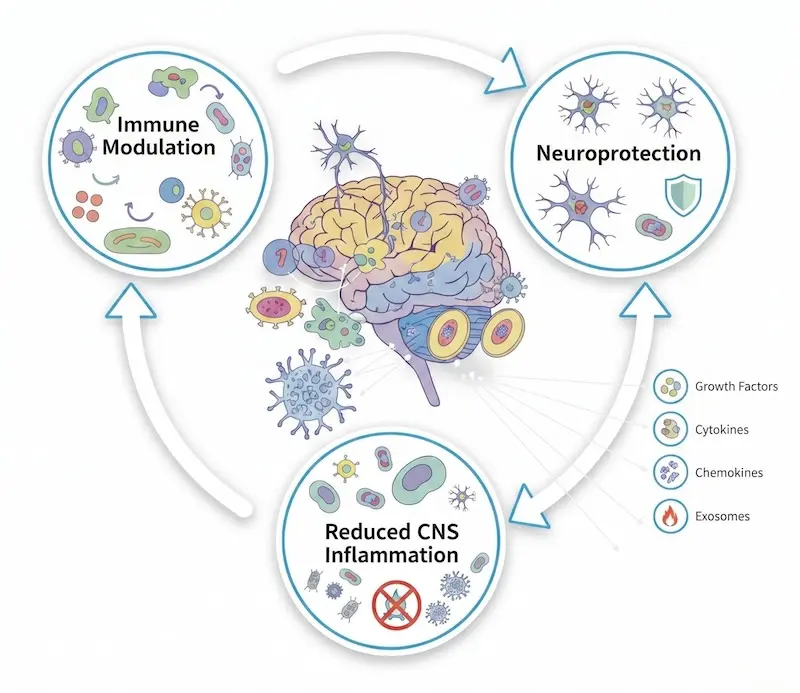
Calming the Immune Attack in Multiple Sclerosis
The single most studied effect of mesenchymal stem cells in autoimmune conditions is their ability to modulate immune cell behavior. In multiple sclerosis specifically, the immune cells most relevant to disease are autoreactive T-cells (particularly Th1 and Th17 subsets) and B-cells that produce inflammatory antibodies. These are the cells that drive the attack on myelin.
When MSCs are infused into a patient with multiple sclerosis, they migrate toward sites of inflammation and begin releasing signaling proteins — cytokines, exosomes, and various growth factors. The net effect of these signals is to suppress the activity of pro-inflammatory T-cells and B-cells while simultaneously expanding the population of regulatory T-cells, often abbreviated as Tregs. Regulatory T-cells are essentially the brake pedal of the immune system; they tell other immune cells to stand down and stop attacking.
In autoimmune conditions where this regulatory capacity is impaired — multiple sclerosis is one, rheumatoid arthritis is another, and the underlying mechanisms have meaningful overlap — restoring some of that regulatory function is a plausible therapeutic strategy. This is distinct from how disease-modifying drugs work. Most DMTs reduce immune activity broadly. MSCs aim to rebalance immune activity, suppressing the attack cells while amplifying the restraining cells.
Supporting Neuroprotection and Repair Signals in Multiple Sclerosis
The second mechanism is less about the immune system and more about the nervous tissue itself. MSCs secrete a range of neurotrophic factors — molecules that support the survival of nerve cells and promote their repair. Among these are brain-derived neurotrophic factor (BDNF), nerve growth factor (NGF), and several others that have been demonstrated in laboratory studies to support oligodendrocyte function and to encourage the survival of axons under stress.
In experimental autoimmune encephalomyelitis — the animal model used in multiple sclerosis research — MSC infusion has been shown to reduce demyelination, decrease axonal loss, and in some studies promote modest remyelination at sites of damage. The cells themselves do not turn into new neurons or new myelin in any clinically meaningful way. What they do is alter the local environment so that the body’s own repair processes have a better chance of succeeding.
This is an important point for setting expectations. MSCs are not building new nervous tissue. They are creating conditions in which the existing nervous tissue is less likely to die and slightly more likely to repair what damage has occurred.
Reducing Chronic CNS Inflammation in Multiple Sclerosis
The third mechanism is the modulation of chronic inflammation within the central nervous system. Microglia — the resident immune cells of the brain and spinal cord — play a complex role in multiple sclerosis. In healthy tissue, microglia perform housekeeping and surveillance. In multiple sclerosis, they can become chronically activated, contributing to the smoldering inflammation that drives progression even when relapse activity has quieted.
MSC signaling has been shown to shift microglia away from a pro-inflammatory state toward a more reparative, tissue-supporting state. This effect is particularly relevant in progressive forms of multiple sclerosis, where chronic CNS inflammation rather than acute attacks dominates the clinical picture. The same immunomodulatory effects are also being studied in other conditions involving chronic inflammation, including heart failure, where smoldering inflammation contributes meaningfully to disease progression.
The combined result — immune modulation peripherally, neuroprotective signaling locally, and reduced chronic CNS inflammation — is what gives MSC therapy its theoretical basis as a potential disease-modifying intervention in multiple sclerosis. The question, as always, is what the clinical data actually shows.
What Clinical Trials Have Actually Shown for Multiple Sclerosis Stem Cell Therapy
The MESEMS Trial and What Its Results Mean
The most rigorous published clinical trial of mesenchymal stem cell therapy in multiple sclerosis is the MESEMS trial, published in Lancet Neurology in 2021 by Uccelli and colleagues. We discuss it first because anyone researching this topic seriously needs to understand what it found and what it did not find.
MESEMS enrolled 144 patients with active multiple sclerosis across 15 sites in nine countries. Patients had relapsing-remitting, secondary progressive, or primary progressive multiple sclerosis, with active disease despite available treatments. The design was a randomized, double-blind, placebo-controlled crossover trial — among the most rigorous designs available for a Phase 2 study. Patients received either intravenous autologous bone marrow-derived MSCs at a dose of 1-2 million cells per kilogram of body weight, or a placebo infusion. After 24 weeks, treatments were switched.
The trial was a real test of whether MSC therapy could reduce inflammatory disease activity in multiple sclerosis. The primary endpoint was the number of contrast-enhancing lesions on MRI at 24 weeks — the standard measure of active inflammation in MS.
The result, honestly stated, was that MSC therapy did not reduce contrast-enhancing lesions compared to placebo. The primary endpoint was not met. The treatment was safe — no serious adverse events were attributed to the cells, no immune rejection occurred — but the trial did not provide evidence that autologous bone marrow MSC therapy reduces inflammatory activity in active multiple sclerosis.
This is an important finding, and it is one that many clinics offering stem cell therapy for multiple sclerosis omit from their patient discussions. We do not believe that is honest. MESEMS is a real result and it constrains what can reasonably be claimed about MSC therapy in this disease.
Smaller Trials of Umbilical Cord MSCs in Multiple Sclerosis
Several smaller, less rigorous studies have looked specifically at umbilical cord-derived MSCs in multiple sclerosis, which is the cell source we use rather than the autologous bone marrow cells used in MESEMS.
The most cited is a feasibility study published by Riordan and colleagues in the Journal of Translational Medicine in 2018. The trial enrolled 20 patients with multiple sclerosis who received seven intravenous infusions of 20 million umbilical cord-derived MSCs over seven days. Patients were assessed at baseline, one month, and one year. The study reported improvements across multiple outcome measures: Expanded Disability Status Scale (EDSS) scores, the Scripps Neurological Rating Scale, the Nine-Hole Peg Test (which measures fine motor function in the hands), the 25-Foot Walk Test, and quality of life scores on the RAND SF-36. No serious adverse events were reported. The most common side effects were mild — headache and fatigue.
A more recent Phase 1 trial published in Scientific Reports in 2025 by Shokati and colleagues examined placenta-derived MSCs in five patients with secondary progressive multiple sclerosis over six months. The study was small but reported safety and preliminary signals of stability or improvement in disability scores.
A 2025 systematic review published in Multiple Sclerosis and Related Disorders examined 34 clinical trials of MSC therapy in MS to date. The overall finding was that MSC therapy was well tolerated and that some studies reported improvements in EDSS scores, MRI lesion activity, and various functional measures — though the reviewers explicitly noted that more research is needed on long-term safety and efficacy.
Why Cell Source Matters in Multiple Sclerosis Research
The honest interpretation of the data is this: the most methodologically rigorous trial (MESEMS) used autologous bone marrow MSCs and did not show benefit on its primary inflammatory endpoint. Smaller, less rigorous studies using umbilical cord-derived MSCs have suggested possible benefit but have not yet been replicated at the scale or with the placebo-controlled rigor that would settle the question.
Why might this difference matter? Autologous bone marrow MSCs in MESEMS were harvested from patients who, by definition, had multiple sclerosis. Their own bone marrow had been operating in a body affected by chronic autoimmune dysregulation for years. Several studies have shown that MSCs harvested from patients with autoimmune disease show measurably reduced immunomodulatory capacity compared to MSCs from healthy donors. Cell potency declines with donor age and with the presence of chronic disease.
Allogeneic umbilical cord-derived MSCs are taken from the Wharton’s jelly of donated umbilical cord tissue collected at the time of healthy births, with full donor consent. These cells are young, have never been exposed to the cumulative biological stressors of an adult life, and have not developed in the context of an autoimmune environment. Laboratory studies consistently show that umbilical cord MSCs have higher proliferative capacity and stronger immunomodulatory signaling than bone marrow-derived MSCs from adult donors.
Whether this biological difference translates into clinically meaningful efficacy in multiple sclerosis specifically has not yet been confirmed by a large randomized controlled trial of the scale of MESEMS. This is a real gap in the evidence base, and we believe patients should know that gap exists before making any decision.
Who Tends to Respond to Multiple Sclerosis Stem Cell Therapy — and Who Does Not
Multiple Sclerosis Profiles That Have Shown Better Response in Available Data
Based on the available clinical trial data and our own clinical observations over seven years, certain patient profiles appear more likely to respond to MSC therapy than others.
Patients with relapsing-remitting multiple sclerosis who continue to show active inflammatory disease — new lesions on MRI, occasional breakthrough relapses — despite ongoing disease-modifying therapy represent one group where MSC’s immunomodulatory action has the most biological rationale. The inflammation that MSCs aim to modulate is still actively present, and the cells have something to work on.
Patients with secondary progressive multiple sclerosis who still have active inflammatory features — what neurologists sometimes call “active SPMS” — represent another group where MSC therapy may have a stronger rationale than in purely non-inflammatory progression. The chronic CNS inflammation that drives much of progressive disability is a plausible target for MSC modulation.
Patients in the EDSS range of 3 to 6 — meaning they have meaningful disability but are still ambulatory — tend to be the population that has been studied most thoroughly. Patients in this range still have substantial nervous system function to preserve.
Younger patients and those with shorter disease duration tend to show better responses across most stem cell therapies in multiple sclerosis. This pattern is consistent across both HSCT and MSC studies, and likely reflects the greater preservation of repair capacity in less advanced disease.
Multiple Sclerosis Situations Where This Treatment Is Unlikely to Help
There are equally important profiles where we do not believe MSC therapy is likely to provide meaningful benefit, and we will say so directly.
Patients with primary progressive multiple sclerosis who show no active inflammatory features on imaging — no new lesions, no contrast enhancement — represent a particularly challenging group. The biological mechanisms by which MSCs appear to act require inflammation to act upon. In purely degenerative disease without inflammatory activity, the rationale weakens significantly.
Patients with very advanced disability — EDSS scores above 7, where ambulation is no longer possible — are unlikely to reclaim function that has been lost over many years. MSC therapy is not a regenerative treatment in the literal sense. It does not rebuild destroyed nervous tissue. The mechanisms favor preservation and modulation, not reconstruction.
Patients with active malignancy, severe systemic infection, or uncontrolled comorbid conditions should not receive MSC therapy until those conditions are stabilized. Patients who are pregnant or who have hematological disorders that affect cell clearance require careful evaluation before any infusion is considered.
We also speak directly with patients whose expectations are out of line with what current evidence supports. MSC therapy for multiple sclerosis, on the basis of what is currently published, is reasonably framed as a potential supportive intervention alongside ongoing disease-modifying therapy — not as a replacement, not as a cure, and not as a guaranteed slowing of progression. Patients who arrive looking for a definitive answer to MS will hear from us that we cannot offer that, and that no one honestly can.
One Patient’s Year With Multiple Sclerosis Stem Cell Therapy
The Decision to Try Mesenchymal Stem Cells for Active Multiple Sclerosis
A woman in her late forties. Diagnosed with relapsing-remitting multiple sclerosis at age 34. Over the thirteen years since diagnosis, she had cycled through three disease-modifying therapies. Her current regimen — a B-cell depleting agent administered every six months — had reduced her relapse rate but had not stopped a slow accumulation of disability. Her EDSS at the time of consultation was 4.5. She walked unaided but with noticeable limitation. Her right hand had lost fine dexterity. Cognitive fatigue affected her work in the late afternoons in ways she had not yet found a way to manage.
Her neurologist had documented several new asymptomatic MRI lesions over the past two years, indicating ongoing inflammatory disease activity even on her current high-efficacy treatment. The conversation about adjunctive options had begun.
She came to our clinic in Malaysia in mid-2024 after reading clinical trial literature and consulting with our team. Before accepting her for treatment, we reviewed her full MRI history, current immunology workup, and treatment record. She was a reasonable candidate: active relapsing-remitting disease with ongoing inflammatory features, moderate disability with substantial remaining function, and explicit acknowledgment that she did not want to discontinue her DMT. Before any infusion was scheduled, we were direct about what the data supports and does not support — including the MESEMS findings — and she was clear that she understood the uncertainty.
What Changed Over Twelve Months — and What Did Not
The first eight weeks following infusion brought no noticeable change. She described that period as the hardest, because she had partly expected to feel something. Patients are told before treatment that biological effects emerge gradually, but knowing this and experiencing the wait are different things.
By the third month, she reported that her cognitive fatigue in the late afternoon had become less pronounced. She was able to complete her usual evening tasks without the heavy mental shutdown she had grown accustomed to. By month six, her right hand peg test scores — measured at her home neurologist’s office — had improved modestly. Her walking distance before fatigue had increased. Her EDSS at the six-month re-evaluation was assessed at 4.0, a small but measurable improvement.
At twelve months, her MRI showed no new contrast-enhancing lesions during the year following treatment, although whether this was attributable to MSC therapy, her ongoing B-cell depleting medication, or both, cannot be determined from a single patient case. She remained on her DMT throughout. No medication changes were made. Her quality of life scores, which she tracked herself using the MSQOL-54 questionnaire, showed improvements in fatigue, social functioning, and emotional well-being subscales.
She continued in follow-up. Whether the changes she experienced will be sustained over a longer time frame remains to be seen. What she has said about the experience is that for the first time in many years, the direction of her disease felt like it had paused rather than continued the slow downward drift.
This is an anonymized account based on actual clinical experience. Individual outcomes vary considerably and cannot be guaranteed for any specific patient.
Why Allogeneic Umbilical Cord MSCs Are Used in Multiple Sclerosis
The cell source matters, and we have discussed why earlier in this article. The umbilical cord-derived MSCs we use come from the Wharton’s jelly of donated cord tissue collected at the time of consented healthy newborn deliveries. These cells share several characteristics that are particularly relevant to multiple sclerosis: they are young in biological terms, they express low levels of the surface markers that ordinarily trigger immune rejection, and they have not been exposed to the cumulative effects of life in an autoimmune environment.
Patients who have considered stem cell therapy options in Japan have typically encountered autologous treatments — cells harvested from their own bone marrow or adipose tissue. The advantage of autologous cells is the complete absence of any rejection risk. The disadvantage in the multiple sclerosis context is that the patient’s own immune system has been chronically dysregulated, and the cells harvested from such an environment may carry signs of that dysregulation. The same logic that informs the use of allogeneic umbilical cord MSCs in rheumatoid arthritis treatment — another autoimmune condition where immune dysregulation has been ongoing for years — applies in multiple sclerosis.
Honest Risks and Limitations of Multiple Sclerosis Stem Cell Therapy
Reported Side Effects in Multiple Sclerosis Stem Cell Trials
The safety profile of MSC therapy in published multiple sclerosis trials has generally been favorable. This is a statement of what the trial data shows, not a dismissal of risk.
The most commonly reported effects following infusion are mild and self-limiting. A low-grade fever in the 24 to 48 hours after infusion is reported by approximately 15 to 25% of patients in various studies and is thought to reflect the immune system’s recognition of the infused cells. Headache, fatigue, and mild generalized body ache in the days following infusion are also reported. These effects typically resolve without specific medical intervention.
Across the published trials — including MESEMS, the Riordan study, the Shokati study, and others — serious adverse events directly attributable to MSC infusion have been uncommon. No cases of disease worsening attributable to the cells themselves have been reported in major peer-reviewed trials. Immune rejection has not emerged as a significant clinical issue, which aligns with the known low immunogenicity of umbilical cord-derived MSCs.
That said, two areas of risk warrant explicit discussion. The first is theoretical: because MSCs modulate immune activity, there is a theoretical concern about interaction with concurrent immunosuppressive medications. For this reason, we do not ask multiple sclerosis patients to discontinue their existing DMT before or during MSC therapy. Decisions about medication changes belong with the treating neurologist, not with us, and not with the patient unilaterally before or after a stem cell infusion.
The second is the long-term safety data gap. The longest follow-up periods in published MSC trials for multiple sclerosis are generally two to three years. Whether the safety profile remains favorable at five years or ten years is genuinely not yet known. This is an honest limitation of the current evidence, and we disclose it to every patient before treatment.
What Stem Cell Therapy Cannot Do for Multiple Sclerosis
We want to be specific about the limits, because vagueness in this area genuinely hurts patients.
MSC therapy cannot reverse established neurological damage from past multiple sclerosis attacks. If axons have been lost, MSC therapy will not regrow them in any clinically meaningful way. This is the most important boundary to understand. Function lost years ago is not function we can promise to restore.
MSC therapy cannot replace disease-modifying drugs. Anyone who suggests stopping DMT in favor of stem cell therapy alone is making a clinical recommendation that is not supported by published evidence. We do not make that recommendation. Patients who receive MSC therapy through our clinic continue under the care of their treating neurologist, on their existing medication regimen, with adjustments made only by that neurologist if and when appropriate.
MSC therapy cannot guarantee that disease activity will stop, that progression will halt, or that any specific symptom will improve. Based on available trial data and our own clinical experience, a meaningful proportion of patients do not show measurable improvement at the six-month and twelve-month follow-up. We cannot currently predict with certainty who will fall into which group. Patients deserve to hear this clearly before deciding whether to invest the time, travel, and cost in this treatment.
MSC therapy is not equivalent to HSCT. For patients with aggressive, treatment-refractory relapsing-remitting multiple sclerosis who meet criteria for HSCT, that intervention has a much stronger and more consistent evidence base for halting disease activity, albeit with significantly more procedural risk. We do not position MSC therapy as a substitute for HSCT in patients for whom HSCT is appropriate.
These are not reasons to dismiss MSC therapy out of hand. They are the honest context in which any decision about it should be made.
FAQ About Multiple Sclerosis Stem Cell Therapy
No. We do not ask patients to discontinue their disease-modifying therapy before, during, or after MSC infusion. MSC therapy is designed to work alongside conventional MS care, not in place of it. Any changes to your DMT regimen should be made only in consultation with your treating neurologist, based on your overall clinical picture.
HSCT involves high-dose chemotherapy to eliminate the existing immune system, followed by reinfusion of the patient’s own blood-forming stem cells to reconstitute a new immune system. It is a hospitalized procedure with significant risks but strong evidence for halting disease activity in well-selected patients with aggressive relapsing-remitting MS. MSC therapy uses mesenchymal stem cells delivered intravenously without chemotherapy. It modulates rather than resets the immune system, has a much gentler safety profile, but generally produces more incremental effects rather than the dramatic disease suppression that successful HSCT can achieve.
Most patients who respond do so gradually. Initial changes — often in fatigue, cognitive endurance, or subtle motor improvements — typically begin to appear between two and four months after treatment. Changes that show up on MRI or formal neurological assessment, where they occur, are usually visible at the six-month and twelve-month follow-up points. Patients who notice no change at all by six months have generally not gone on to show changes at one year.
In most countries, mesenchymal stem cell therapy for multiple sclerosis is not currently covered by health insurance because it is considered an investigational or non-standard intervention. The treatment is conducted in Malaysia on a self-pay basis. We do not discuss specific pricing in articles like this, but full cost information is provided during the initial consultation so patients can make an informed financial decision before any further commitment.
The protocol is determined by individual assessment, but multiple sclerosis patients in our clinic typically receive a course of several infusions delivered over one to two weeks during a single visit to Malaysia. Some patients may be candidates for a booster course at a later date, depending on response. There is currently no established consensus in the field on the optimal dosing schedule, and ongoing research continues to refine this question.
A Conversation About Your Specific Multiple Sclerosis Case
If you have read this far, you are probably someone who is already living with multiple sclerosis, currently on a disease-modifying therapy, and asking yourself whether there is a credible non-chemotherapy stem cell option worth considering.
We offer free online consultations for exactly this kind of conversation. We do not ask you to commit to anything during it. What we do is review your MRI history, your DMT record, and your current clinical picture, and tell you honestly whether we believe MSC therapy is a reasonable option for your specific situation — or whether it is not. If we think it is not appropriate, we will tell you that directly. You are entitled to a clear answer before making any decision.
References
- Uccelli A, Laroni A, Ali R, et al. Safety, tolerability, and activity of mesenchymal stem cells versus placebo in multiple sclerosis (MESEMS): a phase 2, randomised, double-blind crossover trial. Lancet Neurology. 2021;20(11):917-929. https://doi.org/10.1016/S1474-4422(21)00301-X
- Riordan NH, Morales I, Fernández G, et al. Clinical feasibility of umbilical cord tissue-derived mesenchymal stem cells in the treatment of multiple sclerosis. Journal of Translational Medicine. 2018;16:57. https://doi.org/10.1186/s12967-018-1433-7
- Shokati A, Nikbakht M, Sahraian MA, et al. Cell therapy with placenta-derived mesenchymal stem cells for secondary progressive multiple sclerosis patients in a phase 1 clinical trial. Scientific Reports. 2025;15:16005. https://doi.org/10.1038/s41598-025-00590-6
- Walton C, King R, Rechtman L, et al. Rising prevalence of multiple sclerosis worldwide: Insights from the Atlas of MS, third edition. Multiple Sclerosis Journal. 2020;26(14):1816-1821. https://doi.org/10.1177/1352458520970841
- Sheikhi K, Ghaderi S, Firouzi H, et al. Recent advances in mesenchymal stem cell therapy for multiple sclerosis: clinical applications and challenges. Frontiers in Cell and Developmental Biology. 2025;13:1517369. https://doi.org/10.3389/fcell.2025.1517369
- Muraro PA, Pasquini M, Atkins HL, et al. Long-term outcomes after autologous hematopoietic stem cell transplantation for multiple sclerosis. JAMA Neurology. 2017;74(4):459-469. https://doi.org/10.1001/jamaneurol.2016.5867
- Sormani MP, Muraro PA, Schiavetti I, et al. Autologous hematopoietic stem cell transplantation in multiple sclerosis. Neurology. 2017;88(22):2115-2122. https://doi.org/10.1212/WNL.0000000000003987
- Cohen JA, Imrey PB, Planchon SM, et al. Pilot trial of intravenous autologous culture-expanded mesenchymal stem cell transplantation in multiple sclerosis. Multiple Sclerosis Journal. 2018;24(4):501-511. https://doi.org/10.1177/1352458517703802
- Mesenchymal stem cells in clinical trials for multiple sclerosis: A systematic literature review and review of clinical trials. Multiple Sclerosis and Related Disorders. 2025. https://doi.org/10.1016/j.msard.2025.106492
- GBD 2021 Epidemiology of Multiple Sclerosis Collaborators. Epidemiology of Multiple Sclerosis: Global, Regional, National and Sub-National-Level Estimates and Future Projections. Journal of Epidemiology and Global Health. 2025. https://doi.org/10.1007/s44197-025-00353-6