
Sarcopenia Stem Cell Therapy | Can You Rebuild Muscle Strength as You Age?

You used to carry grocery bags without thinking twice. Now your arms tire after lifting something modest. Standing from a low chair takes a moment of concentration. Climbing stairs is slower than it used to be, and you find yourself choosing routes that avoid them when you can.
If you are past 60 and this sounds familiar, there is a name for what you may be experiencing: sarcopenia — the progressive, age-related loss of skeletal muscle mass and function. It affects an estimated 10–16% of older adults worldwide, and by the time it becomes noticeable, it has typically been developing for years. It is not simply being out of shape. It is a recognized medical condition with its own disease classification, its own biology, and — increasingly — its own treatment pathways.
For most patients, the clinical conversation goes in a predictable direction: eat more protein, do resistance training, stay active. These recommendations are genuinely useful, and we will not dismiss them. But for the many older adults who are already exercising and supplementing and still watching their strength decline — or for those whose physical limitations make demanding exercise programs difficult to sustain — they offer diminishing returns.
This article is written for people asking the next question: is there something that works at the biological level, rather than just managing the symptoms of muscle loss?
We are a clinical team based in Malaysia with over seven years of experience and more than 200 patients treated using allogeneic umbilical cord-derived mesenchymal stem cells (MSCs). We will explain what the peer-reviewed research currently shows for sarcopenia stem cell therapy, where the evidence is solid, and where it is still developing. We believe people with sarcopenia deserve precise information — including the limitations — before making any treatment decision.
Table of Contents
- Why Sarcopenic Muscle Stops Rebuilding Itself
- Why Exercise and Nutrition Alone Are Not Enough for Sarcopenia
- One Patient's Experience: Getting Stronger at 71
- How Stem Cell Therapy Works on Sarcopenic Muscle: Four Mechanisms
- What the Research Data Shows for MSC Therapy in Sarcopenia
- Autologous vs. Allogeneic Stem Cells for Sarcopenia: Why Cell Source Matters
- Who Is — and Is Not — a Good Candidate for Sarcopenia Stem Cell Therapy
- Honest Risks and Limitations of Sarcopenia Stem Cell Therapy
- FAQ About Sarcopenia Stem Cell Therapy
- Is Stem Cell Therapy Right for Your Sarcopenia?
- References
Why Sarcopenic Muscle Stops Rebuilding Itself
The Biology of Age-Related Muscle Loss in Sarcopenia
Skeletal muscle is not a static tissue. Throughout your life, it is constantly being broken down and rebuilt — a process of continuous turnover maintained by a specialized population of muscle stem cells called satellite cells. Satellite cells sit dormant along individual muscle fibers, activated when the muscle is stressed or damaged, and responsible for the repair and growth response that follows exercise. The muscle you build in your forties from resistance training is largely thanks to satellite cells doing their job efficiently.
The problem with sarcopenia begins with what happens to satellite cells as you age.
In young muscle, satellite cells are abundant, responsive, and capable of vigorous expansion after activation. In aging muscle, their number declines, their activation response slows, and their capacity to generate new muscle fibers becomes progressively impaired. A healthy 30-year-old muscle fiber and a sarcopenic 75-year-old muscle fiber exposed to the same mechanical stress generate very different repair responses — not because the older person lacks willpower, but because the cellular machinery for rebuilding has deteriorated.
At the same time, the muscle environment itself becomes hostile to regeneration. Chronic low-grade inflammation — the persistent, low-level immune activation that characterizes biological aging, sometimes called “inflammaging” — interferes with satellite cell signaling and accelerates the breakdown of muscle proteins faster than aging muscle can replace them. Fat infiltrates the spaces between muscle fibers. The mitochondria inside muscle cells — the energy-generating structures that power contraction — accumulate damage and function less efficiently, reducing the energy available for both exercise and repair.
The Self-Reinforcing Decline of Sarcopenic Muscle
This creates a biological cycle that is difficult to break without external intervention.
Weakening muscle leads to reduced physical activity. Reduced physical activity removes the mechanical stimulus that signals satellite cells to activate. Without that signal, satellite cell function declines further. The inflammatory environment worsens as activity decreases. Fat infiltration progresses. The muscle shrinks and weakens further.
The result, in clinical terms, is not simply reduced strength. It is an elevated risk of falls and fractures, a decline in metabolic health, reduced immune competence, and — in severe cases — the loss of the functional independence that defines quality of life in later years.
Why Exercise and Nutrition Alone Are Not Enough for Sarcopenia
The Genuine Benefits of Conventional Sarcopenia Treatment
We want to be direct: resistance training and adequate protein intake are not placebo. A substantial body of evidence confirms that regular progressive resistance exercise can slow muscle loss, maintain strength, and reduce fall risk in older adults with sarcopenia. High-quality protein — particularly leucine-rich sources — supports muscle protein synthesis and provides the substrate for the repair processes that exercise triggers. These interventions remain the first recommendation from every evidence-based clinical guideline on sarcopenia, and with good reason.
Vitamin D supplementation, when deficiency is present, can support neuromuscular function. Creatine has modest supporting evidence in some populations.
Why Conventional Treatment Reaches a Ceiling in Advanced Sarcopenia
The limitation is biological, not motivational.
As sarcopenia advances, the muscle’s capacity to respond to the signals generated by exercise progressively diminishes. When satellite cells are depleted and their activation threshold has risen, the same resistance training program that maintained muscle mass at 65 may produce much smaller returns at 75. The machinery for translating the exercise stimulus into muscle adaptation has deteriorated. Protein intake can only be synthesized into new muscle fiber if the cellular infrastructure for protein synthesis is intact — and in advanced sarcopenic muscle, that infrastructure is compromised.
There are no approved pharmaceutical treatments for sarcopenia as of 2026. Testosterone and growth hormone therapies have been explored, but their risk profiles — particularly in older adults — limit their clinical utility. The field is effectively at a therapeutic plateau: conventional approaches are valuable for prevention and early management, but they do not address the underlying biology of satellite cell dysfunction, chronic inflammation, and mitochondrial failure that drives progressive muscle loss.
This gap — between what conventional treatment can achieve and what the underlying biology demands — is precisely where mesenchymal stem cell therapy for sarcopenia is being investigated.
One Patient’s Experience: Getting Stronger at 71
A Sarcopenia Patient Who Had Reached the Limits of Conventional Care
A woman in her early seventies, referred to us by her physiotherapist in 2024. She had been diagnosed with sarcopenia two years earlier following a bone density and body composition scan. Her grip strength had been measured below the threshold for low muscle function, and her gait speed on a standard walking test placed her in the category of significantly impaired physical performance.
She had been diligent — working consistently with her physiotherapist, meeting protein targets, taking vitamin D and creatine as recommended. Her exercise program was well-designed and supervised. After eighteen months of consistent effort, her repeat testing showed minimal improvement in muscle strength and a further small decline in lean mass. She was not inactive, not underweight, and not giving up. The conventional approach had simply stopped producing gains.
She came to Malaysia in mid-2024 after reviewing the preclinical and early clinical research on MSC therapy for sarcopenia. Before proceeding, we reviewed her body composition data, inflammatory markers (including C-reactive protein, which was mildly elevated, consistent with inflammaging), and functional assessment results. She was a suitable candidate: confirmed sarcopenia with documented progression despite consistent conventional treatment, no active infection or malignancy, and realistic expectations about what stem cell therapy could and could not offer.
What Changed — and What Did Not — After Sarcopenia Stem Cell Therapy
The first month produced no noticeable change, which we had prepared her to expect.
By week eight, she reported that her morning fatigue — the heavy-limbed sensation she had come to associate with getting out of bed — had reduced noticeably. She attributed the change to better sleep quality, though she could not be certain of the cause. By the three-month mark, her physiotherapist noted that her performance on seated resistance exercises had improved measurably, and that she was completing sets that had previously been beyond her capacity. At the six-month follow-up assessment, grip strength had increased from below-threshold to within the low-normal range, and her gait speed test showed a meaningful improvement.
Her lean muscle mass on repeat scan at twelve months showed a modest but detectable increase — unusual for someone her age without any change in exercise regime. She continued her conventional program throughout.
She did not return to the muscle mass of her fifties. Her falls risk remains a clinical consideration. But after two years of deterioration despite consistent effort, a measurable turn in the other direction — sustained over twelve months — was meaningful to her in practical, daily terms.
This is an anonymized account based on actual clinical experience. Individual outcomes vary and cannot be guaranteed.
How Stem Cell Therapy Works on Sarcopenic Muscle: Four Mechanisms
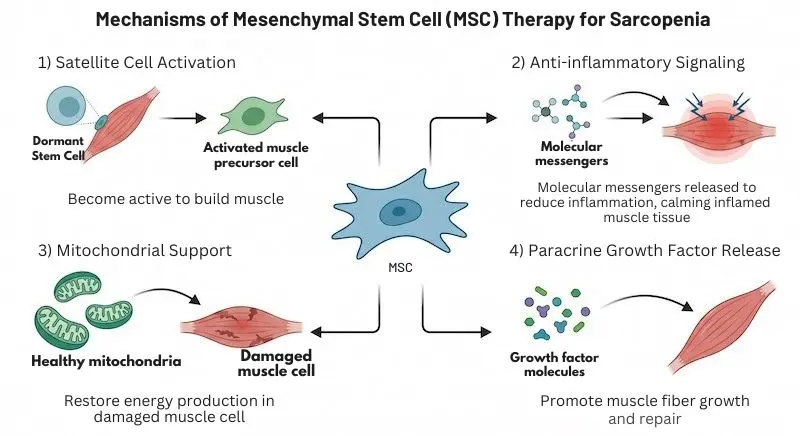
Mechanism 1: Reactivating Dormant Satellite Cells in Sarcopenic Muscle
The most direct impact of MSC therapy on sarcopenic muscle appears to occur through the satellite cell pool.
MSCs secrete a range of bioactive molecules — growth factors, extracellular matrix proteins, and regulatory signals — that interact with the dormant satellite cells in aging muscle. In preclinical studies, human umbilical cord-derived MSCs have been shown to restore the expression of Pax-7, a protein that marks functional satellite cells and is required for their activation. By reactivating satellite cells that have become dormant or dysfunctional, MSCs may partially restore the muscle’s own capacity for repair and adaptation.
Mechanism 2: Reducing the Chronic Inflammation Driving Sarcopenia
Inflammaging — the persistent low-grade inflammation of biological aging — is both a driver and a consequence of sarcopenic muscle loss. It disrupts satellite cell signaling, accelerates muscle protein breakdown, and creates an environment hostile to repair.
MSCs are known immunomodulators. They secrete cytokines (signaling proteins) that shift the local immune environment away from the pro-inflammatory state toward a repair-permissive one. Specifically, they suppress inflammatory macrophage activity and reduce levels of inflammatory markers such as TNF-alpha (tumor necrosis factor alpha — a protein that, when chronically elevated, actively breaks down muscle tissue). This anti-inflammatory effect is well-documented across multiple MSC applications, including in rheumatoid arthritis and heart failure, and it operates through the same biological pathways in aging muscle tissue.
Mechanism 3: Transferring Functional Mitochondria to Damaged Muscle Cells
This mechanism is relatively newly described and is particularly relevant to sarcopenia.
Mitochondria — the energy-generating structures inside muscle cells — accumulate damage as we age, a process that is increasingly recognized as one of the primary drivers of age-related muscle dysfunction. MSCs possess the ability to transfer their own healthy mitochondria to neighboring cells with damaged or dysfunctional mitochondria. This transfer has been documented in laboratory studies and is thought to restore cellular energy production in sarcopenic muscle fibers, partially reversing the metabolic dysfunction that underlies weakness and fatigue.
In one study using dexamethasone-induced sarcopenia in rats, intramuscular transplantation of mitochondria derived from umbilical cord MSCs significantly improved muscle mass, enhanced muscle fiber content, and restored the expression of muscle-specific proteins. This mitochondrial transfer capability sets MSC therapy apart from any other current intervention for sarcopenia.
Mechanism 4: Paracrine Signaling to Support Muscle Fiber Survival
MSCs do not simply become new muscle cells. That is not how they work in any tissue. What they do is release a broad spectrum of signaling molecules — a process called paracrine signaling — that communicate with the cells around them and alter their behavior.
In sarcopenic muscle, MSC paracrine factors appear to suppress the apoptosis (programmed cell death) of existing muscle fibers, support protein synthesis pathways, promote angiogenesis (the formation of new small blood vessels that supply nutrients to muscle tissue), and remodel the extracellular matrix — the structural scaffolding in which muscle cells live. Collectively, these effects shift the muscle’s microenvironment from one that is accelerating degeneration toward one that is more supportive of maintenance and partial recovery.
What the Research Data Shows for MSC Therapy in Sarcopenia
Key Clinical and Preclinical Evidence for Sarcopenia Stem Cell Therapy
The clinical evidence base for MSC therapy specifically in sarcopenia is at an earlier stage than for some other conditions. It is important to be honest about this.
Most of the published data currently available comes from preclinical animal studies and early-phase human trials in older adults with frailty — a related but broader syndrome that includes sarcopenia as a defining component. Large-scale randomized controlled trials specifically targeting sarcopenia as the primary diagnosis are still underway or awaited.
That said, the data that exists is consistent enough to be meaningful.
In a Phase II randomized, double-blind trial by Leng and colleagues, 30 frail older adults with a mean age of 76 years received either allogeneic MSCs (at doses of 100 or 200 million cells) or placebo via intravenous infusion. At the one-month follow-up, no therapy-related adverse events were documented. Participants in the 100-million-cell group showed improvements in physical performance scores, the six-minute walk test (a standard measure of functional capacity and lower-limb muscle endurance), and lung function, with reductions in TNF-alpha — the inflammatory marker directly implicated in muscle protein breakdown. The authors described the improvements in the treated groups as “remarkable” given that a single treatment produced changes sustained over months of follow-up. The 100-million-cell dose appeared to be the optimum, with the higher dose showing diminishing returns on efficacy measures.
In a 2023 study published in Cell Death & Disease, clinical-grade human umbilical cord-derived MSCs (hUC-MSCs) were administered to two established mouse models of age-associated sarcopenia. The results showed that hUC-MSCs significantly restored skeletal muscle strength and physical performance in both models. The mechanisms confirmed in this study included satellite cell activation, enhancement of muscle autophagy (the cellular process by which damaged components are cleared), suppression of cellular aging markers, and remodeling of key structural proteins in the muscle fiber matrix. This was the first comprehensive preclinical evaluation of clinical-grade hUC-MSCs specifically for age-associated sarcopenia, and the results across two independent models strengthen confidence in the biological plausibility of the approach.
A 2025 review in Stem Cell Research & Therapy examining umbilical cord MSCs specifically for sarcopenia confirmed that the regenerative potential of hUC-MSCs operates through bioactive factor secretion that simultaneously suppresses apoptosis, attenuates inflammation, enhances angiogenesis, and promotes extracellular matrix remodeling — the full spectrum of mechanisms discussed above.
What Realistic Improvement Looks Like for Sarcopenia Patients After MSC Therapy
Based on available evidence and our clinical experience, realistic expectations for sarcopenia stem cell therapy look like this.
Patients who respond typically begin to notice changes in fatigue levels and physical endurance between the sixth and twelfth week after treatment. Measurable improvements in grip strength, gait speed, or physical performance battery scores, when they occur, tend to emerge between the third and sixth month. Lean muscle mass changes, measured by body composition scan, are typically modest — a detectable increase rather than a dramatic one — and become visible on repeat assessment at nine to twelve months.
Not every patient responds. Based on available trial data, a meaningful proportion of older adults with frailty and sarcopenia — roughly 25–35% — may not experience clinically significant benefit from a single treatment course. We cannot currently predict with certainty who will or will not respond.
Autologous vs. Allogeneic Stem Cells for Sarcopenia: Why Cell Source Matters
Why the Patient’s Own Cells Are a Limited Tool in Sarcopenia
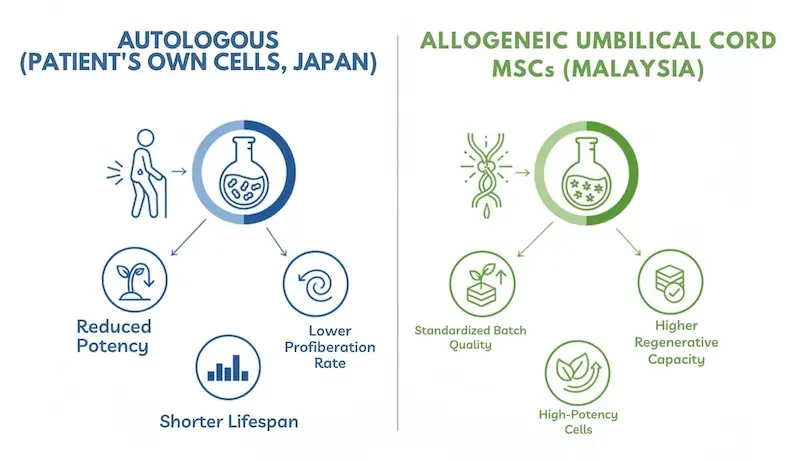
In Japan’s current regulatory framework for regenerative medicine, autologous stem cell therapy — using cells harvested from the patient’s own fat tissue or bone marrow — is the standard approach. The advantage is immunological: the cells are the patient’s own, so rejection is not a concern.
The limitation, for sarcopenia specifically, is profound. A sarcopenic 72-year-old’s stem cells are themselves affected by the same aging processes that are driving their muscle loss. Their satellite cells have reduced activation capacity. Their mesenchymal stem cells have lower proliferative potential, produce fewer anti-inflammatory signals, and show diminished paracrine output compared to cells from a healthy young donor. You are, in effect, asking an aging, compromised repair system to fix itself using components that are also aged and compromised.
Why Allogeneic Cord-Derived MSCs Are Used for Sarcopenia in Malaysia
The allogeneic umbilical cord-derived MSCs used in our Malaysia-based program come from donated cord tissue of healthy newborns at the time of delivery, with full donor consent. These cells are biologically young — they have not accumulated decades of mitochondrial damage, inflammatory exposure, or age-related epigenetic changes. They exhibit high proliferative capacity and potent secretory activity. They produce the growth factors and anti-inflammatory signals at the levels needed to meaningfully alter the muscle microenvironment in an older patient.
Because umbilical cord MSCs express low levels of the surface proteins that typically trigger immune rejection, they are immunologically well tolerated by recipients, making allogeneic infusion safe without requiring the type of immunosuppression used in organ transplantation. This is the same cell source and rationale used in our approach to knee osteoarthritis, where the same inflammatory and degenerative mechanisms operate at the joint level as operate in sarcopenic muscle at the systemic level.
The critical practical advantage is consistency. Allogeneic cells are prepared in standardized, quality-tested batches, with verified cell viability and potency confirmed before each treatment is administered.
Who Is — and Is Not — a Good Candidate for Sarcopenia Stem Cell Therapy
Sarcopenia Patients Who May Benefit from MSC Therapy
Stem cell therapy for sarcopenia appears most likely to produce meaningful benefit in patients who meet these criteria.
They have a confirmed sarcopenia diagnosis — established through standardized assessment of muscle mass (by DEXA or bioelectrical impedance), muscle strength (by grip strength measurement), and physical performance (by gait speed or short physical performance battery). They have shown inadequate response to a consistent program of resistance exercise and nutritional optimization over at least six months. Their sarcopenia is moderate in severity — with measurable muscle loss and functional impairment, but without complete physical dependency. They do not have active malignancy, uncontrolled diabetes, severe kidney or liver disease, or active systemic infection. And they have realistic expectations: they understand that stem cell therapy is not a reversal of aging, but an attempt to slow the biological deterioration that conventional treatment alone cannot address.
Older adults with elevated inflammatory markers at baseline — elevated CRP or TNF-alpha — may be particularly likely to benefit, as the anti-inflammatory mechanism of MSC therapy directly targets the inflammaging process that drives their muscle loss.
When Sarcopenia Stem Cell Therapy Is Not Appropriate
There are clinical scenarios where we do not recommend proceeding with this treatment.
Patients with severe, end-stage sarcopenia who have very limited residual muscle function and significant physical dependency are unlikely to experience meaningful benefit — the remaining viable muscle tissue is insufficient to respond to the biological stimulus MSC therapy provides. For these patients, focused rehabilitative care and fall prevention remain the priority.
Patients who have not yet attempted a consistent exercise and nutritional program should complete that program first. MSC therapy is not a substitute for the foundational interventions that evidence most strongly supports.
Active cancer or recent cancer treatment is a contraindication. Patients currently hospitalized for acute illness or requiring intensive medical management are not appropriate candidates for an elective regenerative therapy.
And patients who are looking for a rapid transformation — a return to the physical function of decades earlier — should understand clearly that this is not what the data supports. The appropriate framing for sarcopenia stem cell therapy is: a potential intervention to modulate the biological environment of aging muscle and slow further decline, with the possibility of modest functional gains for those who respond. Nothing more.
What Recovery After Sarcopenia Stem Cell Therapy Looks Like
The recovery from an intravenous MSC infusion is considerably lighter than recovery from surgery. Most patients are comfortable and mobile the day after treatment. There are no incisions, no immobilization requirements, and no mandatory rest period beyond avoiding strenuous physical exertion for the first week.
The most important guidance for the weeks after treatment is patience. Unlike a steroid injection — which can produce noticeable effects within days — stem cell therapy works through a slower biological process. The cells need time to migrate to sites of inflammation and muscle damage, begin releasing their paracrine signals, and allow those signals to alter the muscle microenvironment. Most patients who respond begin to notice changes between weeks six and twelve. Judging the treatment as ineffective before the three-month mark is premature.
We encourage patients to continue their existing exercise and nutritional program throughout the follow-up period. MSC therapy is designed to support and amplify the effects of conventional interventions, not replace them.
Honest Risks and Limitations of Sarcopenia Stem Cell Therapy
Known Side Effects and Safety Data in Sarcopenia and Frailty MSC Trials
The safety profile of intravenous allogeneic MSC administration in older adults has been consistently favorable across published trials. In the Leng Phase II trial, which specifically enrolled frail older adults with an average age of 76 — the same population as most sarcopenia candidates — no therapy-related serious adverse events were documented across any dose group.
The most commonly reported effects following infusion are mild and self-limiting: low-grade fever in the 24–48 hours after treatment, transient fatigue, and occasional mild headache. These typically resolve within one to two days without requiring any intervention.
Immune rejection has not emerged as a clinical problem with umbilical cord-derived MSCs. Their low immunogenicity — the result of low expression of the surface proteins that trigger rejection — appears to hold across different recipient populations, including older adults whose immune systems are functionally different from those of younger patients.
What Sarcopenia Stem Cell Therapy Cannot Do
We want to be specific about limits, because precision is more useful than vagueness.
MSC therapy for sarcopenia does not reverse decades of muscle loss. It does not restore the muscle composition of someone twenty years younger. It will not enable someone with severe functional impairment to return to independent heavy physical work. The magnitude of improvement seen in available trials — modest gains in functional performance, reductions in inflammatory markers, and in some cases small detectable changes in lean mass — reflects a biological shift in trajectory, not a dramatic physical transformation.
The evidence base, while consistent in direction, is still relatively young at the clinical scale for sarcopenia specifically. Most of the human trial data comes from frailty studies rather than sarcopenia-specific trials. Larger randomized controlled trials focused specifically on sarcopenia are needed to establish the magnitude of benefit more precisely and to identify which patient subgroups respond most reliably.
Long-term data beyond two years is limited. Whether benefits persist, whether repeat treatment is needed, and what the optimal dosing schedule might be over time are questions the field has not yet fully answered.
For patients considering this treatment, the most honest framing is this: it is an attempt to address the biology of aging muscle in a way that conventional treatment cannot — with meaningful evidence of effect at the preclinical and early clinical level, an acceptable safety profile, and realistic rather than dramatic expectations for what improvement looks like.
FAQ About Sarcopenia Stem Cell Therapy
Hormone-based approaches such as testosterone or growth hormone work by increasing anabolic signaling throughout the body — they push the muscle to try to grow, but they do not address the underlying dysfunction in satellite cells, mitochondria, or the inflammatory environment. They also carry significant systemic risks in older adults, including cardiovascular effects. MSC therapy targets the local muscle microenvironment through multiple biological pathways simultaneously, with a more favorable safety profile based on current evidence.
Most patients who respond begin to notice changes between weeks six and twelve. Initial signs are often subjective — less fatigue, slightly better endurance — before objective measurements change. Functional improvements measurable on standardized tests tend to emerge between months three and six.
Based on preclinical evidence, combining MSC therapy with resistance exercise appears to produce the most favorable outcomes. Exercise provides the mechanical stimulus that activates satellite cells; MSC therapy provides the biological environment in which that activation can proceed more effectively. We actively encourage patients to continue their supervised exercise programs throughout the follow-up period.
The optimal number of treatments for sarcopenia has not yet been established in clinical trials. Based on the frailty data showing benefits from a single infusion sustained over months, we typically begin with one treatment and assess response before discussing whether a repeat infusion would add value. This is determined on an individual basis.
No. Sarcopenia stem cell therapy is a self-funded treatment conducted outside standard insurance coverage. It is a self-pay medical service. Specific pricing information is not published on our website and is discussed during the consultation process.
Is Stem Cell Therapy Right for Your Sarcopenia?
If you have tried the standard approaches consistently — and you are still watching your strength decline — it is reasonable to ask whether there is a different biological lever to pull.
We offer free online consultations for exactly this kind of conversation. Bring your body composition data, your functional assessment results, your blood work, and your questions. We will tell you honestly whether your clinical picture falls within the range where this therapy has evidence of benefit, and if not, why not.
We do not ask you to make any decision during that first conversation. Our goal is to help you understand your options clearly, not to add you to a treatment list.
References
- Cruz-Jentoft AJ, Sayer AA. “Sarcopenia.” The Lancet. 2019;393(10191):2636–2646. https://doi.org/10.1016/S0140-6736(19)31138-9
- Shafiee G, Keshtkar A, Soltani A, Ahadi Z, Larijani B, Heshmat R. “Prevalence of sarcopenia in the world: a systematic review and meta-analysis of general population studies.” Journal of Diabetes & Metabolic Disorders. 2017;16:21. https://doi.org/10.1186/s40200-017-0302-x
- Leng SX, et al. “Aging and Frailty Research Consortium. Safety and tolerability of allogeneic human mesenchymal stem cells in frail older adults.” Trials in Translational Medicine / Phase II frailty MSC trial. Referenced in: Golpanian S, et al. https://doi.org/10.3727/096368918X695004
- Zhang X, et al. “Clinical-grade human umbilical cord-derived mesenchymal stem cells improved skeletal muscle dysfunction in age-associated sarcopenia mice.” Cell Death & Disease. 2023;14(5):317. https://doi.org/10.1038/s41419-023-05843-8
- Bao S, et al. “Umbilical cord mesenchymal stromal cells in sarcopenia: benefits and strategies for enhancing efficacy.” Stem Cell Research & Therapy. 2025;16(1):571. https://doi.org/10.1186/s13287-025-04841-1
- Jeong DH, Kim MJ, Park CH. “Effect of combining exercise with adipose-derived mesenchymal stem cells in muscle atrophy model of sarcopenia.” International Journal of Molecular Sciences. 2025;26(2):451. https://doi.org/10.3390/ijms26020451
- Wang H, et al. “Exercise-activated mesenchymal stem cells: a translational strategy for age-related sarcopenia management.” Stem Cell Reviews and Reports. 2025. https://doi.org/10.1007/s12015-025-10969-7
- Li B, et al. “Mitochondria transplantation from stem cells for mitigating sarcopenia.” Aging and Disease. 2023;14(5):1700–1713. https://doi.org/10.14336/AD.2023.0210
- Carapeto PV, Aguayo-Mazzucato C. “Effects of exercise on cellular and tissue aging.” Aging (Albany NY). 2021;13(10):14522–14543. https://doi.org/10.18632/aging.203051
- Peng TC, et al. “Therapeutic potential of mesenchymal stem cells and their derivatives in sarcopenia.” Aging. 2022;14(21):8651–8673. https://doi.org/10.18632/aging.204414