
Stem Cell Treatments
Experience cellular rejuvenation and vitality restoration through advanced stem cell anti-aging therapy in Malaysia, combining science, safety, and natural regeneration for a younger, healthier you.
Introduction
A Scientific Approach to the Body’s Gradually Diminishing Healing Power
As we grow older, concerns like these are no longer someone else’s problem—they are experiences many people come to share. These changes are often dismissed as simply “because of age,” but at their core lie biological changes occurring within our bodies.
In reality, many of these issues stem from a decline in the number of stem cells within the body as we age, along with a reduction in our natural self-healing ability—the capacity to recover from injury or physical imbalance. This is why discomforts that once healed quickly in younger years can begin to linger.
However, what was once thought to be an unavoidable challenge now has a response. Today, cutting-edge regenerative medicine offers Mesenchymal Stem Cell (MSC) therapy. In Malaysia, a country internationally recognized as a leader in advanced medical care, access to high-quality MSC therapy—still not approved in Japan—has become a realistic option.


Welcome to Stem Cell Malaysia Concierge
What Is Stem Cell Anti-Aging Therapy?
Stem Cell Anti-Aging Therapy is a non-surgical, cell-based rejuvenation program that restores the body’s natural ability to repair and regenerate itself.
As we age, stem cells in our body decrease and lose their function — leading to fatigue, weaker immunity, slower healing, and visible aging of the skin and organs.
By replenishing these cells through MSC infusions, the body receives new regenerative signals that:
- Enhance cellular repair and tissue regeneration
- Boost collagen production for youthful skin
- Improve energy levels and metabolic balance
- Support immune modulation and hormonal stability
- Improve sleep, focus, and overall vitality
Basics of Stem Cell Therapy
Why MSC Therapy Is Gaining Attention?
MSC therapy is drawing attention as a next-generation approach to anti-aging care.
It is not merely a temporary cosmetic solution. Rather, it is a medical approach that works on the body’s fundamental repair mechanisms, supporting the reconstruction of health and vitality from within.
What Are Stem Cells: The Remarkable Functions of Stem Cells
Within the human body exist special cells known as stem cells.
Mesenchymal stem cells (MSC) possess two particularly remarkable capabilities:
Differentiation ability
They can transform (differentiate) into various types of cells, including bone, cartilage, blood vessels, and cardiac muscle cells.
Self-renewal ability
This refers to cell division — the ability to replicate themselves, increasing their numbers while maintaining their function within the body.
In other words, stem cells maintain and increase their own numbers through division while continuously repairing a wide range of bodily tissues.
When we are younger, both the quantity and function of stem cells in the body are well preserved, allowing relatively rapid recovery from injury or illness.
The Reality of Aging: The Gradual Loss of the Body’s “Healing Power”
Aging is a natural biological process that no one can avoid. However, it involves far more than changes in outward appearance. Within the body, a more fundamental change is quietly progressing — the decline in stem cell numbers.
This decline accelerates the aging process and is considered a root cause of increased susceptibility to various diseases.
The Decline of Stem Cells With Age
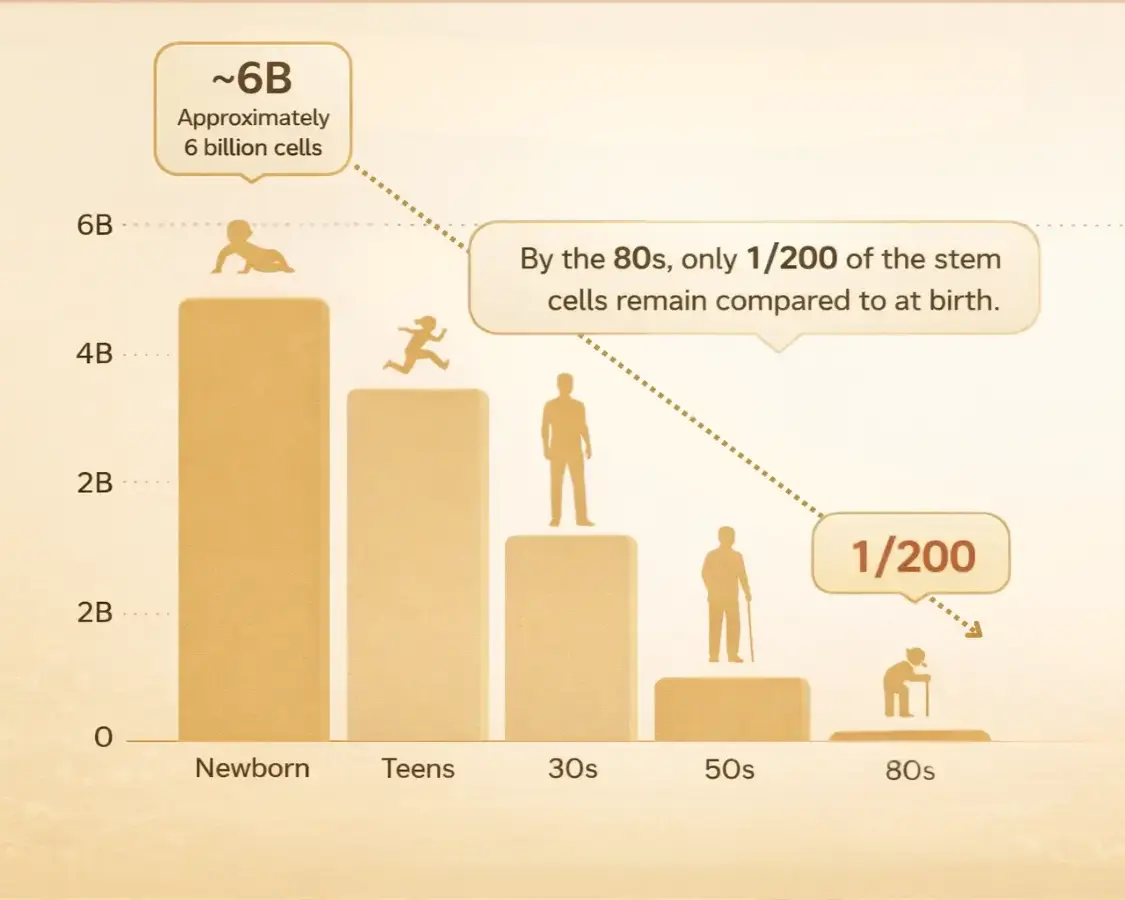
The number of stem cells within the body peaks at birth and then decreases dramatically with age. While new-borns possess an abundance of stem cells, their numbers gradually decline through adolescence, the 30s, and the 50s, becoming extremely limited by the time a person reaches their 80s.
What makes this decline even more problematic is that it is not only the quantity that decreases. The quality of the remaining stem cells also diminishes with age. Specifically, their ability to secrete biologically active substances—such as exosomes and growth factors essential for tissue repair—becomes impaired.
As a result, the body’s regenerative and repair capacity is significantly reduced.
For example, when knee cartilage becomes worn and pain develops, the body would normally suppress inflammation while gradually repairing cartilage and surrounding tissues. However, when this function weakens, pain may persist for long periods or easily recur even after temporary improvement.
Other common examples include:
Pain and swelling from minor sprains or bruises taking longer to subside Lingering fatigue or cough even after a fever resolves from a cold Small cuts or abrasions healing slowly and leaving scars more easily Shoulder or lower back discomfort becoming chronic rather than resolving naturally Reduced skin firmness and luster, with spots and fine wrinkles becoming more noticeable
These are the biological reasons why recovery becomes slower and chronic discomfort more common compared to younger years.
The fundamental approach of MSC therapy is to supplement the stem cells that have decreased with age by administering them intravenously from outside the body, thereby adjusting the internal stem cell levels to a state closer to that of a younger biological age.
Through this approach, MSC therapy is expected not only to slow the progression of aging, but also to bring about a variety of positive changes throughout the body.
How MSC Therapy Works — Explained in Four Steps
The treatment itself is highly simple and rational:
- Cultivation and Administration
MSCs are collected from sources such as neonatal umbilical cords and expanded in specialized facilities. They are then administered into the body via intravenous infusion. - Signal Detection
After administration, MSCs circulate throughout the body via the bloodstream, detecting distress signals emitted from areas affected by inflammation or damage. - Migration (Homing Effect)
Upon detecting these signals, MSCs automatically migrate through blood vessels to the affected areas. This phenomenon is known as the homing effect. - Repair and Regeneration
Once they reach the damaged site, MSCs secrete biologically active substances such as exosomes to activate surrounding cells, or in some cases replace damaged cells themselves, thereby promoting tissue repair and regeneration.
Key Characteristics of MSC Therapy
Due to this mechanism, MSC therapy offers two major advantages not found in other treatments:
- A non-surgical approach: Because MSCs naturally gather at damaged sites by responding to internal signals, it is possible to support weakened areas throughout the body without surgical intervention. Even when multiple areas such as joints, blood vessels, or organs are involved, intravenous administration allows for broad, simultaneous support.
- Systemic conditioning effects (anti-aging aspects): By supporting the regulation of chronic inflammation and tissue repair, MSC therapy may influence not only individual symptoms but overall systemic condition.
Within the range of what has been reported:

Some individuals also report experiencing these so-called “anti-aging aspects”


We Provide the Best Service for your Health
How It Works
Our therapy uses GMP-certified umbilical cord–derived MSCs, administered via intravenous (IV) infusion or localized injection, depending on your personalized plan.
These stem cells:
- Detect and repair damaged tissues
- Reduce inflammation throughout the body
- Stimulate anti-aging growth factors
- Enhance mitochondrial function, improving cellular energy production
Most patients report improvements within weeks — including brighter skin tone, better stamina, reduced joint discomfort, and an improved sense of well-being.
What Effects Can Be Expected?
From Rejuvenation to the Improvement of Medical Conditions
Stem cell therapy holds broad potential. By supplementing the body’s diminished self-healing capacity caused by aging, it is not limited to simply slowing the aging process as an anti-aging measure, but may extend to the improvement of specific symptoms and even overall rejuvenation of the body (so-called reverse aging).
As stem cells circulate throughout the body and work to repair damaged areas, a wide range of effects has been reported.
Expected Effects
The expected effects can generally be divided into two major categories.
Even in individuals without diagnosed illnesses, stem cells may activate cells throughout the body, leading to the following rejuvenation-related effects:
Improvement in skin spots, wrinkles, and sagging
Hair becoming darker
Muscle rejuvenation and increased ease of building muscle
Reported cases of improvement in eyelid drooping (ptosis)
Reduced fatigue and increased daytime vitality
Improved sleep quality
Reduction in joint stiffness and discomfort
These are reported examples only. Individual experiences and the degree of change vary, and the same results are not guaranteed for everyone.
Prevention and Improvement of Various Medical Conditions
The anti-inflammatory properties, immune-regulating functions, and tissue repair capabilities of stem cells have been reported in numerous studies to be effective in relation to specific diseases.
Examples include:
- Lifestyle-related diseases and internal organ conditions
Improvements may be expected in conditions such as diabetes and kidney failure, which involve chronic inflammation. - Dermatitis such as atopic dermatitis
Immune-regulating functions and skin regenerative capacity may contribute to improvements in skin condition. - Cancer prevention
Certain MSCs (particularly those derived from Wharton’s Jelly) are reported to contain factors that suppress cancer. - ALS (Amyotrophic Lateral Sclerosis)
Effects have been reported in which MSCs act on damaged nerves and slow the progression of symptoms.
These diverse effects are brought about through a fundamentally important function of stem cells: restoring and enhancing the body’s innate natural healing ability.
However, in order to pursue such effects while also taking safety into consideration, it becomes critically important what kind of “stem cells” are used.
Your Path to Better Health Begins Here
Benefits of Anti-Aging Stem Cell Therapy
Physical Benefits
- Reduced wrinkles & pigmentation
- Thicker, healthier hair
- Reduced joint stiffness
- Improved sleep quality
Internal Benefits
- Enhanced metabolism
- Strengthened immune function
- Balanced hormone & stress response
- Slower biological aging
Differences in Stem Cells
Why Are “Baby Umbilical Cord”–Derived Cells Considered the Most Powerful?
One of the most important factors in maximizing the effectiveness of stem cell therapy is which source of stem cells is used.
Stem cells can be harvested from various parts of the human body, such as fat tissue or bone marrow. However, their characteristics and functional potential vary greatly depending on their origin.
Among these sources, stem cells contained in the umbilical cord of new-borns at birth have attracted strong global attention due to their youthfulness and high potential, making them one of the most promising cell sources in regenerative medicine.
Autologous vs. Allogeneic Cultivation: A Critical Difference
First, stem cell therapy can broadly be divided into two approaches.
| Method | Description | Approved in Japan | Key Characteristic |
|---|---|---|---|
| Autologous Cultivation | A method in which cells are collected from the patient’s own fat tissue or bone marrow, cultured, and then returned to the body. | ○ | Because one’s own cells are used, this method offers a sense of reassurance; however, the cells are the same biological age as the patient. |
| Allogeneic Cultivation | A method in which cells provided by a third party (donor) are cultured and administered. | × | Because young and healthy donor cells (e.g., newborn umbilical cords) can be used, higher therapeutic potential is expected. |
Regulatory Differences Between Japan and Other Countries
Under Japanese regulations, only autologous cultivation is generally permitted. However, rather than returning cells that have weakened due to aging back into the body, it has become clear that allogeneic cultivation, which administers young, highly vital cells, may offer greater therapeutic potential.
The “stem cell–conditioned media” or “exosome” infusions provided by clinics within Japan are fundamentally different from the allogeneic MSC therapy received in Malaysia.
Exosomes are signaling substances (messengers) secreted by stem cells, and while treatments using them may offer certain effects, these messengers are eliminated from the body in a relatively short period of time, resulting in limited duration of effect.
In contrast, MSC therapy involves administering the stem cells themselves, which act as “factories” that continuously produce biologically active substances, allowing for more sustained and fundamental tissue repair.
Autologous vs. Allogeneic Cultivation: Two Approaches
Stem cell therapy can broadly be divided into two approaches: autologous and allogeneic.
| Method | Description | Key Characteristic |
|---|---|---|
| Autologous Cultivation | This method involves collecting stem cells from the patient’s own fat tissue or bone marrow, culturing them, and then returning them to the patient’s own body. | - Because one’s own cells are used, they are immunologically compatible and often provide psychological reassurance.
- However, the “age” and condition of the stem cells are the same as the patient’s and are therefore affected by aging and lifestyle factors. - A procedure to collect the cells (such as minor surgery) is required, and the cultivation process takes a certain amount of time. |
| Allogeneic Cultivation | This method involves culturing stem cells provided by a third party (donor) and administering them. | - By selecting young and healthy donor cells (for example, stem cells derived from the umbilical cord of new-borns at birth), higher biological potential is considered possible.
- On the other hand, strict safety management systems are required, including donor selection, infectious disease screening, quality control, and traceability. - There are relatively few countries where allogeneic stem cells can be used. |
Requirements for the Clinical Use of Allogeneic Cells
In order to use allogeneic cells in clinical practice:
- Regulations and guidelines defining what types of cells may be used and under what conditions
- Accreditation and audit systems for cell culture facilities, including GMP-level standards
Record management systems that allow donor information and cell lots to be trace
*Must be properly established at a national or regional level.
In countries or regions where these frameworks are not sufficiently established, allogeneic stem cell therapy is generally not permitted. As a result, even if patients wish to receive treatment using donor-derived stem cells, there may be very limited or no options available locally.
On the other hand, in countries or regions where certain regulations, guidelines, and accreditation systems are in place, there are cases in which treatment and clinical research using allogeneic stem cells are being advanced in stages, while limiting the indications and administration conditions.
In this way, while “allogeneic cultivation” is highly attractive in terms of cellular potential, establishing the rules and infrastructure necessary to provide it safely is essential. As a result, the level of such development differs by country and region, and the treatments available likewise vary significantly.
Why “Baby Umbilical Cord”?
Among MSCs used in allogeneic cultivation, those harvested from the gel-like tissue inside the new-born umbilical cord, known as Wharton’s Jelly, are attracting attention as one of the most promising cell sources due to their youth and biological characteristics.
This tissue is reported to contain a large number of stem cells that were formed at the very earliest stage of life, and which are both young and functionally active.
What Is MSC (Mesenchymal Stem Cell)?
Stem cells collected from Wharton’s Jelly, the gel-like tissue inside the new-born umbilical cord, belong to a category of stem cells known as MSC (Mesenchymal Stem Cells).
MSC (Mesenchymal Stem Cells) are a type of undifferentiated cell that can transform (differentiate) into various types of tissue cells, including bone, cartilage, blood vessels, skin, and others.
Their key characteristics include:
- Being in an undifferentiated state, meaning they have not yet specialized into a specific type of cell
- Possessing immune-regulating properties that help balance immune responses
Because of these characteristics, MSCs are attracting worldwide attention in the field of regenerative medicine.
MSCs are generally considered to have characteristics that make them less likely to be strongly recognized as “foreign substances” by immune cells (i.e., they are regarded as having relatively low immunogenicity). As such, when appropriate testing and quality control are carried out, it is considered a feature of MSCs that—even when MSCs from another person are administered via IV infusion—the risk of immune rejection can be more easily kept low.
Of course, no medical treatment is entirely without risk; however, the ability to administer MSCs allogeneically is regarded as one of the major advantages unique to MSC therapy.
The Overwhelming Advantages of Wharton’s Jelly–Derived MSCs
Wharton’s Jelly–derived MSCs possess overwhelming advantages compared with MSCs derived from other sources, in the following respects:
- High Quality and Effectiveness: Because these cells are formed at the time of birth—an extremely early stage of life—they are not affected by aging. As a result, they are often reported to have strong proliferative capacity (self-renewal ability) and high differentiation potential. Some studies suggest that, compared with MSCs derived from adipose tissue or bone marrow, Wharton’s Jelly–derived MSCs may secrete a greater abundance of biologically active substances, including exosomes, cytokines, and growth factors.
*Example:“Comparative Proteomic Analysis of the Mesenchymal Stem Cells Secretome from Adipose, Bone Marrow, Placenta and Wharton’s Jelly”
(ISSN: 1422-0067, Vol.22, No.2)
- Ethical Safety: When stem cells are harvested from bone marrow, the procedure can cause pain to the donor. In contrast, umbilical cords are naturally provided at the time of birth. Therefore, using umbilical cords places no physical burden on the donor and avoids ethical concerns.
- Cancer-Suppressing Potential: It has been shown that Wharton’s Jelly–derived MSCs contain a large number of factors that suppress cancer. As such, they are expected to be effective not only for disease improvement but also for cancer prevention.
- Cost Efficiency: Because a very large number of high-quality stem cells can be cultured from a single umbilical cord, Wharton’s Jelly–derived MSCs also offer excellent cost performance.
In this way, MSCs are cells that combine the characteristics of being “undifferentiated” and “well suited for allogeneic administration.” Among them, Wharton’s Jelly–derived MSCs are positioned as one of the promising options in regenerative medicine, particularly from the perspectives of youthfulness, ethical considerations, safety management, and supply stability.
Despite the exceptional advantages of Wharton’s Jelly–derived MSCs, unfortunately, allogeneic cultivation is not permitted in Japan, making it impossible to receive this treatment domestically.
So, where can one receive the world’s highest-quality MSC therapy?
The answer lies in Malaysia.
Why Malaysia
The Optimal Choice for Receiving Cutting-Edge Treatment
When receiving allogeneic MSC therapy derived from Wharton’s Jelly, which is expected to offer the highest effectiveness, the choice of where to undergo treatment is extremely important.
From the three perspectives of regulation, track record, and cost, Malaysia is an optimal destination for receiving high-quality MSC therapy.
1. Because “Allogeneic Stem Cells” Can Be Used for Treatment
The greatest reason is that allogeneic MSC therapy is permitted under national guidelines in Malaysia.
Not only Japan and South Korea, but also many advanced countries such as the United States and the United Kingdom have not yet generally approved allogeneic cultivation. Among these, Malaysia has been promoting research and practical application of regenerative medicine at a national level and is one of the countries where MSC therapy is most advanced in the world.
2. Because It Is a Government-Recognized “Advanced Medical Country”
Malaysia’s medical standards are highly regarded worldwide, and an environment is in place where advanced treatments can be received with confidence. This reliability is supported by the following objective data:
- Long-standing track record: Malaysia established national guidelines related to stem cell therapy early in 2011 and has since accumulated more than 13 years of extensive clinical experience and results.
- Medical tourism as a national strategy: Under the leadership of former Prime Minister Mahathir, who is also a physician, the government established the Malaysia Healthcare Travel Council (MHTC) in 2005 and has promoted medical tourism as a national policy.
- Overwhelming number of medical travelers: Through the initiatives of MHTC, approximately 1.22 million people visited Malaysia for medical purposes in 2019.
- High international recognition: In 2020, these achievements were internationally recognized, and Malaysia received the “Destination of the Year” award at the IMTJ Medical Travel Awards.
3. Because High-Quality Treatment Can Be Received at an Appropriate Cost
Another major attraction of Malaysia is its excellent cost performance.
For example, in Switzerland, which is also known as an advanced country in stem cell therapy, it is not uncommon for comparable treatment to cost USD 70,000 or more.
In contrast, in Malaysia, it is possible to receive world-class treatment at approximately USD 15,000 to 30,000, without compromising on quality.
This is because Malaysia has a well-established system in which umbilical cords are provided by hospitals, as well as a large number of cultivation facilities, enabling stable supply and cost reduction of stem cell therapy.
Our Strengths
Treatment Process and Safety — Reliable One-Stop Support
Receiving medical treatment overseas often comes with concerns such as language barriers and complicated procedures. For this reason, it is essential to choose a reliable partner with specialized knowledge who can provide attentive support tailored to Japanese patients.
Stem Cell Malaysia / Empression Co., Ltd. has been supporting stem cell treatment in Malaysia since 2018 and has an extensive track record of serving over 200 Japanese patients. From initial inquiry to aftercare, we have established a one-stop support system that allows patients to focus on their treatment with peace of mind.
Treatment Process: 10 Steps From Inquiry to Aftercare
Throughout the entire treatment process, Japanese staff provide careful support.
STEP 1: Counselling (Online Available)
Please feel free to contact us first. Specialized Japanese staff will use Zoom to provide detailed explanations about the treatment and answer any questions you may have.
STEP 2: Application
Once you are satisfied, you will complete the application form with the required information.
STEP 3: Submission of Pre-Treatment Medical Checkup (English)
To assess treatment eligibility, you are required to submit a medical check-up report (in English) conducted within the past six months. This can be obtained at a medical facility in Japan.
STEP 4: Confirmation of Treatment Date
Based on your preferred treatment date, cultivation of your personalized stem cells will begin.
STEP 5: Payment of Treatment Fees
Treatment fees are to be paid in advance.
STEP 6: Travel to Malaysia (As Short as 1 Night, 2 Days)
Please arrive in Kuala Lumpur by the day before the procedure. Treatment can be completed with a minimum stay of one night and two days.
STEP 7: Stem Cell IV Infusion (Japanese Staff Accompaniment On-Site)
Japanese staff will accompany you to the clinic. The procedure itself takes approximately one hour.
STEP 8: Rest Period
After the procedure, please refrain from strenuous exercise and alcohol consumption, and spend the time resting. The physician will explain post-treatment precautions.
Our Strengths
Post-Treatment Medical Check-up (Optional / Recommended for Effect Evaluation)
To objectively assess effects, it is recommended to undergo a medical check-up in Japan approximately two to three months after treatment.
Commitment to Safety: Three Thorough Quality Controls
We place the highest priority on treatment safety and quality.
Use of Only the Freshest Stem Cells
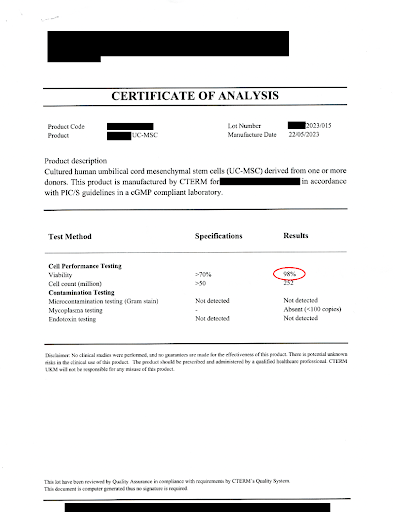
Only the freshest stem cells shipped from the cultivation facility on the day of treatment are used. These cells meet our partner’s independent standard of over 95% viability, which significantly exceeds Malaysia’s national standard of 70% or higher.
Strict Donor Selection Criteria
The stem cells used are ethically provided only from healthy new-born donors who meet Malaysia’s strict health standards.
Procedures by Specialized Physicians and Full Transparency
Procedures are performed by physicians experienced in stem cell therapy. At the time of treatment, patients are provided with inspection reports certifying stem cell quality (viability, sterility, endotoxin non-detection, etc.), allowing quality to be confirmed on the spot.
Partnerships That Support the Highest Quality
The pharmaceutical company we partner with is a pioneer in stem cell therapy in Malaysia, operating GMP-certified laboratories under the supervision of the Malaysian Ministry of Health (MOH).
Treatment is carried out at a private clinic dedicated exclusively to patients, which is directly operated by the pharmaceutical company, allowing patients to receive treatment in the highest-quality environment.
Contact Us
For Those Considering Wharton’s Jelly Stem Cell IV Therapy (MSC Therapy) in Malaysia
We offer free online counseling, during which our specialized Japanese staff will respond carefully and attentively.
In addition to detailed information regarding treatment, we also welcome consultations regarding costs and travel arrangements. Please feel free to ask about anything. We will do our utmost to resolve your concerns and support you in making the most appropriate choice.
Please contact us using the information below.
Contact Form
If you contact us through the inquiry form, a representative will reply by email within one business day, as a general rule.
*Personal information entrusted to us by customers is strictly managed in accordance with our personal information protection policy and will not be disclosed to third parties without the customer’s consent.