

Chronic Kidney Disease Stem Cell Therapy | Slowing Decline Before Dialysis

The simple things take more out of you than they should. Afternoon energy fades by four o’clock when it didn’t used to. Your ankles are puffy by evening. And the latest blood test results show your eGFR has slipped again — another small drop on the chart that has been telling the story of your chronic kidney disease for the last few years.
You take the ACE inhibitor every morning. You watch the blood pressure. You added the SGLT2 inhibitor when it was suggested, and you read the labels on packaged food in a way you never did before. The numbers are still drifting in the wrong direction, just more slowly than they were two years ago. And you have started thinking about something you hoped you would not have to consider seriously: dialysis.
If this is your situation, you are far from alone. An estimated 850 million people worldwide are living with some form of chronic kidney disease — about one in ten adults globally, based on data from the Global Burden of Disease Study. The number reaching end-stage kidney failure climbs each year, and CKD now ranks among the fastest-growing causes of death of any major non-communicable disease.
Most people in this position have already done what conventional medicine asks of them. They take the medications, control the blood pressure, manage the diabetes if it is part of the picture, and watch their eGFR creep downward. For some, the slope of decline is shallow enough that they may never reach dialysis. For others, the slope is steeper — and the question becomes whether anything can shift the underlying biology, not just delay it modestly.
This article looks at that question in detail. We will explain what stem cell therapy for chronic kidney disease actually does at the tissue level, what published clinical trials show about real outcomes, who is and is not a realistic candidate, and where the evidence still has clear limits. We have been working in Malaysia for over seven years, with more than 200 patients treated using allogeneic umbilical cord-derived mesenchymal stem cells across multiple conditions. We do not claim this is a cure for chronic kidney disease, and we will not write as if it is.
Table of Contents
- Why Kidney Function Rarely Returns Once Chronic Kidney Disease Sets In
- Where Standard Chronic Kidney Disease Treatment Reaches Its Plateau
- How Stem Cells Engage With Damaged Kidneys in Chronic Kidney Disease
- What Clinical Trials Show About Chronic Kidney Disease Stem Cell Therapy
- Why Chronic Kidney Disease Stage Matters for Stem Cell Therapy Outcomes
- A Patient's Twelve-Month Experience With Chronic Kidney Disease Stem Cell Treatment
- Why Allogeneic Umbilical Cord MSCs Are Used for Chronic Kidney Disease
- Honest Risks and Limitations of Chronic Kidney Disease Stem Cell Therapy
- FAQ About Chronic Kidney Disease Stem Cell Therapy
- If You Are Asking Where to Go From Here
- References
Why Kidney Function Rarely Returns Once Chronic Kidney Disease Sets In
The Limited Regenerative Capacity of Nephrons in Chronic Kidney Disease
Each kidney contains roughly one million microscopic filtering units called nephrons. These structures are extraordinary little machines — together, the two kidneys filter your entire blood volume about thirty times every day, separating waste from what should be retained.
The trouble is that nephrons are largely a one-time gift. Unlike the liver, which can regenerate substantial volumes of itself, kidneys have very limited capacity to make new nephrons after birth. We are born with our full complement of nephrons, and from there it is a matter of preserving what we have. Some natural decline is expected with age — eGFR (estimated glomerular filtration rate, the standard measure of how well your kidneys filter blood) typically falls by about 1 mL/min per year in healthy adults after the age of forty.
When chronic kidney disease accelerates that decline — through diabetes, hypertension, glomerulonephritis, or other causes — the damaged nephrons cannot be replaced. The remaining healthy ones work harder to compensate, which sounds positive but in fact tends to wear them out faster. This is sometimes called the hyperfiltration injury cycle: surviving nephrons are pushed beyond their sustainable workload, and they begin to fail in turn.
How Fibrosis Takes Over Once Kidney Damage Is Established
When a nephron dies, the body responds the way it responds to wounds everywhere — through scar tissue formation. The medical term for kidney scarring is renal fibrosis, and it is the structural hallmark of progressive chronic kidney disease.
Fibrotic tissue is mechanically stable. It does not bleed or leak. What it cannot do is filter blood. As fibrosis spreads through the kidney, the proportion of working tissue shrinks, and the eGFR — which depends on the total filtering capacity — drops accordingly.
Fibrosis is also self-reinforcing. The signaling environment that drives fibrosis (TGF-β, a master regulator protein, alongside angiotensin II and a network of pro-inflammatory mediators) tends to perpetuate itself once established. Inflammation drives fibrosis, fibrosis drives more inflammation, and the cycle continues with each phase of disease activity. This is the central biological reason why even well-managed chronic kidney disease tends to progress over years and decades — the underlying scarring process has very few natural off-switches.
Where Standard Chronic Kidney Disease Treatment Reaches Its Plateau
What ACE Inhibitors, ARBs, and SGLT2 Inhibitors Actually Accomplish in Chronic Kidney Disease
The medications used in chronic kidney disease management are genuinely effective for what they are designed to do, and we want to be clear about this before discussing their limits.
ACE inhibitors and angiotensin receptor blockers (ARBs) reduce the pressure inside the glomerulus — the tiny filtering structure at the heart of each nephron — and have been shown across decades of clinical trials to slow the rate of eGFR decline in many patients. SGLT2 inhibitors, originally developed for type 2 diabetes, have demonstrated additional kidney protection in trials such as DAPA-CKD and EMPA-KIDNEY, with reductions in the risk of kidney failure or significant eGFR loss across both diabetic and non-diabetic populations.
Blood pressure control, glucose management in diabetic kidney disease, dietary protein moderation, and the avoidance of nephrotoxic medications all contribute to a treatment approach that, when followed consistently, can meaningfully alter the trajectory of CKD.
What this combined approach does not do is repair existing damage or reverse fibrosis. It creates a less stressful environment for the surviving nephrons. It does not bring lost nephrons back, and it does not undo scarring that has already taken place. A patient with eGFR 35 on a fully optimized regimen may slow their decline from one mL/min per year to half that — but they are still moving in the wrong direction. The destination is delayed, not changed.
The Timing Problem When Slow Progression Still Leads to Dialysis
For patients diagnosed at younger ages, particularly those with diabetic kidney disease beginning in their forties or fifties, even a slowed rate of eGFR decline can still lead to a point where dialysis becomes a real conversation. A 50-year-old with eGFR 40 and a slowed decline of 2 mL/min per year may still reach the dialysis threshold within ten to fifteen years.
For these patients, optimized medication is necessary but not sufficient. The clinical reality is what we sometimes call the long, narrowing corridor — every year, the options shrink slightly, the kidney function reduces, and the eventual conversation about renal replacement therapy gets a bit closer. Many patients in this corridor begin asking whether anything can address the underlying biology rather than simply manage its progression.
Stem cell therapy enters the conversation at exactly this point.
How Stem Cells Engage With Damaged Kidneys in Chronic Kidney Disease
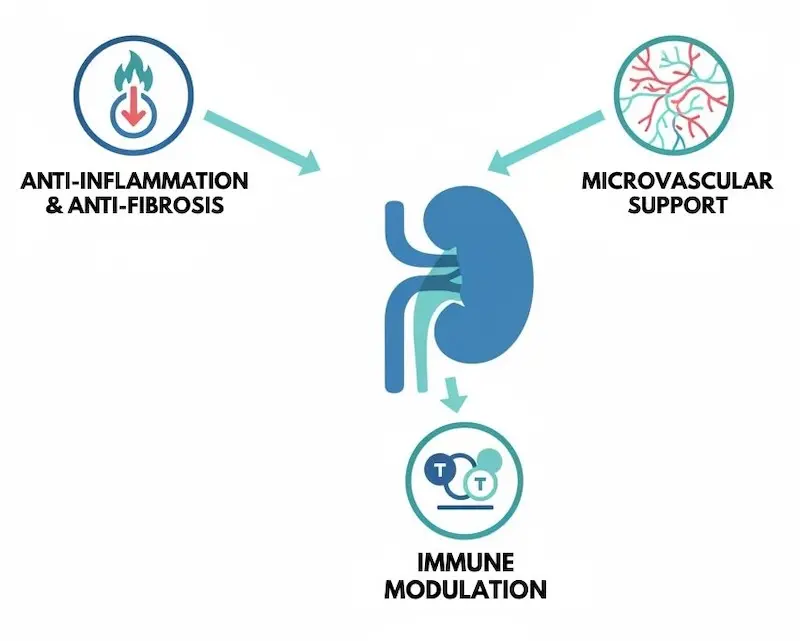
Anti-Inflammatory and Anti-Fibrotic Signaling in Chronic Kidney Disease
The first and best-documented mechanism is the modulation of the inflammatory and fibrotic environment within damaged kidney tissue. MSCs release a constellation of signaling molecules — cytokines (chemical messages between cells), growth factors, and small membrane-bound packages called exosomes — that interact with surrounding cells.
In experimental and clinical models of CKD, this signaling environment has been shown to suppress the activity of TGF-β, reduce the activation of myofibroblasts (the cells that lay down scar tissue), and shift the local immune cell population away from inflammatory and toward repair-oriented behavior. The clinical consequence in human studies has been measurable reductions in inflammatory markers and, in some trials, slowed eGFR decline.
The same anti-inflammatory mechanisms are studied in immune-driven conditions like rheumatoid arthritis, where stem cell therapy for refractory inflammation has shown comparable patterns of disease activity reduction in patients who have failed conventional medication.
Supporting Microvascular Structure and Tubular Cell Survival in Chronic Kidney Disease
The second mechanism involves the small blood vessels that supply each nephron and the tubular cells that line the nephron’s filtering structure. Both are routinely damaged in chronic kidney disease — particularly in diabetic and hypertensive nephropathy, where microvascular injury is a central feature of the pathology.
MSCs secrete pro-angiogenic factors (signals that support the maintenance and formation of small blood vessels) and pro-survival factors that protect tubular cells under stress. The kidney is one of the most vascular organs in the body, and the integrity of its microvasculature is closely tied to its filtering function. Supporting this vascular bed in compromised but not yet destroyed nephrons is a plausible mechanism by which MSC therapy could meaningfully alter the trajectory of disease.
Modulating Immune-Driven Kidney Injury in Chronic Kidney Disease
The third mechanism is most relevant to specific etiologies of CKD where immune dysregulation plays a primary role — IgA nephropathy, lupus nephritis, and certain forms of glomerulonephritis. MSCs interact directly with T cells and B cells, suppressing the inflammatory effector cells while supporting the regulatory T cell populations that normally constrain autoimmune attack.
This immunomodulatory profile is not unique to kidney conditions. The same biological logic applies in heart failure stem cell therapy, where chronic low-grade inflammation contributes to progressive cardiac damage and where MSCs are being investigated for their effect on the broader inflammatory tone of the disease.
What Clinical Trials Show About Chronic Kidney Disease Stem Cell Therapy
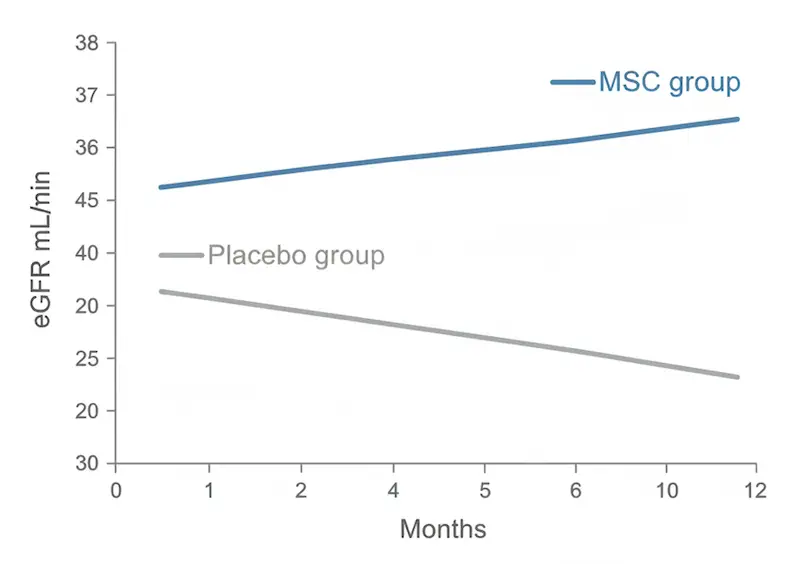
Key Studies of Stem Cell Therapy in Diabetic Nephropathy and Other Chronic Kidney Disease Etiologies
The most cited published trial is the Packham study (EBioMedicine, 2016), a randomized, placebo-controlled, dose-escalation Phase Ib/IIa trial in patients with type 2 diabetes and stage 3b–4 chronic kidney disease. Thirty patients received either intravenous allogeneic mesenchymal precursor cells at one of two doses, or placebo, alongside their existing optimized medical care. At twelve weeks, both stem cell groups showed eGFR stability or slight improvement, while the placebo group showed continued decline. By week sixty, the higher-dose stem cell group still maintained statistically meaningful preservation of eGFR compared to placebo. No serious treatment-related adverse events were attributed to the cells.
Saad and colleagues (Journal of the American Society of Nephrology, 2017) studied autologous adipose-derived MSCs in patients with renovascular disease — a specific form of kidney injury caused by narrowed renal arteries. Cortical kidney perfusion (the blood supply to the outer working layer of the kidney) increased measurably in the treated group, which represented a structural finding rather than just a laboratory number.
Makhlough and colleagues (Stem Cell Research & Therapy, 2017) reported on autologous MSC infusion in autosomal dominant polycystic kidney disease, a progressive genetic form of CKD. The study was small but documented safety and stable kidney function over the follow-up period.
Beyond these specific trials, multiple systematic reviews — including one published in Stem Cell Research & Therapy in 2021 — have analyzed MSC therapy across a range of CKD etiologies and concluded that the safety profile is reassuring and that there is signal for clinical benefit in select patient populations, though large Phase III trials are still needed.
What the eGFR Numbers Actually Mean for Chronic Kidney Disease Patients
We want to translate the clinical numbers into something meaningful at the patient level.
A change in eGFR of two or three mL/min per year is the difference between reaching dialysis at age 70 and reaching it at age 75 — sometimes the difference between reaching it at all and not. Stabilization of eGFR for twelve months in a patient who was previously losing 4 mL/min per year is a meaningful clinical result, even if it does not sound dramatic in raw numbers.
That said, we want to be realistic. The published trials show signals of benefit, not transformation. Not every patient responds. The duration of effect from a single course of treatment, and whether re-treatment is required, are questions the field is still working through. Patients who go into this with realistic expectations are far better positioned to assess their own response fairly.
Why Chronic Kidney Disease Stage Matters for Stem Cell Therapy Outcomes
The Most Studied Range and Why Earlier Stages of Chronic Kidney Disease Respond Better
Chronic kidney disease is staged from G1 (eGFR 90+, with markers of kidney damage) through G5 (eGFR below 15, often dialysis territory). The clinical trial evidence for MSC therapy has concentrated primarily on the G3a, G3b, and earlier G4 ranges — eGFR roughly between 20 and 60.
This range is studied for a reason. There is enough remaining functional kidney tissue for MSC therapy’s biological mechanisms — anti-inflammatory signaling, vascular support, anti-fibrotic effect — to plausibly do something meaningful. There is meaningful function still to protect.
Patients at earlier stages, with eGFR in the 50–60 range, often respond well clinically — though for some, the slow rate of decline they were already experiencing makes the benefit harder to detect over short timeframes. Patients in the 30–45 range tend to show the clearest signal in clinical trials and in our own clinical experience.
When Chronic Kidney Disease Stem Cell Therapy Is Unlikely to Help
We are direct about cases where this treatment is unlikely to provide meaningful benefit.
Patients with eGFR below 15, or already on dialysis, are not appropriate candidates outside of carefully designed clinical research. The structural damage at this stage is too extensive for the biological mechanisms of MSC therapy to overcome. The clinical conversation in this range is appropriately about transplant evaluation or optimization of dialysis.
Patients with active acute kidney injury, active severe glomerulonephritis flares, or untreated underlying causes such as urinary tract obstruction or active infection need those conditions stabilized first. Patients with active malignancy, severely uncontrolled hypertension, or active systemic infection are not candidates.
Patients whose kidney decline is being driven by an ongoing process that has not been addressed — uncontrolled diabetes with HbA1c above 10%, severely uncontrolled blood pressure, ongoing nephrotoxic medication exposure — should have that underlying driver addressed before considering stem cell therapy. Adding MSC therapy on top of an unaddressed primary insult is unlikely to change the trajectory in any durable way.
A Patient’s Twelve-Month Experience With Chronic Kidney Disease Stem Cell Treatment
The Pre-Treatment Picture Before Chronic Kidney Disease Stem Cell Therapy
A man in his early sixties, diagnosed with type 2 diabetes nineteen years prior. Diabetic kidney disease had been progressing for the last seven of those years. By the time he came to our clinic, his eGFR was 32 mL/min, his urinary albumin-to-creatinine ratio was elevated, and he had lost approximately 4 mL/min of eGFR per year for the past three years. His diabetes was reasonably controlled, with HbA1c around 7.2%. He was on a maximum-tolerated dose of an ARB and had been started on an SGLT2 inhibitor eight months earlier.
His nephrologist had begun the early conversations about vascular access planning for eventual dialysis — not as imminent, but as a realistic possibility within five to seven years if his current trajectory continued. He came to Malaysia in early 2025 after researching the published literature carefully and consulting with his nephrologist, who supported him exploring the option while continuing all existing care.
How the Year After Chronic Kidney Disease Stem Cell Treatment Unfolded
He received a single course of allogeneic umbilical cord-derived MSC infusions over a one-week stay. The first two months produced no detectable change. By month three, his eGFR had stabilized at 33 — the first time in three years it had not moved downward at the quarterly check. At six months it was 34. At twelve months it was 33 — essentially flat over a year, in a patient who had been losing function steadily before treatment. His urinary albumin had also reduced moderately. He continued every existing medication. His nephrologist was cautiously satisfied with the trajectory, and the conversation about vascular access planning was put on hold pending the next year’s data.
He has not been cured. He still has chronic kidney disease, and the long-term durability of his stabilization remains an open question. But twelve months without further decline, in a patient who was previously declining steadily, has changed the practical picture of what the next decade might look like for him.
This is an anonymized account based on actual clinical experience and shared with the patient’s consent. Individual results vary, and this experience does not represent a guaranteed or typical outcome for any other patient.
Why Allogeneic Umbilical Cord MSCs Are Used for Chronic Kidney Disease
The choice of cell source matters and is worth explaining clearly.
Autologous stem cell therapy uses cells harvested from the patient’s own body — typically bone marrow or adipose tissue — and is the framework permitted under Japan’s regenerative medicine regulations. The advantage is the absence of any rejection concern. The disadvantage, particularly for chronic kidney disease patients, is that the cells reflect the patient’s existing biology. A 65-year-old with diabetes and CKD has cells that have been exposed to that internal environment for years, and laboratory studies have shown reduced potency in MSCs harvested from patients with established CKD compared to healthy donors.
The treatment we provide in Malaysia uses allogeneic MSCs derived from donated umbilical cord tissue (specifically the Wharton’s jelly layer of the cord). These cells come from healthy newborn donors, are biologically young, and are characterized by particularly potent immunomodulatory and anti-inflammatory signaling. They are produced under controlled laboratory conditions in standardized doses, with quality and potency verified before each treatment is administered. Because umbilical cord MSCs express low levels of the surface proteins that normally trigger immune rejection, clinically significant rejection reactions are uncommon.
Honest Risks and Limitations of Chronic Kidney Disease Stem Cell Therapy
Known Side Effects in Chronic Kidney Disease Stem Cell Treatment Practice
The safety profile of allogeneic MSC therapy across published kidney trials has been generally favorable. The Packham study reported no serious treatment-related adverse events. Across the broader MSC literature in CKD and adjacent conditions, the most commonly observed effects have been mild and transient.
Low-grade fever in the 24–48 hours after infusion occurs in approximately 15–20% of patients — believed to reflect mild immune recognition of the donor cells rather than infection. Fatigue and mild headache during the same window are also reported. These effects typically resolve on their own without medical intervention.
Theoretical concerns include the interaction between MSC therapy and existing immunosuppressive medications, which is why we do not advise patients to alter existing medications around the time of treatment. We coordinate, where possible, with the patient’s nephrologist to ensure continuity of care.
Long-term safety data beyond two to three years remains limited because the field at this scale is still relatively young. We disclose this openly to every patient before treatment.
What Stem Cell Therapy Cannot Do for Chronic Kidney Disease
We want to be specific about the limits.
Stem cell therapy cannot reverse end-stage kidney disease. Once eGFR has fallen below approximately 15 and structural damage is extensive, the biological mechanisms of MSC therapy do not have the substrate to act on. At that point, the appropriate clinical pathway is renal replacement therapy — dialysis or transplantation.
Stem cell therapy cannot replace the medications that have been shown to slow CKD progression. ACE inhibitors, ARBs, SGLT2 inhibitors, and good blood pressure and glucose control are foundational. MSC therapy is added to that foundation, not in place of it.
Stem cell therapy does not cure the underlying cause of CKD. If diabetes or hypertension is driving the disease, those conditions remain present and must continue to be managed.
Not every patient responds. The proportion of patients who experience meaningful eGFR stabilization or improvement varies across the published trials, and we cannot reliably predict in advance who will respond and who will not. Pre-treatment assessment provides useful guidance, but no guarantee.
If you are looking for a guaranteed reversal of chronic kidney disease, this treatment will not provide it, and we will say so clearly in any consultation.
FAQ About Chronic Kidney Disease Stem Cell Therapy
In Malaysia, allogeneic umbilical cord MSC therapy is provided under the country’s regulated medical practice framework for stem cell therapy. It is not an approved first-line treatment for CKD in most countries, and patients should understand they are accessing a treatment whose evidence base is still developing through ongoing clinical research.
No. We specifically advise patients to continue all existing medications before, during, and after the treatment process. Decisions about medication adjustment must remain with the treating nephrologist and should never be made unilaterally because of a stem cell intervention.
The biological effects of MSC therapy unfold gradually. Most patients see no change in the first six to eight weeks. Meaningful changes in eGFR, urinary albumin, or inflammatory markers, when they occur, are typically detectable at the three-month follow-up and become clearer at six and twelve months.
This is one of the open questions in the field. Published trials have follow-up periods of one to two years, with some showing sustained benefit at the longer endpoints. Whether re-treatment is needed, and at what interval, is not yet established. Some patients in our program elect to repeat treatment annually as a maintenance approach; others have shown stable effect from a single course over multiple years. We discuss this openly during the consultation.
Not in established end-stage kidney disease. Where stem cell therapy may make a difference is upstream — slowing or stabilizing decline in patients who are not yet at end-stage, and potentially extending the timeline before dialysis becomes necessary. For patients already at end-stage, transplantation remains the only restorative option, and stem cell therapy is not an alternative to it.
If You Are Asking Where to Go From Here
If you are watching your eGFR decline despite doing everything you have been asked to do, and you are wondering whether anything beyond the current pathway is worth considering, that is exactly the kind of situation our free online consultations are designed to address.
We will review your laboratory history, medication regimen, and the trajectory of your disease, and tell you honestly whether your case falls within the range where this therapy has shown evidence of meaningful benefit. If we do not think the treatment is appropriate for your specific situation, we will say so clearly. You are not committing to anything by reaching out other than the conversation itself.
References
- GBD Chronic Kidney Disease Collaboration. “Global, regional, and national burden of chronic kidney disease, 1990–2017: a systematic analysis for the Global Burden of Disease Study 2017.” The Lancet. 2020;395(10225):709–733. https://doi.org/10.1016/S0140-6736(20)30045-3
- Packham DK, Fraser IR, Kerr PG, Segal KR. “Allogeneic mesenchymal precursor cells (MPC) in diabetic nephropathy: a randomized, placebo-controlled, dose escalation study.” EBioMedicine. 2016;12:263–269. https://doi.org/10.1016/j.ebiom.2016.09.011
- Saad A, Dietz AB, Herrmann SMS, et al. “Autologous mesenchymal stem cells increase cortical perfusion in renovascular disease.” Journal of the American Society of Nephrology. 2017;28(9):2777–2785. https://doi.org/10.1681/ASN.2017020151
- Makhlough A, Shekarchian S, Moghadasali R, et al. “Safety and tolerability of autologous bone marrow mesenchymal stromal cells in patients with autosomal dominant polycystic kidney disease.” Stem Cell Research & Therapy. 2017;8(1):116. https://doi.org/10.1186/s13287-017-0557-7
- Heerspink HJL, Stefánsson BV, Correa-Rotter R, et al. “Dapagliflozin in patients with chronic kidney disease (DAPA-CKD).” New England Journal of Medicine. 2020;383(15):1436–1446. https://doi.org/10.1056/NEJMoa2024816
- Liu D, Cheng F, Pan S, Liu Z. “Mesenchymal stem cells as therapeutic agents and novel carriers for the delivery of candidate genes in acute kidney injury and chronic kidney disease: a systematic review.” Stem Cell Research & Therapy. 2020;11:1–17. https://doi.org/10.1186/s13287-020-01840-2
- The EMPA-KIDNEY Collaborative Group. “Empagliflozin in patients with chronic kidney disease.” New England Journal of Medicine. 2023;388(2):117–127. https://doi.org/10.1056/NEJMoa2204233