Spinal Cord Injury Stem Cell Therapy | What Function Can Realistically Return
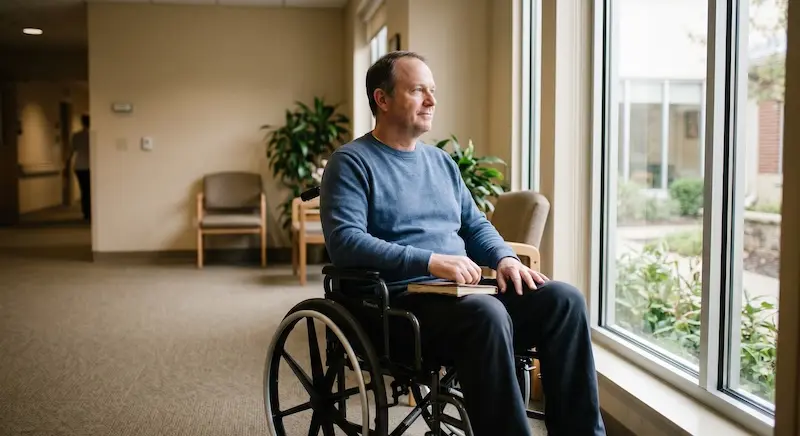
You tell your leg to move. The message leaves your brain the way it always has — but somewhere along your spine, it stops. The signal that used to travel without a thought now reaches a damaged stretch of cord and goes no further.
For people living with a spinal cord injury, that interrupted signal is the whole of daily life. It shows up as legs that will not answer, hands that have lost their grip, a bladder and bowel that no longer report in, skin that cannot feel pressure or temperature, and a kind of nerve pain that medication only partly touches. These are not small inconveniences. They reorganise everything.
You are not facing this alone. According to the Global Burden of Disease Study 2019, an estimated 20.6 million people worldwide were living with a spinal cord injury, with roughly 900,000 new injuries every year. Falls and road traffic crashes are the two leading causes, and injuries at the neck level — the ones that affect the most function — are the single largest group.
Most people who reach us have already been through the standard sequence: emergency surgery to stabilise the spine, weeks or months of intensive rehabilitation, and then a slow tapering of recovery until it flattens into a plateau. At that point, the honest message from conventional medicine is usually that what you have now is close to what you will keep.
In recent years, stem cell therapy for spinal cord injury has become one of the most searched — and most oversold — topics in regenerative medicine. Some sites promise people will walk again; others dismiss the whole field as a scam. This article takes neither position. We look at what the published clinical trials actually measured, explain in plain language what stem cells can and cannot realistically target, and are direct about where the evidence is still thin.
We are a clinical team based in Malaysia with over seven years of experience and more than 200 patients treated using allogeneic (donor-derived) umbilical cord mesenchymal stem cells. Spinal cord injury is, frankly, the condition where we are most cautious about expectations — and this article reflects that.
Table of Contents
- What Actually Happens to the Body After a Spinal Cord Injury
- Where Standard Spinal Cord Injury Care Reaches Its Ceiling
- How Stem Cell Therapy Works on Spinal Cord Injury — Three Realistic Targets
- Complete vs Incomplete: Why Injury Type Shapes Spinal Cord Injury Stem Cell Outcomes
- What the Clinical Data Actually Shows for Spinal Cord Injury Stem Cell Therapy
- Allogeneic Umbilical Cord vs Autologous Stem Cells for Spinal Cord Injury
- Honest Risks and Limitations of Spinal Cord Injury Stem Cell Therapy
- FAQ About Spinal Cord Injury Stem Cell Therapy
- Next Step
- References
What Actually Happens to the Body After a Spinal Cord Injury
The Primary and Secondary Injury Cascade in Spinal Cord Injury
A spinal cord injury happens in two stages, and understanding the difference matters for understanding what any treatment can hope to do.
The first stage is the primary injury — the physical damage of the moment itself. A fall, a crash, or a sudden compression bruises, tears, or crushes the cord. This is mechanical, instantaneous, and over in a fraction of a second.
The second stage is slower and, in some ways, more destructive. Over the hours, days, and weeks that follow, the injured cord triggers a secondary injury cascade: swelling, bleeding, a flood of inflammatory cells, loss of blood supply to nearby tissue, and a wave of chemical activity that kills nerve cells which survived the original impact. Think of the primary injury as the initial blow and the secondary injury as a fire that keeps spreading outward from it. A great deal of the final disability comes not from the first instant, but from this second, expanding wave.
Why the Spinal Cord Cannot Repair Itself After Injury
In most of the body, damaged tissue rebuilds. The spinal cord does not, and there are two reasons why.
First, the central nervous system has very limited regenerative capacity. Unlike a cut on your skin, severed nerve fibres in the cord — called axons — do not reliably regrow across the injury. The mature spinal cord simply was not built to replace itself.
Second, once nerve tissue dies, the body fills the space with a dense glial scar. That scar is biologically useful in the short term, because it walls off the damaged zone. But it also becomes a physical and chemical barrier that blocks any axons trying to grow back through it. The result is a gap in the cord’s wiring that the body cannot bridge on its own. This is why a spinal cord injury, unlike a broken bone, does not knit back together with time and rest.
Where Standard Spinal Cord Injury Care Reaches Its Ceiling
What Surgery and Rehabilitation Can — and Cannot — Do for Spinal Cord Injury
The conventional care pathway for spinal cord injury is genuinely valuable, and nothing here is a criticism of it.
Early surgical decompression and stabilisation relieve pressure on the cord and prevent further mechanical damage. Intensive rehabilitation — physiotherapy, occupational therapy, retraining of remaining muscles, and adaptation strategies — is the single most important factor in recovering and preserving function. Medications manage spasticity, neuropathic pain, and bladder problems. Devices, from catheters to advanced wheelchairs to, in some cases, epidural electrical stimulators, extend what a person can do.
What none of these can do is restore the lost nerve tissue itself. Rehabilitation trains the nervous system to make the most of what survived the injury; it cannot rebuild the connections that were destroyed. Surgery protects the cord; it does not regenerate it. This is the structural gap that regenerative approaches are trying to address.
The Plateau Most Spinal Cord Injury Patients Eventually Reach
After a spinal cord injury, most natural recovery happens in the first six to twelve months. During this window, swelling resolves, the secondary injury settles, and the nervous system reorganises around the damage. Then, for the majority of people, the pace of improvement slows and levels off into what clinicians call a plateau.
Reaching that plateau is often the hardest psychological moment. The acute phase is over, the rehabilitation gains have largely been banked, and the question shifts from “how much will I get back?” to “is this all there is?” It is precisely at this stage — medically stable, past the natural recovery window, but living with significant daily limitation — that many people begin asking whether stem cell therapy could add anything the standard pathway cannot.
How Stem Cell Therapy Works on Spinal Cord Injury — Three Realistic Targets
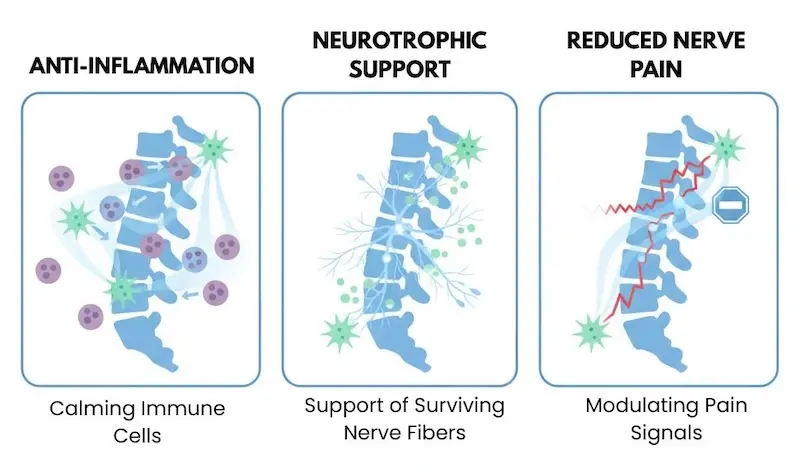
The most important thing to clear up first is a misconception. Mesenchymal stem cells (MSCs), the cell type used in most spinal cord injury trials and in our own program, do not reliably turn into new nerve cells and rewire a severed cord. The early dream of “growing a new spinal cord” has not been borne out by the evidence. What the research has identified instead are three indirect but meaningful targets.
Calming the Secondary Injury and Inflammation in Spinal Cord Injury
The first target is the inflammatory environment around the injury. MSCs release signalling molecules called cytokines (chemical messages passed between cells) that shift the local immune response away from its destructive, attacking state toward a calmer, repair-oriented one.
In an early or sub-acute injury, this may help limit the secondary cascade — the spreading fire described earlier. Even in a long-standing injury, the chronically inflamed tissue around the scar can be quieted, which appears to matter for symptoms like nerve pain and spasticity. This immune-calming effect is the same broad mechanism that has been studied in inflammatory conditions elsewhere in the body, including the work on rheumatoid arthritis stem cell therapy and on the chronic inflammation seen in heart failure stem cell therapy.
Supporting Surviving Nerve Tissue After Spinal Cord Injury
The second target is the nerve tissue that survived the injury but is struggling. After a spinal cord injury, the damage is rarely a clean, complete break. Often a rim of partially functioning tissue survives around the core of the injury, working poorly in a hostile environment.
MSCs secrete growth factors — proteins that support the survival and function of neighbouring cells. In laboratory and clinical studies, these signals appear to help surviving neurons stay alive, support the cells that insulate nerve fibres (a process related to remyelination), and encourage small-scale sprouting of new connections. The goal here is not to regrow a destroyed cord, but to coax more function out of the tissue that is still there.
Modulating Neuropathic Pain and Spasticity in Spinal Cord Injury
The third target is one that patients often value most, even though it gets the least attention in dramatic headlines: pain and spasticity.
Neuropathic pain after spinal cord injury is notoriously hard to treat and responds poorly to standard medication. MSCs appear to reduce the sensitisation of the nerve pathways that drive this pain, partly by quieting the inflammatory signals around damaged nerve roots — a mechanism that overlaps with what is seen in disc-related conditions such as low back pain stem cell therapy. Several trials have reported improvements in neuropathic pain, spasticity, and bladder and bowel control even in patients whose motor strength changed little. For someone living with constant nerve pain or daily bladder dysfunction, these are not minor outcomes.
Complete vs Incomplete: Why Injury Type Shapes Spinal Cord Injury Stem Cell Outcomes
This section is the one that decides, more than any other, whether stem cell therapy is worth considering for a given person.
Why Incomplete Spinal Cord Injury Tends to Respond Better
Doctors classify spinal cord injury severity using the ASIA Impairment Scale (AIS), which runs from grade A to grade E. In plain terms: grade A means a complete injury, with no motor or sensory function preserved in the lowest sacral segments. Grades B through D describe incomplete injuries, where some sensation or movement is preserved below the level of injury. Grade E is normal function.
The distinction is not bureaucratic — it reflects how much living tissue remains. In an incomplete injury, surviving nerve fibres still cross the damaged zone, even if they work poorly. That is exactly the tissue the three mechanisms above can support. In a complete injury where the cord has been functionally severed, there may be very little surviving connection for stem cells to act on. This is why, across the literature, patients with incomplete injuries and some preserved function tend to show more consistent benefit than those with complete injuries.
Who Is and Is Not a Candidate for Spinal Cord Injury Stem Cell Therapy
Based on the published trials and our own clinical experience, stem cell therapy for spinal cord injury is most worth discussing for people who have an incomplete injury (AIS grade B, C, or D) with some preserved sensation or movement, are medically stable and past the acute emergency phase, have realistic goals — for example, improvements in sensation, bladder or bowel control, nerve pain, or spasticity rather than a guarantee of walking, and who understand that any gains develop slowly over months and are not guaranteed.
It is far less likely to help, and we will say so directly, for people with a complete (AIS grade A) injury where the cord has been functionally divided and no viable tissue remains across the gap. It is not appropriate for anyone in an acute medical emergency, with an unstable spine, active infection, active cancer, or uncontrolled systemic illness. And it is the wrong path for anyone who needs a guaranteed or rapid result, because spinal cord injury is the area of regenerative medicine where outcomes are least predictable.
What the Clinical Data Actually Shows for Spinal Cord Injury Stem Cell Therapy
The evidence for stem cells in spinal cord injury is real, peer-reviewed, and steadily growing — but it is mostly early-phase, in small numbers of patients, and it includes disappointments alongside the encouraging results. We think you should see all of it.
Key Trials on Stem Cell Therapy for Spinal Cord Injury
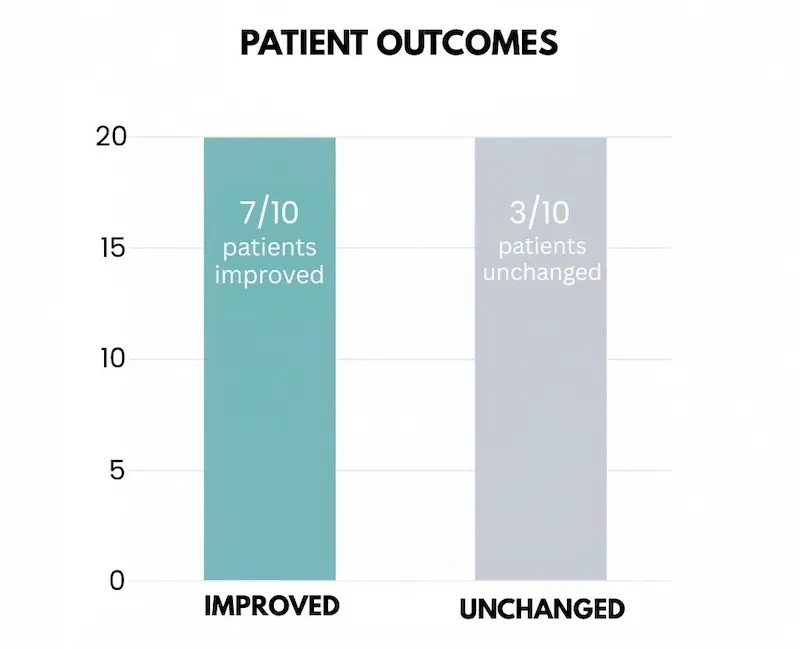
One of the most carefully reported recent studies is the CELLTOP Phase I trial at Mayo Clinic (Bydon and colleagues, published in Nature Communications in 2024). Ten patients with traumatic spinal cord injury, all AIS grade A or B at the time of injury, received an intrathecal injection (delivered into the spinal fluid via a lumbar puncture) of 100 million of their own adipose-derived MSCs. Over two years of follow-up, seven of the ten patients showed measurable improvement in motor and/or sensory function, three showed no change, and importantly none got worse. The most common side effects were headache and musculoskeletal pain, and there were no serious adverse events.
A Phase 2 trial from the Puerta de Hierro group in Spain (Vaquero and colleagues, Cytotherapy, 2018) treated patients with chronic spinal cord injury using three intrathecal doses of 100 million MSCs each. The treatment was well tolerated with no adverse events attributed to the cells, and patients showed variable improvements in sensation, motor power, spasms, spasticity, neuropathic pain, sexual function, and bladder and bowel control — notably, regardless of injury level or how much time had passed since the injury.
Most relevant to our own approach is a 2026 multicentre, randomised, double-blind, placebo-controlled Phase I/II trial of intrathecal allogeneic Wharton’s jelly-derived umbilical cord MSCs in 18 patients with chronic incomplete cervical spinal cord injury (published in Biomedicines). This is the same allogeneic umbilical cord cell source we use, tested in the gold-standard placebo-controlled design that the field has long needed.
It is just as important to report the trials that fell short. A Phase III study of autologous MSC therapy for spinal cord injury (Oh and colleagues, Neurosurgery, 2016) found only limited efficacy. That result is part of the honest picture: larger, more rigorous trials have not always reproduced the gains seen in smaller ones, and the field still lacks a large, definitively positive Phase III.
What Realistic Improvement Looks Like After Spinal Cord Injury Stem Cell Therapy
Putting the data together, here is the realistic picture we give patients, rather than a highlight reel.
When improvement occurs, it is usually partial and develops gradually over three to twelve months, not overnight. The most commonly reported gains are in sensation, bladder and bowel function, neuropathic pain, and spasticity — the quality-of-life domains. Motor improvements happen for some patients, especially with incomplete injuries, but they are less predictable, and a return to walking is the exception rather than the rule. A meaningful proportion of patients — in CELLTOP, three of ten — experience no measurable change at all. And there is, at present, no reliable way to predict in advance exactly who will respond and who will not.
Allogeneic Umbilical Cord vs Autologous Stem Cells for Spinal Cord Injury
The Limits of Autologous Stem Cells in Spinal Cord Injury
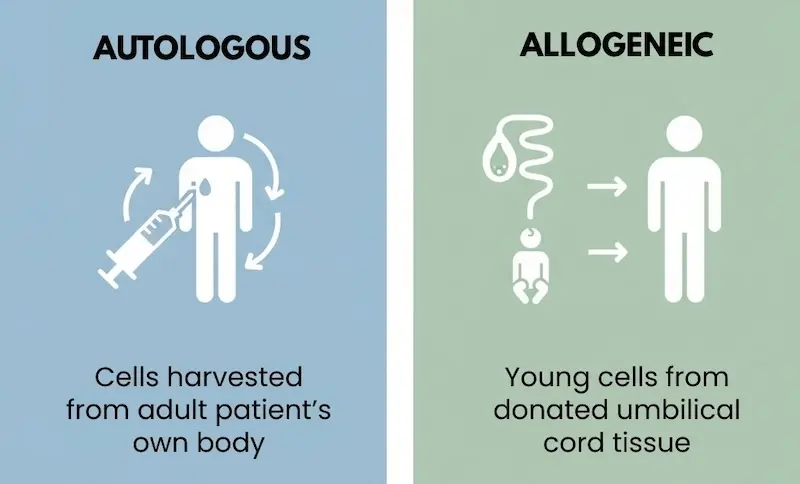
In Japan and several other countries, the regulatory framework centres on autologous stem cells — cells harvested from the patient’s own bone marrow or fat tissue, then expanded and returned. The clear advantage is that there is no risk of immune rejection, because the cells are genetically your own.
The drawbacks matter, though. Harvesting is an additional invasive step. The cells must be cultured for weeks before they can be used. And critically, the quality of a person’s own MSCs reflects their age and health: cells from an older adult, or from someone with years of systemic stress after a serious injury, tend to be fewer, less proliferative, and weaker in their signalling than cells from a young, healthy source.
Why We Use Allogeneic Umbilical Cord MSCs for Spinal Cord Injury
We use allogeneic MSCs derived from donated umbilical cord tissue (Wharton’s jelly), collected at the time of a healthy birth with full donor consent. These are among the youngest and most potent MSCs available, and they carry a particularly strong immunomodulatory and neurotrophic signal — the very properties that the three mechanisms above depend on.
Because umbilical cord MSCs express low levels of the surface markers that trigger immune rejection, serious rejection reactions are extremely rare, and the recent placebo-controlled trial of allogeneic Wharton’s jelly MSCs reflects growing confidence in this source. Practically, there is no harvesting procedure for the patient, the cells can be prepared in standardised, quality-tested doses, and potency can be verified before treatment. In Malaysia, this treatment is carried out as a regulated medical procedure, and for spinal cord injury the cells are delivered intrathecally, into the spinal fluid, so they can reach the injured region.
Honest Risks and Limitations of Spinal Cord Injury Stem Cell Therapy
Known Side Effects of Spinal Cord Injury Stem Cell Therapy
Across published trials, the safety profile of MSC therapy for spinal cord injury has been generally reassuring. In the CELLTOP trial, no serious adverse events occurred over two years; the most common effects were headache and musculoskeletal pain, both temporary.
The most relevant procedural risk comes from the intrathecal delivery itself. A lumbar puncture can cause a post-procedure headache, transient back or nerve pain, and, rarely, infection — risks shared by any spinal injection and minimised by performing the procedure under strict sterile conditions. A low-grade fever or fatigue in the day or two afterward, reflecting the immune system noticing the donor cells, is also reported by some patients and usually resolves on its own.
What Stem Cell Therapy Cannot Do for Spinal Cord Injury
We want to be as clear about the limits as about the potential, because this is where overselling does the most harm.
Stem cell therapy cannot reconnect a completely severed spinal cord or regrow a destroyed segment of cord. It cannot reverse a complete (AIS grade A) injury with no surviving tissue. It is not a substitute for rehabilitation — the gains that do occur are built on, and amplified by, continued physiotherapy. It will not deliver a guaranteed or rapid result, and it is not a replacement for the surgical and medical care that manages an acute or unstable injury. Long-term data beyond two to three years remains limited, and the field still awaits a large, definitively positive trial. Anyone presenting this treatment as a cure for paralysis is not being honest with you, and we would rather lose your trust by being cautious than keep it by overpromising.
Recovery and Follow-Up After Spinal Cord Injury Stem Cell Therapy
Recovery from the procedure is straightforward; most patients can travel home within a few days. The more important point is patience with the biological timeline. Unlike a medication that acts within hours, stem cells work through slow processes — calming inflammation, supporting surviving tissue, and modulating nerve signalling — that take weeks to months to show effect.
We schedule remote follow-up assessments over the following year, and we strongly encourage patients to continue their rehabilitation program throughout, because the function stem cells may help unlock still has to be trained and strengthened. Most patients who respond begin to notice changes — often first in sensation, pain, or bladder and bowel control — between the second and sixth month.
FAQ About Spinal Cord Injury Stem Cell Therapy
There is no strict cut-off. The Spanish and other trials treated patients with chronic, long-standing injuries and still reported variable improvements regardless of how much time had passed. That said, the type and completeness of the injury matter far more than the calendar.
For most people, the honest answer is no, this should not be expected. Motor recovery does happen for some patients with incomplete injuries, but the more common and realistic gains are in sensation, bladder and bowel function, neuropathic pain, and spasticity.
Japan’s framework centres on using your own cells. We use allogeneic umbilical cord-derived MSCs, which are younger and more potent and require no harvesting procedure from you. Neither approach has been proven definitively superior, but cell quality is a meaningful variable.
No. It is an experimental, adjunctive approach aimed at improving specific functions and quality of life, used alongside — not instead of — surgery, rehabilitation, and ongoing medical care.
This is a self-funded medical procedure performed in Malaysia and is generally not covered by insurance. We discuss the practical details individually during consultation.
Next Step
If you have read this far, you are probably weighing a difficult and personal decision, and you have likely already encountered both the people who promise too much and the people who dismiss the whole idea. We try to sit honestly between the two.
We offer free online consultations where you can share your injury classification, imaging, and history, and we will tell you candidly whether we think your situation falls within the range where this therapy has shown evidence of benefit — or whether it does not. There is no obligation to proceed, and you do not need to have made any decision beforehand. Whatever you choose, we believe you deserve a clear and realistic picture rather than a sales pitch.
References
- GBD 2019 Spinal Cord Injuries Collaborators. “Global, regional, and national burden of spinal cord injury, 1990–2019: a systematic analysis for the Global Burden of Disease Study 2019.” The Lancet Neurology, 22(11):1026–1047, 2023. DOI: https://doi.org/10.1016/S1474-4422(23)00287-9
- Bydon M, et al. “Intrathecal delivery of adipose-derived mesenchymal stem cells in traumatic spinal cord injury: Phase I trial (CELLTOP).” Nature Communications, 15:2201, 2024. DOI: https://doi.org/10.1038/s41467-024-46259-y
- Vaquero J, et al. “Intrathecal administration of autologous mesenchymal stromal cells for spinal cord injury: safety and efficacy of the 100/3 guideline.” Cytotherapy, 20(6):806–819, 2018. DOI: https://doi.org/10.1016/j.jcyt.2018.03.032
- de Araújo LT, et al. “Mesenchymal stromal/stem cells in chronic incomplete traumatic spinal cord injury: a Phase I/II double-blind placebo-controlled multicentre trial.” Biomedicines, 14(4):762, 2026. DOI: https://doi.org/10.3390/biomedicines14040762
- Oh SK, et al. “A Phase III clinical trial showing limited efficacy of autologous mesenchymal stem cell therapy for spinal cord injury.” Neurosurgery, 78(3):436–447, 2016. DOI: https://doi.org/10.1227/NEU.0000000000001056
- Mendonça MVP, et al. “Safety and neurological assessments after autologous transplantation of bone marrow mesenchymal stem cells in subjects with chronic spinal cord injury.” Stem Cell Research & Therapy, 5(6):126, 2014. DOI: https://doi.org/10.1186/scrt516