
Shoulder Osteoarthritis Stem Cell Therapy | Easing Pain Without Replacement

Reaching back to fasten a seatbelt makes you catch your breath. Lifting a plate down from the cupboard, threading an arm into a jacket sleeve, washing the back of your hair — movements you never used to think about have become slow, careful manoeuvres planned around a sore shoulder. And the part nobody warns you about is the night: rolling onto that side wakes you up, again and again.
If this is your shoulder, you are part of a large and often overlooked group. Glenohumeral osteoarthritis — osteoarthritis of the main ball-and-socket joint of the shoulder — is the third most commonly affected large joint after the knee and the hip. Population studies have found that roughly 16 to 20 percent of adults over the age of 65 show radiographic evidence of glenohumeral osteoarthritis, and it is more common in women and in people over 60. Most people with it have already worked through the standard route — anti-inflammatory tablets, physiotherapy, the occasional cortisone injection — and have reached the point where the next conversation is about a shoulder replacement.
This article is for people standing at exactly that point. We will look at what the clinical data actually shows for the shoulder specifically, explain in plain language how stem cells are thought to work, and be honest about where the evidence is still thin. We are a clinical team based in Malaysia with over seven years of experience and more than 200 patients treated using allogeneic (donor-derived) umbilical cord mesenchymal stem cells. We do not call this a cure, and we will be straightforward about what it can and cannot do.
Table of Contents
- Why Shoulder Osteoarthritis Behaves Differently From Other Joints
- The Real Limits of Standard Shoulder Osteoarthritis Treatment
- What the Clinical Data Shows for Shoulder Osteoarthritis Stem Cell Therapy
- How Stem Cells Work Inside the Shoulder Osteoarthritis Joint
- Autologous vs. Allogeneic Cells for Shoulder Osteoarthritis
- Who Is — and Is Not — Suited to Shoulder Osteoarthritis Stem Cell Therapy
- Honest Risks and Limitations of Shoulder Osteoarthritis Stem Cell Therapy
- FAQ About Shoulder Osteoarthritis Stem Cell Therapy
- Talking Through Your Options
- References
Why Shoulder Osteoarthritis Behaves Differently From Other Joints
The Mobility Joint That Pays for Its Range
The shoulder is the most mobile joint in the body, and that is exactly why osteoarthritis there feels so disruptive. The knee mostly bends and straightens; the shoulder rotates in nearly every direction. So when the smooth cartilage lining the ball (the head of the upper-arm bone) and the socket starts to wear thin, the loss does not just show up as pain — it shows up as a shrinking circle of movement. Combing hair, reaching a back pocket, lifting a grandchild — each one quietly drops off the list.
Cartilage is the slick, rubbery cushion that lets the two bone surfaces glide instead of grind. Think of it like the smooth coating on a non-stick pan: once it is scratched away, everything underneath catches and sticks. The catch with cartilage is that it has almost no blood supply of its own, so it cannot summon the repair cells that heal a cut or knit a broken bone. Once it wears past a certain point in the shoulder, the body has no natural way to grow it back.
The Inflammation Loop That Keeps It Progressing
Shoulder osteoarthritis is not simply “wear and tear” running in a straight line. As cartilage breaks down, the loose fragments irritate the joint lining, which becomes inflamed. That inflammation releases enzymes — molecular scissors — that chew up still more cartilage, while the bone underneath responds by forming rough spurs and the joint stiffens further. It is a self-feeding loop: damage drives inflammation, and inflammation drives more damage. This is the same underlying engine that drives knee osteoarthritis, and the reason rest and painkillers alone cannot reverse it once it is established.
It is worth separating glenohumeral osteoarthritis from two conditions it is often confused with. Rotator cuff problems involve the tendons around the joint rather than the cartilage surface itself. And shoulder pain caused by rheumatoid arthritis follows a different, immune-driven path, where the body’s defence system attacks the joint lining directly. These need different assessments and, often, different treatment.
The Real Limits of Standard Shoulder Osteoarthritis Treatment
What Tablets and Injections Can and Cannot Reach
The standard ladder for shoulder osteoarthritis is well established and genuinely useful for a while. It usually starts with over-the-counter pain relief such as paracetamol or anti-inflammatories like ibuprofen, adds physiotherapy to keep the surrounding muscles strong, and then moves to cortisone injections into the joint. These approaches turn the volume down on pain and stiffness.
What they do not do is repair the worn cartilage or stop the disease moving forward. Cortisone in particular tends to lose its punch with repeated use, and there is research suggesting that frequent steroid exposure may actually speed cartilage breakdown rather than slow it. For many people, the relief gets shorter and shallower each time, until it barely registers.
When Shoulder Replacement Is on the Table — and Why People Hesitate
At the far end of the ladder sits shoulder replacement surgery, where the damaged ball and socket are replaced with artificial components. For severe shoulder osteoarthritis it can be transformative for pain. But it is major surgery: it requires general anaesthesia, months of rehabilitation, and carries the usual surgical risks of infection and complications, and the implant has a finite lifespan that may eventually need revision. Surgeons themselves are often careful to say that replacement reliably relieves pain but does not reliably restore full function.
That leaves a real gap. Many people are past the point where painkillers help, but they are not ready for — or not yet suited to — replacing the joint. They are often in their late fifties and sixties, still active, still working, and reluctant to spend half a year recovering from an operation. It is this group that most often starts asking whether stem cell therapy is a credible middle path.
What the Clinical Data Shows for Shoulder Osteoarthritis Stem Cell Therapy
Outcomes Recorded in Shoulder Osteoarthritis Patients
We want to lead with the data rather than the promise, because that is precisely what the promotional pages tend to skip.
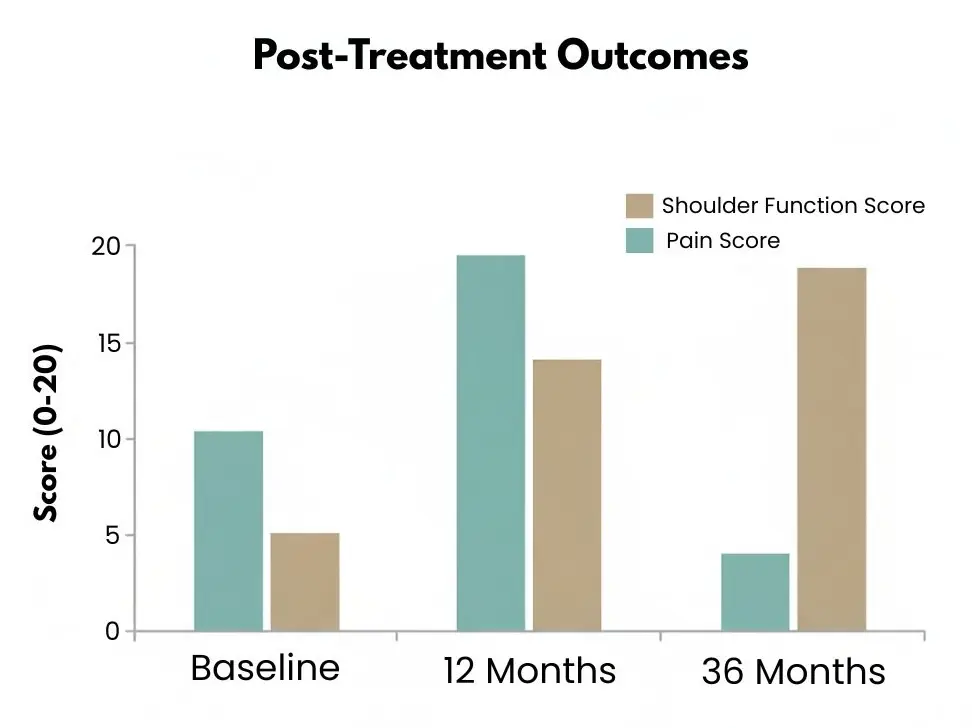
The most directly relevant published study followed people with glenohumeral osteoarthritis specifically. In a study of 65 patients with chronic shoulder pain and concentric glenohumeral osteoarthritis who received an intra-articular injection of their own micro-fragmented fat tissue (a source of adipose-derived stem cells), the average Constant-Murley shoulder score had risen to 84.6 at 36 months, the visual analogue pain score had fallen to 3.34, and just over 83 percent of patients reported being completely satisfied with the treatment. Most of those patients had milder, early-stage disease, and the improvements in pain and shoulder function were statistically significant. In plain terms: a meaningful, lasting reduction in pain and a real gain in usable shoulder movement, sustained over three years, in people who had not responded to conservative care.
That single study is encouraging, but it is not the whole picture, and honesty matters here. Much of the broader, higher-quality stem cell evidence in osteoarthritis comes from the knee, simply because the knee has been studied far more. A 2025 systematic review and meta-analysis of randomised controlled trials found that intra-articular MSC injections produced a significant reduction in pain compared with control treatments, with the strongest effects appearing at the 24-month mark — suggesting the biological process takes time to mature. Across a separate review of 43 clinical trials, almost all reported clinical improvement after MSC injection, though the knee was by far the most studied joint and the authors stressed that standardised protocols are still needed.
Reading the Numbers Without Inflating Them
A few honest qualifiers belong with those figures. The shoulder-specific study used the patient’s own fat-derived cells, not donor umbilical cord cells, and it responded best in people with milder disease. The strongest knee data shows pain relief that is partial, not total, and that builds slowly over many months. And a consistent finding across osteoarthritis trials is that not everyone responds — a meaningful minority see little or no change. Anyone presenting stem cell therapy for the shoulder as a sure thing is overstating what the evidence supports.
How Stem Cells Work Inside the Shoulder Osteoarthritis Joint
Mesenchymal stem cells (MSCs) are not painkillers in the usual sense. They do not block a receptor or numb a nerve. Instead they behave like site managers, releasing signals that change the environment inside the joint and instruct the body’s own repair cells. Three of those signals matter most for shoulder osteoarthritis.
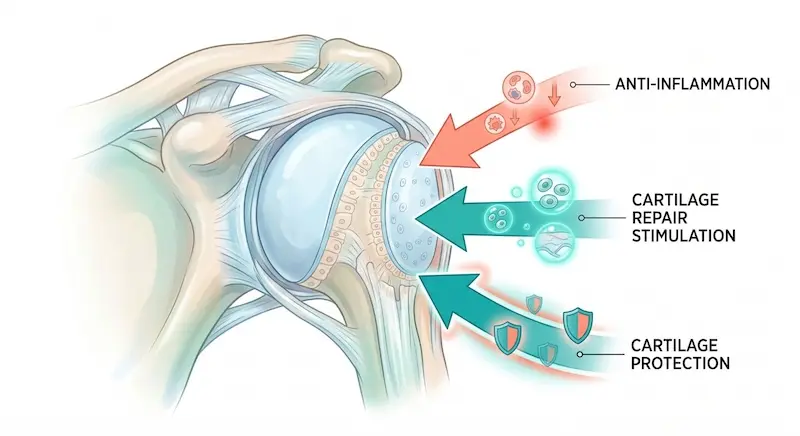
The first is calming inflammation. MSCs release signalling molecules called cytokines — think of them as chemical messages between cells — that quiet the overactive immune response inside the joint. Rather than spraying water on the flames, they help switch off the alarm that keeps the fire burning.
The second is supporting cartilage repair. MSCs secrete growth factors that wake up the cartilage-making cells already living in the joint, encouraging them to lay down new cartilage framework. The stem cells largely act as the foreman, not the bricklayer — they send instructions rather than turning into large amounts of new cartilage themselves.
The third is protecting what remains. MSCs release molecules that slow the enzymes responsible for breaking cartilage down. By easing off the demolition crew while encouraging the repair crew, the aim is to tip the balance inside the shoulder away from destruction and toward preservation. None of this rebuilds a joint that is already bone-on-bone — it works on shoulders that still have something left to protect.
Autologous vs. Allogeneic Cells for Shoulder Osteoarthritis
Using Your Own Cells: the Limits
In Japan and several other countries, most clinics use autologous MSCs — cells taken from the patient’s own bone marrow or fat. The appeal is obvious: your own cells carry essentially no rejection risk. But there are real drawbacks. Harvesting them is invasive, and the cells reflect your age and health. Stem cell quality declines as we get older, and shoulder osteoarthritis mostly affects people over 55 — exactly the group whose own cells tend to be fewer, less active, and less potent.
Why We Use Allogeneic Umbilical Cord Cells
We use allogeneic MSCs from donated umbilical cord tissue (the Wharton’s jelly inside the cord), collected with consent at the time of healthy births. These are among the youngest and most active MSCs available. They need no harvesting procedure from the patient, they can be prepared in consistent, quality-checked doses, and because they are biologically “quiet” to the immune system, rejection reactions are very rare. The same allogeneic cord-tissue source is what we use for patients exploring stem cell therapy for knee osteoarthritis, for the same reasons of cell potency and consistency.
It is fair to note that the strongest shoulder-specific study used a patient’s own fat cells, so the direct comparison in the shoulder joint is still limited; the case for younger donor cells leans partly on broader osteoarthritis and laboratory evidence. We tell patients that openly.
Who Is — and Is Not — Suited to Shoulder Osteoarthritis Stem Cell Therapy
Shoulder Osteoarthritis Patients Who May Benefit
This treatment tends to suit people with mild to moderate glenohumeral osteoarthritis where some cartilage and joint space remain, who have not got adequate relief from physiotherapy, painkillers, or cortisone, and who are trying to delay or avoid shoulder replacement. Good candidates are in reasonable general health, without active joint infection or uncontrolled autoimmune disease, and they understand that improvement, when it comes, is gradual and partial rather than instant or complete.
Shoulder Osteoarthritis Patients Who Are Not Ideal Candidates
This is not for everyone. People with end-stage shoulder osteoarthritis, where cartilage is almost entirely gone and the joint is grinding bone on bone with significant deformity, are unlikely to see meaningful benefit — at that stage, replacement remains the most effective option. Where the real problem is a large rotator cuff tear or instability rather than cartilage loss, the assessment and treatment are different. And anyone with active cancer, an uncontrolled blood disorder, a systemic infection, or who is pregnant should not undergo this treatment.
Realistically, most people who respond notice little in the first weeks, with changes in pain and movement emerging between the second and third month and continuing to develop over six to twelve months. A meaningful minority do not improve significantly, and we cannot yet predict reliably who will fall into which group.
What Recovery Realistically Looks Like
Most people describe the first few weeks as quiet — some mild soreness, others no change at all. Improvements in pain and the ability to reach and lift tend to begin around the second to third month and continue to build over six to twelve months as inflammation settles and tissue repair processes mature. Patience genuinely matters here: judging the treatment a failure at three weeks is the most common mistake, because the biology simply has not had time to work.
Honest Risks and Limitations of Shoulder Osteoarthritis Stem Cell Therapy
Known Side Effects
The safety record of MSC joint injections is generally reassuring. Across clinical trials, only minor adverse events have generally been reported, indicating that intra-articular MSC applications are potentially safe. The most common effects are temporary and minor — injection-site pain, mild swelling, and short-lived stiffness. Rarer risks include infection, as with any joint injection, and allergic reactions, which are uncommon with umbilical cord-derived cells because of their low immunogenicity.
What Stem Cells Cannot Do for the Shoulder
We would rather set expectations honestly than oversell. Stem cells cannot regrow a shoulder that is already bone-on-bone — once the cartilage is essentially gone, the biology does not support regeneration at that level. Even where cartilage is present, MSC injections may be insufficient for full repair of cartilage defects. The shoulder-specific evidence base is also younger and smaller than the knee’s, and much shoulder stem cell research to date has focused on rotator cuff tendons rather than the joint surface. And not everyone responds. These are not reasons to dismiss the option — they are the context any honest decision should be made in.
FAQ About Shoulder Osteoarthritis Stem Cell Therapy
In the shoulder-specific study, improvements in pain and function were still present at 36 months, and knee data shows benefits peaking around 24 months. Durability varies between individuals, and longer-term data is still being gathered.
It is performed under local anaesthetic with imaging guidance and usually takes under an hour. Mild soreness for a few days afterward is normal and typically settles on its own.
Cortisone temporarily suppresses inflammation and often fades within weeks, with repeated use sometimes accelerating cartilage breakdown. Stem cells aim to change the joint environment and support repair, with effects that build slowly over months rather than appearing in days.
Possibly. This treatment aims to ease pain and delay or avoid surgery, not guarantee you never need it. For people who respond, replacement may be postponed; for those with advanced disease, it can still become the right choice later.
That is a different problem requiring a different assessment. Part of the initial consultation is confirming whether cartilage loss or a tendon issue is the main driver of your pain.
Talking Through Your Options
Living with a worn shoulder can feel like slowly handing back the things you used to do without thinking. If you have reached the point where painkillers and cortisone are no longer enough but you are not ready for a replacement, it may be worth understanding whether stem cell therapy fits your specific situation. We offer free online consultations where you can share your imaging and history, and we will tell you honestly whether we think you are a realistic candidate — and if not, why not. You do not need to have made any decision to simply have the conversation.
References
- Natali S, Screpis D, Patania E, et al. “Efficacy and Long-Term Outcomes of Intra-Articular Autologous Micro-Fragmented Adipose Tissue in Individuals with Glenohumeral Osteoarthritis: A 36-Month Follow-Up Study.” Journal of Personalized Medicine. 2023;13(9):1309. https://doi.org/10.3390/jpm13091309
- Cao Y, et al. “Efficacy and safety of mesenchymal stem cells in knee osteoarthritis: a systematic review and meta-analysis of randomized controlled trials.” Stem Cell Research & Therapy. 2025;16:122. https://doi.org/10.1186/s13287-025-04252-2
- Ibounig T, Simons T, Launonen A, Paavola M. “Glenohumeral osteoarthritis: an overview of etiology and diagnostics.” Scandinavian Journal of Surgery. 2021. https://doi.org/10.1177/1457496920935018
- Tran G, Fascia D, Askew J, et al. “The prevalence of glenohumeral joint osteoarthritis in a primary care shoulder pain population referred for radiographs.” Rheumatology. 2022;61(3):1290–1292. https://doi.org/10.1093/rheumatology/keab867
- Maheshwari S, et al. “Mesenchymal Stem Cell Injections for the Treatment of Osteoarthritis: A Systematic Review of Clinical Trials.” 2024. https://pubmed.ncbi.nlm.nih.gov/39440509/
- Park YB, Ha CW, Lee CH, et al. “Cartilage regeneration in osteoarthritic patients by a composite of allogeneic umbilical cord blood-derived mesenchymal stem cells and hyaluronate hydrogel: 7-year follow-up.” Stem Cells Translational Medicine. 2017;6(2):613–621. https://doi.org/10.5966/sctm.2016-0157