Premature Ovarian Failure Stem Cell Therapy | Can Your Ovaries Still Recover?

Your period stopped before you expected it to. The FSH numbers came back far higher than normal. The word “menopause” appeared in a report that felt written for someone a generation older.
If you have received a diagnosis of premature ovarian failure — also called premature ovarian insufficiency (POI) or primary ovarian insufficiency — you are probably sitting with a set of questions that the medical system rarely answers in full. You have likely been told that hormone replacement therapy will protect your bones and heart, and that egg donation is available if you want to carry a pregnancy. Both of those are real and appropriate options. But they are not the same thing as an answer to the question you are actually asking: is there anything that can help the ovaries recover?
Premature ovarian failure is a condition in which the ovaries stop functioning as expected before the age of 40 — sometimes in a woman’s twenties, and occasionally in her teens. The ovaries, which should still be producing estrogen and maturing eggs for years to come, falter. FSH (follicle-stimulating hormone — the hormone the brain sends to signal the ovaries to produce eggs) rises as the ovaries respond less and less reliably. Estrogen drops. Menstruation becomes irregular and eventually absent.
The condition affects approximately 1 in 250 women under 35 and 1 in 100 women under 40, making it far more common than most people assume. Only 5 to 10 percent of women with confirmed premature ovarian failure conceive naturally and deliver after diagnosis.
Stem cell therapy for premature ovarian failure is one of the more actively researched areas in reproductive regenerative medicine. The published evidence includes Phase I and II clinical trials, systematic reviews, and a growing number of case reports documenting hormone improvement and — in some cases — restored menstruation and confirmed pregnancy. We have been working in Malaysia for over seven years, with more than 200 patients treated across multiple conditions. This article shares what the clinical data actually shows, where it falls short, and who this treatment is and is not likely to help.
Table of Contents
- What Premature Ovarian Failure Does to the Body — and Why Recovery Is So Difficult
- How Stem Cell Therapy Targets the Biology of Premature Ovarian Failure
- What the Clinical Trials Actually Show: Numbers, Not Promises
- Where Conventional Premature Ovarian Failure Treatment Reaches Its Limit
- Who Is — and Is Not — a Realistic Candidate for Stem Cell Therapy
- A Patient's Experience: What Recovery Looked Like Month by Month
- Honest Risks and Limitations of Premature Ovarian Failure Stem Cell Therapy
- FAQ About Premature Ovarian Failure Stem Cell Therapy
- Next Step
- References
What Premature Ovarian Failure Does to the Body — and Why Recovery Is So Difficult
Why the Ovarian Clock Runs Out Early in Premature Ovarian Failure
Every woman is born with a finite ovarian reserve — a pool of primordial follicles, the tiny cellular structures that contain immature eggs. At birth, this pool contains approximately one to two million follicles. By puberty, natural attrition has already reduced that number to around 300,000. Over the reproductive years, follicles are continuously recruited, developed, and either ovulated or lost through a natural process of depletion. By the time a woman reaches her early forties, the pool has declined significantly, and the hormonal signals that sustain the menstrual cycle begin to fluctuate — the beginning of the transition toward natural menopause.
In premature ovarian failure, this depletion accelerates dramatically, or the follicles that remain become unresponsive to the hormonal signals that should trigger their development. The causes are not fully understood. Autoimmune mechanisms are implicated in approximately 20 to 30 percent of identifiable cases — the immune system attacks the ovarian tissue in a process similar in principle to how it attacks joint tissue in conditions like rheumatoid arthritis. Genetic factors account for a portion of cases. Iatrogenic causes — premature ovarian failure triggered by chemotherapy, radiation, or ovarian surgery — account for a meaningful fraction, particularly in cancer survivors. But in more than 90 percent of cases, no specific cause can be identified.
The ovaries have almost no capacity to repair or replenish themselves. Unlike the liver, which can regenerate substantial portions of its tissue, or the bone marrow, which continuously produces new cells, the ovarian follicle pool is established before birth and cannot be renewed. What is lost, stays lost — unless something intervenes in the biological environment that is accelerating or sustaining that loss.
The Hormonal Consequences That Extend Far Beyond Fertility
The loss of ovarian function in premature ovarian failure is not a fertility problem in isolation. Estrogen is a systemic hormone with effects throughout the body.
When ovarian estrogen production drops, bone density begins to decline — a gradual process that, over years without treatment, significantly elevates the risk of osteoporosis and fracture. Cardiovascular risk increases as estrogen’s protective effects on the arterial walls diminish. Cognitive function, mood stability, and sleep are all affected by estrogen’s roles in the central nervous system. Many women with premature ovarian failure describe a persistent fatigue and cognitive fog that feels qualitatively different from ordinary tiredness — and that hormone replacement therapy, while essential, does not fully resolve for everyone.
These systemic consequences explain why treatment for premature ovarian failure cannot focus on the ovaries in isolation. Any approach — including stem cell therapy — must be considered alongside, not instead of, appropriate hormonal management under a qualified gynecologist’s supervision.
How Stem Cell Therapy Targets the Biology of Premature Ovarian Failure
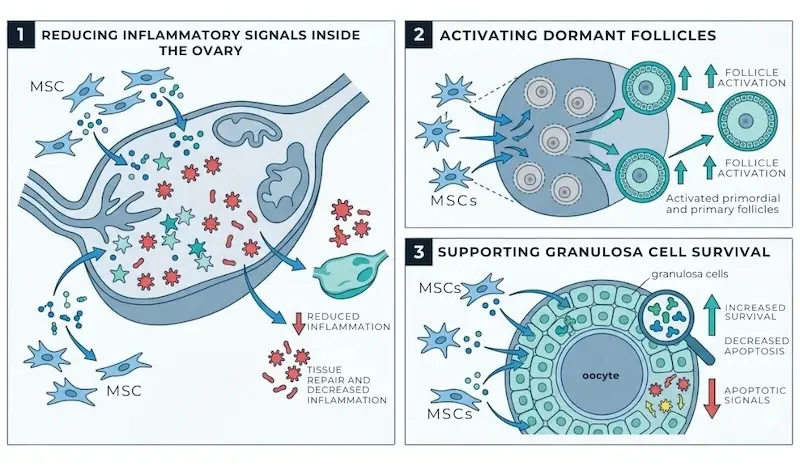
Mechanism 1: Modulating the Inflammatory Environment Inside the Ovary
In cases of autoimmune premature ovarian failure, the local environment inside the ovary is actively hostile to follicle survival. Inflammatory cytokines — chemical messengers between immune cells — create conditions in which granulosa cells (the support cells that surround and nourish each follicle) are under sustained attack.
Mesenchymal stem cells (MSCs) — the cell type used in our treatment program — have a well-documented ability to modulate this kind of inflammatory environment. When introduced intravenously, MSCs migrate toward sites of active inflammation and release their own signaling molecules that shift the local immune response from a destructive pattern toward a reparative one. They suppress the activity of the T-cells and macrophages driving the attack while amplifying regulatory T-cells (Tregs) — a specialized immune population whose function is essentially to tell the rest of the immune system to stand down. This immunomodulatory mechanism is among the most consistent findings across the MSC clinical literature, including research in rheumatoid arthritis and other autoimmune-driven inflammatory conditions.
For autoimmune-driven premature ovarian failure specifically, this represents a biological target that conventional hormone therapy does not address at all. HRT replaces what the ovaries are no longer producing. MSC therapy attempts to reduce the immune activity that is suppressing what they might still be capable of producing.
Mechanism 2: Protecting and Activating Remaining Follicles
Even in women with confirmed premature ovarian failure, the ovaries are rarely completely devoid of follicles. In the resistant ovary pattern, a meaningful follicle reserve remains but does not respond to hormonal stimulation. In other presentations, a reduced but not fully exhausted pool persists. The biological question is whether these dormant or resistant follicles can be rescued from the environment that is preventing their development.
MSCs secrete growth factors — proteins that signal surrounding cells to maintain activity and resist programmed cell death (apoptosis). In laboratory studies and in preclinical animal models of premature ovarian failure, MSC-derived growth factors including vascular endothelial growth factor (VEGF, a protein that promotes new blood vessel formation), hepatocyte growth factor (HGF), and insulin-like growth factor (IGF-1) have all been shown to promote follicle survival and stimulate the recruitment of dormant follicles into active development cycles.
The implication of this mechanism is not that stem cells create new eggs. That claim is not supported by the evidence. Rather, the biological environment around existing follicles may become more favorable — and some follicles that would otherwise have continued their silent decline may become activated.
Mechanism 3: Supporting Granulosa Cell Survival
Granulosa cells — the cells that surround, nourish, and communicate with each developing follicle — are central to ovarian function. They produce estrogen, regulate the hormonal feedback loop that controls FSH and LH from the pituitary gland, and support the maturation of each egg. When granulosa cells are dysfunctional or dying, the entire hormonal axis becomes dysregulated: FSH rises as the pituitary sends ever-louder signals to ovaries that are no longer responding.
Multiple laboratory studies have demonstrated that MSCs reduce the rate at which granulosa cells undergo apoptosis and support their continued function. By protecting these key cells, stem cell therapy aims to partially restore the hormonal signaling dynamic within the ovary — which may translate, in patients who respond, into measurable reductions in serum FSH and increases in estradiol on follow-up blood panels.
What the Clinical Trials Actually Show: Numbers, Not Promises
Hormone Markers: What the Published Data Reports
The clinical evidence for stem cell therapy in premature ovarian failure is newer and smaller in scale than in conditions like heart failure or osteoarthritis. There are currently no large Phase III randomized controlled trials. What exists is a body of Phase I and II trial data, case series, and prospective studies — alongside systematic reviews and meta-analyses that synthesize their findings.
A 2024 meta-analysis published in Regenerative Therapy, which analyzed multiple clinical studies of stem cell transplantation in premature ovarian failure, found that stem cell treatment was associated with a statistically significant reduction in FSH levels compared to baseline — an elevated FSH is the principal hormone marker of premature ovarian failure, so a measurable reduction represents a meaningful biological signal. The analysis found estradiol levels, which are typically suppressed in POF, showed statistically significant increases across pooled post-treatment data. Follicle count on ultrasound also improved with statistical significance.
A systematic review and meta-analysis published in Frontiers in Endocrinology in 2023 (Liu et al.), which analyzed 37 preclinical studies involving 1,079 animals treated with MSCs for premature ovarian failure, confirmed consistent and statistically significant improvements in estradiol, FSH, and multiple follicle categories across diverse MSC types and administration methods. The findings were robust across cell sources and delivery routes.
A 2021 clinical study by Shareghi-Oskoue and colleagues, published in Stem Cell Research and Therapy, specifically evaluated transplantation of human umbilical cord-derived MSCs — the cell type we use — in women with premature ovarian failure. The study reported improvements in serum FSH, anti-Müllerian hormone (AMH, a direct marker of ovarian reserve), and antral follicle counts in treated patients, with no serious adverse events observed.
Pregnancy Outcomes: What the Data Actually Supports
Pregnancy outcomes are the most important and the most complex metric in premature ovarian failure treatment. The baseline is difficult — women with confirmed POF have low natural pregnancy rates, and improvements in hormone markers do not automatically translate into viable eggs and live births.
The 2024 meta-analysis found a combined pregnancy rate across clinical stem cell therapy studies of approximately 9 percent (combined proportion: 0.09, 95% CI: 0.03 to 0.15, p = 0.002). This number requires careful interpretation. It represents the proportion of treated POF patients across analyzed studies who achieved pregnancy following stem cell therapy — in a population for whom conventional infertility treatments had largely been ineffective, and for whom the natural conception rate is 5 to 10 percent at best. The 9 percent figure is modest, and it includes patients with varying degrees of residual ovarian function, different cell types, and different administration methods. It is not a prediction for any individual patient. But it is a statistically significant signal that treatment produces biological activity, and for a condition where the alternatives are limited, it represents a meaningful finding.
Why the Evidence Is Promising but Not Yet Definitive
The honest assessment of the current evidence is this: the biological rationale is well-supported, the hormone marker improvements are real and reproducible across multiple studies, and documented cases of pregnancy following stem cell therapy in women who had not conceived through conventional methods exist in the peer-reviewed literature. But the field is at an earlier stage of clinical validation than conditions like osteoarthritis or heart failure. There are no large Phase III randomized controlled trials specifically in human premature ovarian failure using allogeneic cord-derived MSCs.
This means that the effect size, which patient profiles respond best, how durable the improvements are, and whether pregnancy outcomes improve reliably across independent research groups are all questions still being answered. We disclose this to every patient before any decision is made — because patients deserve this framing rather than a selection of best-case outcomes.
Where Conventional Premature Ovarian Failure Treatment Reaches Its Limit
Hormone Replacement Therapy: Essential but Not Restorative
The standard response to premature ovarian failure is hormone replacement therapy (HRT) — supplementing the estrogen and progesterone that the ovaries are no longer producing adequately. HRT addresses the downstream consequences of POF: it protects bone density, reduces cardiovascular risk, manages menopausal symptoms like hot flashes, night sweats, and vaginal dryness, and supports cognitive and mood function. It is appropriate, important, and should not be discontinued without medical guidance.
What HRT does not do is support ovarian recovery. It manages the hormonal deficit from outside the system. A woman on HRT for premature ovarian failure is not being helped to produce her own hormones again — she is being provided with external substitutes. For women who are not pursuing fertility, this may be entirely sufficient. For women who want the possibility of biological children, or who want to understand whether their ovarian function can improve at all, it addresses only part of the problem.
Assisted Reproduction and the Emotional Reality of Egg Donation
When premature ovarian failure is established and pregnancy is desired, the primary option within conventional reproductive medicine is egg donation — using eggs from a screened donor and the patient’s own uterus. Egg donation has high success rates, and for many women it is the right path.
But the desire for a genetic biological child is deeply personal and should not be minimized. Many women with premature ovarian failure find themselves in an uncomfortable position: their reproductive endocrinologist has reached the end of the conventional treatment pathway, but they are not ready to close the door on their own eggs. Standard fertility stimulation protocols — including gonadotropin-releasing hormone agonist suppression — have shown no statistically significant advantage over placebo in large controlled studies for women with established POF. IVF using the patient’s own eggs achieves pregnancy in only a small minority of cases where ovarian failure is confirmed.
It is this gap — between women who are not yet ready to pursue egg donation and a medical system that has little else to offer — that stem cell therapy for premature ovarian failure is attempting to address biologically.
Who Is — and Is Not — a Realistic Candidate for Stem Cell Therapy
Profiles That Tend to Respond Best to Premature Ovarian Failure Stem Cell Therapy
The clinical profiles most likely to benefit from stem cell therapy share several consistent characteristics across published studies and our clinical experience.
Patients with residual ovarian activity have the most to work with. This includes women who still have antral follicles visible on ultrasound, a measurable (even if low) AMH level, or occasional spontaneous menstruation — even if irregular. The biology of MSC therapy requires follicles that are still present, even if dormant or under-responsive. AMH above 0.1 ng/mL and at least two to three antral follicles visible across both ovaries on ultrasound are practical markers suggesting remaining reserve.
Women with autoimmune-driven premature ovarian failure — where elevated anti-ovarian antibodies are documented — may be particularly responsive candidates, because the immunomodulatory mechanism of MSC therapy directly targets the inflammatory attack on ovarian tissue. Women whose POF was triggered by chemotherapy or radiation, where the ovarian microenvironment was damaged but follicles were not entirely depleted, are also a profile that appears in clinical case reports with relatively favorable responses.
Younger age at diagnosis generally correlates with better response — not because older women are excluded, but because younger women typically have more residual follicular activity to work with.
The patient should be in good general health, without active systemic infection, active malignancy, or severe uncontrolled autoimmune disease. Current medications — including immunosuppressants — must be reviewed by our clinical team before treatment is arranged.
When Premature Ovarian Failure Stem Cell Therapy Is Unlikely to Help
We are direct about the cases where we advise against proceeding.
Women with complete ovarian failure — no detectable follicles on repeated ultrasound, AMH below detectable limits, confirmed cessation of all ovarian activity over multiple years — are unlikely to experience meaningful ovarian recovery from stem cell therapy. There is no biological substrate for the cells to work with. In these cases, egg donation represents the most evidence-supported path to pregnancy, and we tell patients this clearly.
Women approaching their mid-forties or beyond with long-established complete POF face an intersection of diminished biological responsiveness and a limited time window that makes stem cell therapy a poor investment of resources and hope. Individual exceptions exist, but they should not set general expectations.
Active cancer, active systemic lupus erythematosus requiring high-dose immunosuppression, severe endometriosis requiring urgent surgical treatment, and active pelvic infections are all situations that should be addressed before any ovarian-directed regenerative therapy is considered.
Finally, women who need certainty of outcome — who are working within a tightly defined window for personal or professional reasons — may find the gradual and uncertain timeline of stem cell therapy poorly suited to their situation. We discuss this honestly in every initial consultation, because setting accurate expectations is more important to us than proceeding with treatment.
A Patient’s Experience: What Recovery Looked Like Month by Month
The Decision to Pursue Premature Ovarian Failure Treatment
A woman in her early thirties had been diagnosed with premature ovarian failure three years before she reached out to our clinic. She had undergone two rounds of conventional IVF using her own eggs — both produced no usable embryos, as her ovarian response to stimulation was minimal. Two separate reproductive specialists had advised that egg donation was, in their clinical view, her most realistic path to pregnancy. She had been on hormone replacement therapy for two years.
She was not ready to close the door on her own biological eggs. Her most recent AMH measured 0.2 ng/mL — low, but detectable. Pelvic ultrasound showed two to three antral follicles across both ovaries on the most recent scan. Her autoimmune antibody panel was positive for anti-ovarian antibodies, suggesting an autoimmune component to her condition.
After reviewing her records, we assessed her as a realistic — not guaranteed, but realistic — candidate. We told her directly that we could not promise menstruation resumption, a retrievable egg, or a pregnancy. What the evidence suggested was that the inflammatory environment in her ovaries might respond to MSC therapy, and that if it did, some of her remaining follicles might become more biologically active. That was the honest limit of what we could offer.
What Changed — and What Did Not
She received an intravenous infusion of allogeneic umbilical cord-derived MSCs in Malaysia in mid-2024. She continued her HRT throughout and was explicitly advised not to modify her hormone regimen without direction from her reproductive endocrinologist.
The first eight weeks produced no perceptible change — a period she described as discouraging but which we had specifically told her to expect. At the ten-week mark, she had a spontaneous bleed for the first time in over two years: light, lasting four days. At the three-month hormone panel, her FSH had decreased meaningfully from pre-treatment levels and her estradiol had risen. Her AMH remained at 0.2 ng/mL — unchanged, but not lower.
At six months, she underwent a monitored ovarian stimulation cycle with her own reproductive specialist. She produced one mature egg — her first viable response since diagnosis. That cycle did not result in a pregnancy. She remains in follow-up and is discussing a second stimulation cycle with her fertility team.
She described the experience as: “I still don’t know if I’ll get pregnant. But I know the ovaries are doing something again. That’s more than I had before.”
No promise was made or implied. Her HRT was not reduced. Her fertility care continues under her specialist’s direction. This is an honest account of one patient’s partial biological response — not a template for what every woman will experience.
This is an anonymised account. Individual outcomes vary and cannot be guaranteed for any other patient.
Why Allogeneic Cord-Derived MSCs Are Used for Premature Ovarian Failure Treatment in Malaysia
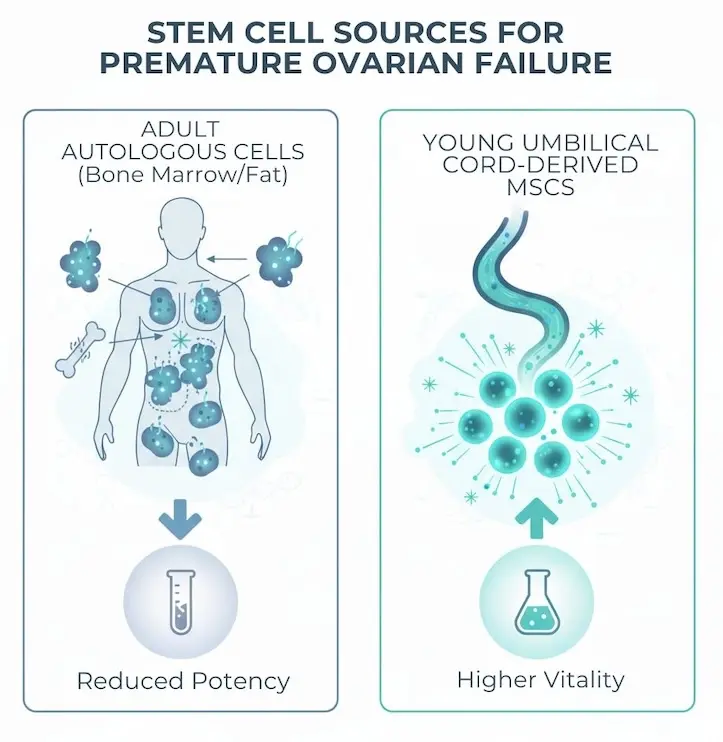
In Japan and several other regulatory frameworks, stem cell therapies for reproductive conditions typically use autologous cells — meaning cells harvested from the patient’s own bone marrow or fat tissue. The advantage is immunological: there is no rejection risk because the cells are genetically the patient’s own. The significant limitation, particularly relevant for premature ovarian failure, is that the patient’s own cells reflect the same biological environment already contributing to the condition. A woman whose ovaries are under autoimmune attack is harvesting immune cells from a body in which that attack is ongoing. The anti-inflammatory and regenerative potency of her own cells — already affected by years of the condition and by age — is measurably lower than that of cells from healthy newborn tissue.
The allogeneic umbilical cord-derived MSCs used in Malaysia come from the youngest available biological source — the Wharton’s jelly of healthy newborn umbilical cords, donated with full consent — with high proliferative capacity, potent immunomodulatory activity, and standardized quality control in each batch. Because these cells express low levels of the surface markers that typically trigger rejection responses, serious immune reactions are extremely rare, and the clinical trial safety data across conditions supports this. This is the same cell source we use for other inflammatory and degenerative conditions — including osteoarthritis — where the potency and consistency of the cells matters directly to treatment outcomes.
Honest Risks and Limitations of Premature Ovarian Failure Stem Cell Therapy
Known Side Effects and How They Present
The safety profile of allogeneic umbilical cord MSC infusion, across published trials spanning multiple conditions, is generally favorable.
The most commonly reported effects in the 24 to 48 hours following infusion are mild fever, transient fatigue, and occasional mild headache. These are consistent with mild immune recognition of the infused cells and resolve without specific intervention in the large majority of cases. Approximately 15 to 20 percent of patients report a low-grade fever in the first two days.
No serious treatment-related adverse events — including tumor formation, thromboembolism, or significant immune rejection — have been reported in the clinical trials of MSC therapy for premature ovarian failure using umbilical cord-derived cells in the published literature to date.
One specific practical consideration for POF patients is the interaction between MSC immunomodulation and any existing autoimmune treatment regimen. We do not advise patients to discontinue existing medications. Decisions about any medication modification must involve the patient’s own gynecologist or immunologist — not be made unilaterally before or after stem cell therapy.
What Stem Cell Therapy Cannot Do for Premature Ovarian Failure
There are clear limits, and we are direct about them.
Stem cell therapy cannot restore a depleted follicle pool. If the ovarian reserve has been entirely exhausted — no AMH, no antral follicles visible on repeated scanning, confirmed cessation over multiple years — there is no biological substrate for the cells to support. The treatment does not create new follicles. In these cases, egg donation remains the most evidence-supported path, and we will say so clearly.
Stem cell therapy cannot guarantee ovulation, menstruation resumption, or pregnancy. The most honest framing of what this treatment offers is an attempt to improve the biological environment inside the ovary — reducing inflammation, supporting remaining follicle survival, and potentially improving hormonal responsiveness. Whether that improvement translates into menstruation, a retrievable egg, or a live birth depends on factors that cannot be controlled or predicted.
The combined pregnancy rate of approximately 9 percent across clinical studies is real but modest. It is a statistically significant finding in a difficult population, but it is not a prediction that is generalizable to any individual. Approximately 60 to 70 percent of patients may experience limited or no measurable biological response.
Long-term data beyond two years is limited. Whether improvements in hormone markers are durable, whether repeated treatment cycles add meaningful benefit, and what the optimal treatment schedule looks like for this condition are all questions that the field has not yet definitively answered.
We do not claim this treatment is a cure. We do not suggest it as a substitute for conventional gynecological care or HRT. And we do not encourage patients to postpone decisions about egg donation indefinitely in pursuit of a natural pregnancy when their clinical picture does not support a realistic basis for that hope.
FAQ About Premature Ovarian Failure Stem Cell Therapy
Measurable changes in hormone levels — if they occur — typically appear in blood tests taken between the second and fourth month following infusion. This timeline reflects the biological process required for MSC-induced changes in the ovarian microenvironment to translate into altered FSH and estradiol signaling. Expecting results within the first four to six weeks is likely to produce a premature and inaccurate conclusion that treatment has not worked.
Yes — and we strongly advise it. Hormone replacement therapy protects bone density and cardiovascular health, and discontinuing it independently carries real health risks. Any decision about modifying HRT should be made in direct consultation with the patient’s own gynecologist, and not based on post-treatment hopes about ovarian recovery. We do not advise discontinuing any existing medication on the basis of stem cell treatment alone.
If treatment produces a measurable improvement in ovarian response — meaning more follicles become visible on monitoring and respond to stimulation — a subsequent IVF cycle using the patient’s own eggs may produce better results than prior cycles. This is not guaranteed, and would need to be evaluated in close partnership with a reproductive endocrinologist who can monitor the ovarian response directly. We work alongside the patient’s own fertility specialist; we do not replace them.
In Japan and some European countries, autologous stem cell therapy for reproductive conditions uses cells harvested from the patient’s own body — most commonly from fat tissue or bone marrow. The advantage is the absence of any immune rejection concern. The limitation is that the patient’s cells carry their own biological age and disease context. For a woman with autoimmune premature ovarian failure, her own harvested cells come from a body in which that autoimmune activity is ongoing. The allogeneic umbilical cord-derived MSCs used in Malaysia come from healthy newborn donors — biologically young, highly potent, and immunologically well-tolerated. Direct head-to-head comparison trials in premature ovarian failure specifically do not yet exist, but the evidence in other conditions suggests comparable or superior immunomodulatory capacity for cord-derived cells.
Most patients receive one infusion, with the possibility of a second evaluated at the three-month or six-month follow-up based on measured hormone response and clinical picture. We do not apply a fixed protocol to every patient. The timing and number of any additional infusions is determined by objective response data, not by a standardised schedule.
Next Step
If you have read to this point, you are probably someone who has been living with this diagnosis for some time — told that HRT and egg donation are the available options, and trying to understand whether there is something biologically meaningful that can still be explored.
We offer free online consultations for exactly this kind of conversation. Bring your hormone panel results, ultrasound reports, treatment history, and questions. We will look at your specific case honestly and tell you whether we believe your clinical picture suggests realistic potential for benefit from stem cell therapy — or whether it does not, and why. You are not committing to treatment by reaching out.
References
- Chon SJ, Umair Z, Yoon MS. “Premature ovarian insufficiency: past, present, and future.” Frontiers in Cell and Developmental Biology. 2021;9:672890. https://doi.org/10.3389/fcell.2021.672890
- Golezar S, Ramezani Tehrani F, Khazaei S, Ebadi A, Keshavarz Z. “The global prevalence of primary ovarian insufficiency and early menopause: a meta-analysis.” Climacteric. 2019;22(4):403–411. https://doi.org/10.1080/13697137.2019.1574738
- Shareghi-Oskoue O, Aghebati-Maleki L, Yousefi M. “Transplantation of human umbilical cord mesenchymal stem cells to treat premature ovarian failure.” Stem Cell Research and Therapy. 2021;12:454. https://doi.org/10.1186/s13287-021-02529-w
- Liu R, Zhang X, Fan Z, Wang Y, Yao G, Yang B, et al. “Mesenchymal stem cells therapy improves ovarian function in premature ovarian failure: a systematic review and meta-analysis based on preclinical studies.” Frontiers in Endocrinology. 2023;14:1165574. https://doi.org/10.3389/fendo.2023.1165574
- Zhang L et al. “Meta-analysis highlight the therapeutic potential of stem cells for premature ovarian failure.” Regenerative Therapy. 2024. https://doi.org/10.1016/j.reth.2024.07.002
- Webber L, Anderson RA, Davies M, Janse F, Vermeulen N. “HRT for women with premature ovarian insufficiency: a comprehensive review.” Human Reproduction Open. 2017;2017:hox007. https://doi.org/10.1093/hropen/hox007
- Sheikhansari G, Aghebati-Maleki L, Nouri M, Jadidi-Niaragh F, Yousefi M. “Current approaches for the treatment of premature ovarian failure.” Biomedicine and Pharmacotherapy. 2018;102:254–262. https://doi.org/10.1016/j.biopha.2018.03.056
- Gao M, Yu Z, Yao D, Qian Y, Wang Q, Jia R. “Mesenchymal stem cells therapy: a promising method for the treatment of uterine scars and premature ovarian failure.” Tissue and Cell. 2022;74:101676. https://doi.org/10.1016/j.tice.2021.101676