
Hair Loss (Androgenetic Alopecia) Stem Cell Therapy | Can Hair Density Recover Without Surgery?
You stand in front of the mirror and tilt your head to check the crown. You have been doing this for years now, and the ritual has become a quiet kind of dread. The part in your hair is wider than it was. The hairline has shifted. What once required no thought at all — running your fingers through thick hair — now requires a certain kind of resignation.
If you have androgenetic alopecia, or suspect you may have it, you already know the standard script: minoxidil applied twice daily, perhaps finasteride taken every morning, perhaps a conversation with a hair transplant surgeon. Underneath all of it sits a question the standard script rarely answers directly — is there anything that can actually change what is happening inside the follicle itself, not just slow things down on the surface, but shift the biological environment driving the loss?
That question is what this article addresses. Androgenetic alopecia — commonly known as male pattern baldness or female pattern hair loss — is the most prevalent form of hair loss in the world, affecting approximately 50% of men over age 50 and up to 40% of women over their lifetime. The global treatment market is estimated at USD 4 billion annually, yet most patients cycle through the same limited options. Stem cell therapy for androgenetic alopecia has now accumulated enough published clinical trial data to offer specific numbers rather than vague promises.
We are a clinical team based in Malaysia with over seven years of experience and more than 200 patients treated. We are not going to tell you this treatment is a cure. What we will do is show you the published evidence — specific numbers from controlled trials, not curated best-case outcomes — explain where the treatment works, where it does not, and what realistic improvement looks like for patients who respond.
Table Of Contents
- Why Androgenetic Alopecia Keeps Getting Worse
- Where Standard Treatments for Androgenetic Alopecia Run Out
- What the Clinical Data Shows: Stem Cell Therapy for Androgenetic Alopecia
- How Stem Cell Therapy Works on Androgenetic Alopecia: Three Biological Pathways
- Allogeneic vs. Autologous: Why Cell Source Matters for Androgenetic Alopecia Treatment
- Who Is — and Is Not — a Realistic Candidate for Androgenetic Alopecia Stem Cell Therapy
- One Patient's Experience With Androgenetic Alopecia Stem Cell Therapy in Malaysia
- Honest Risks and Limitations of Stem Cell Therapy for Androgenetic Alopecia
- FAQ About Androgenetic Alopecia Stem Cell Therapy
- Next Steps: Thinking Through Your Androgenetic Alopecia Treatment Options
- References
Why Androgenetic Alopecia Keeps Getting Worse
The Biology of Follicle Miniaturization in Androgenetic Alopecia
Androgenetic alopecia is not simply hair falling out. It is a progressive, genetically mediated process in which hair follicles gradually shrink over years — a phenomenon researchers call miniaturization.
In a healthy scalp, each follicle cycles through phases: a growth phase called anagen, which can last two to six years; a brief transitional phase; and a resting phase called telogen, after which the hair sheds and the cycle restarts. In androgenetic alopecia, a hormone called dihydrotestosterone — or DHT, formed when testosterone is converted by an enzyme called 5-alpha reductase — binds to receptors in genetically sensitive follicles and progressively shortens the growth phase. Each successive cycle produces a finer, shorter strand of hair. Eventually, the follicle shrinks to the point of producing barely visible hair, and in advanced cases, it stops producing anything at all.
The critical distinction for understanding whether biological treatments can help is this: in the early to moderate stages of androgenetic alopecia, follicles are still alive and metabolically active — they are suppressed, not destroyed. In late stages, the follicle may be replaced by scar-like fibrous tissue. Whether a follicle is dormant or permanently destroyed determines whether stem cell therapy has anything meaningful to work with.
Why the Damage in Androgenetic Alopecia Compounds Without Intervention
Androgenetic alopecia does not naturally plateau. Left unaddressed, the miniaturization process continues in the genetically susceptible zones of the scalp across decades, which is why most people notice gradual, incremental change rather than sudden loss. Research has confirmed a chronic low-grade inflammatory microenvironment surrounding miniaturizing follicles — inflammation that itself accelerates follicle damage and compounds the DHT-driven suppression. The scalp also undergoes progressive fibrosis in the subcutaneous layer beneath affected follicles, reducing blood supply and nutrient delivery to an area that already struggles. Understanding this biology is the foundation for understanding why standard topical treatments often lose effectiveness over time — and what stem cell therapy is attempting to change.
Where Standard Treatments for Androgenetic Alopecia Run Out
What Minoxidil and Finasteride Can — and Cannot — Do for Androgenetic Alopecia
The two medications approved for androgenetic alopecia are genuinely effective within their scope, and it is important to say that clearly. Minoxidil, applied topically to the scalp twice daily, prolongs the growth phase of the hair cycle and increases scalp blood flow. In clinical trials, approximately 60% of men using minoxidil consistently show some reduction in hair loss progression over 12 months, and a proportion experience modest regrowth. Oral finasteride reduces DHT levels by approximately 70% and, in long-term trials, showed that about 66% of male patients maintained hair count and 48% experienced some degree of regrowth at two years.
But both medications operate under an important constraint: the benefits depend entirely on continuous use. When either is stopped, the effects reverse within months, and hair loss resumes at the pace it would have followed without treatment. Neither medication repairs the structural changes already accumulated in miniaturized follicles. Neither addresses the inflammatory microenvironment around the follicle. A meaningful proportion of patients see limited benefit from one or both. And finasteride carries documented sexual side effects in a subset of men that in some cases persist after discontinuation — a factor that leads a portion of patients to stop the medication regardless of efficacy.
When Hair Transplant Surgery Reaches Its Limit for Androgenetic Alopecia
Hair transplant surgery — in the forms of follicular unit transplantation (FUT) and follicular unit extraction (FUE) — remains the most established surgical option for androgenetic alopecia. It works by relocating DHT-resistant follicles from the back and sides of the scalp to the thinning areas. For carefully selected patients, the results can be significant.
The fundamental limitation is supply. Transplant surgery requires donor follicles, and patients with extensive androgenetic alopecia may not have sufficient donor density to cover their area of loss. The procedure also does not halt the underlying miniaturization of native, untransplanted hairs — so patients who do not continue medical treatment alongside their transplant often find that surrounding native hairs continue to thin around transplanted follicles over subsequent years. There is also the practical reality of recovery time, cost, and the reality that results depend heavily on the treating physician’s experience. For patients who are not yet at the stage where surgery makes clinical sense, who lack adequate donor density, or who have good reasons not to pursue surgery, there is a genuine gap between the treatments currently available and the outcome they are trying to reach. Stem cell therapy for androgenetic alopecia aims to occupy that gap.
What the Clinical Data Shows: Stem Cell Therapy for Androgenetic Alopecia
Key Trials and What the Numbers Actually Show
The evidence base for stem cell therapy in androgenetic alopecia has grown substantially in the past five years, and it is now specific enough to give meaningful numbers rather than general impressions.
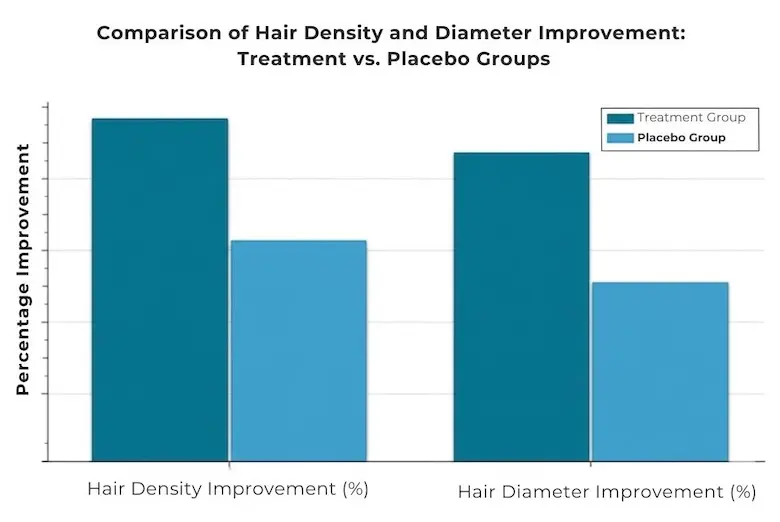
A randomized, double-blind, vehicle-controlled trial by Tak and colleagues, published in Stem Cells Translational Medicine in 2020, enrolled 38 patients with androgenetic alopecia and assigned them to receive either adipose-derived stem cell extract (a preparation derived from fat tissue stem cells) or a placebo vehicle. At 16 weeks, the treated group showed a 28.1% improvement in total hair count compared to a 7.1% improvement in the placebo group. Hair diameter in the treated group improved by 14.2%, versus 6.3% in controls. Both differences were statistically significant.
A systematic review and meta-analysis published in the Journal of Plastic, Reconstructive and Aesthetic Surgery in 2023 pooled data from eight randomized controlled trials involving 221 patients with alopecia. The analysis found that stem cell-derived conditioned medium (signaling molecules secreted by stem cells, applied without the cells themselves) increased hair density by a mean of 14.93 hairs per square centimeter compared to control groups — a result that was statistically highly significant, with a p-value below 0.0001. Hair thickness also improved by a mean of 18.67 micrometers compared to controls.
A 2025 randomized, double-blind, placebo-controlled trial published in the Journal of Haematology and Stem Cell Research enrolled 120 patients with clinically diagnosed androgenetic alopecia across Hamilton-Norwood grades II through VII. Patients were randomized to receive either a single intradermal injection of allogeneic bone marrow-derived mesenchymal stem cells or placebo. At 12 weeks, the stem cell group showed statistically significant improvements in total hair count, hair diameter, and patient satisfaction compared to the placebo group (p below 0.001 for all outcomes). No serious adverse events were reported in any participant.
An earlier systematic review analyzing 14 published studies involving 653 patients concluded that stem cell treatments produced positive effects on hair density across all studies reviewed, regardless of whether stem cells were derived from adipose tissue, hair follicles, or bone marrow. A study by Elmaadawi and colleagues in patients with androgenetic alopecia who had not responded to conventional therapies found a mean improvement of 52% in the bone marrow cell group and 42% in the follicular stem cell group at six months post-injection.
What These Numbers Mean in Practical Terms for Androgenetic Alopecia Patients
Hair density improvements in the range of 15 to 28% represent a clinically meaningful shift. The difference between hair that appears visibly sparse and hair that appears fuller is often a matter of density in that range — not restoration to the density of someone who never had androgenetic alopecia, but a meaningful improvement in the visual appearance and coverage of the scalp. Hair diameter improvement matters because the fineness of individual hair strands is one of the most visually significant markers of androgenetic alopecia; strands that are thicker, even modestly, produce better optical coverage.
It is equally important to be honest about what the data does not yet show. Most published trials have follow-up periods of 6 to 12 months. Long-term durability — whether improvements persist at two or three years, or whether retreatment is periodically needed — has not been definitively established. A proportion of patients in every trial showed limited or no response. The most recent systematic reviews uniformly call for larger, longer, more rigorously controlled trials. We do not present these numbers as more settled than they are.
How Stem Cell Therapy Works on Androgenetic Alopecia: Three Biological Pathways
Pathway One: Growth Factor Signaling to Dormant Follicles in Androgenetic Alopecia
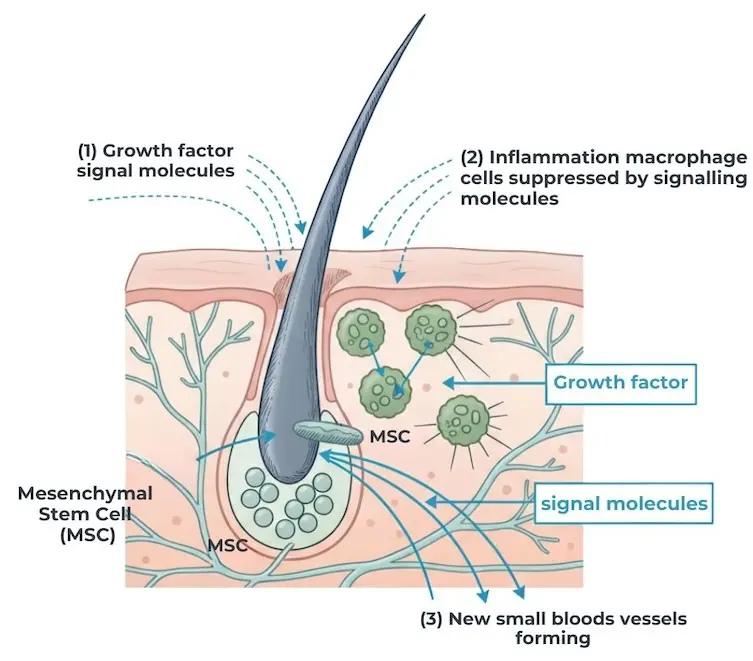
Mesenchymal stem cells — adult stem cells found in various tissues, capable of communicating with and influencing the cells around them — do not work by turning themselves into new hair follicle cells. The primary mechanism is what researchers call paracrine signaling: the cells release a spectrum of growth factors, including hepatocyte growth factor (HGF), vascular endothelial growth factor (VEGF), insulin-like growth factor (IGF), and platelet-derived growth factor (PDGF). In plain terms, these are molecular messages sent from one cell to another that instruct neighboring cells to activate, proliferate, or repair.
These signals act on the dermal papilla cells at the base of each hair follicle — the cluster of cells responsible for telling the follicle to enter and sustain the active growth phase. Think of the dermal papilla as the follicle’s control center, and the growth factors as messages arriving from outside saying: start producing again. In androgenetic alopecia, follicles in the early and moderate stages do not lack dermal papilla cells; they lack adequate stimulation to sustain meaningful growth cycles. Stem cell-released growth factors provide that stimulation from outside the follicle.
Pathway Two: Reducing the Inflammatory Microenvironment Around Androgenetic Alopecia Follicles
Chronic low-grade perifollicular inflammation — inflammation in the tissue immediately surrounding the follicle — is a consistent finding in the research literature on androgenetic alopecia, and it accelerates miniaturization beyond what DHT alone drives. Mesenchymal stem cells secrete molecules, including interleukin-10 and prostaglandin E2, that suppress the activity of inflammatory immune cells in the scalp and shift the local environment from a destructive state toward a reparative one.
This anti-inflammatory mechanism mirrors what the same stem cells do in joint conditions: in conditions like osteoarthritis, MSC-driven reduction of joint inflammation is one of the central documented mechanisms by which stem cell therapy produces clinical benefit. In the scalp, the target is the perifollicular microenvironment rather than joint cartilage, but the cellular signaling pathway is closely analogous.
Pathway Three: Supporting the Vascular Network That Sustains Androgenetic Alopecia Follicles
Hair follicles are among the most metabolically active structures in the body during the growth phase, requiring robust blood supply to sustain the rapid cell division that produces the hair shaft. In androgenetic alopecia, the subcutaneous layer beneath affected follicles undergoes progressive thinning, and reduced vascular supply is a well-documented feature of miniaturizing scalp zones. Mesenchymal stem cells promote the formation of new small blood vessels through VEGF secretion and related pro-vascular signals — a process called angiogenesis. For follicles that are dormant but structurally intact, this improved vascular environment supports re-entry into active growth and helps sustain the growth phase once it restarts.
Allogeneic vs. Autologous: Why Cell Source Matters for Androgenetic Alopecia Treatment
The Autologous Approach and Its Practical Limitations for Androgenetic Alopecia
Most stem cell treatments for androgenetic alopecia currently offered in Japan and several other countries use autologous cells — cells harvested from the patient’s own body, typically through a scalp biopsy, a liposuction procedure to collect fat tissue, or a bone marrow aspiration. The cells are processed in a laboratory and then reinjected into the scalp, usually four to six weeks later.
The rationale for autologous treatment is immunological: because the cells come from the patient’s own body, there is no risk of immune rejection. In practice, however, this approach has meaningful limitations that are particularly relevant to the patient with androgenetic alopecia. The harvest procedure carries discomfort and minor recovery time. The four-to-six week laboratory culture period extends the timeline considerably. Most significantly from a biological standpoint, the cells harvested from a person who has had androgenetic alopecia for years are cells from a body that may already carry the inflammatory and hormonal influences of that condition. Research suggests that MSCs from individuals with established androgenetic alopecia show reduced growth factor secretion compared to cells from younger, healthy donors — the precise quality that matters most for driving follicle reactivation.
Why Our Malaysia Program Uses Allogeneic Umbilical Cord-Derived MSCs for Androgenetic Alopecia
Our program uses allogeneic MSCs derived from umbilical cord tissue — specifically the Wharton’s jelly layer surrounding the cord — collected from healthy, consenting donors at the time of birth. These cells are biologically young, highly proliferative, and characterized by particularly potent growth factor secretion and anti-inflammatory signaling capacity.
Because umbilical cord-derived MSCs express low levels of the surface proteins that typically trigger immune rejection responses, serious immune reactions are rare. They are produced in standardized, quality-verified batches, meaning potency and viability can be confirmed before each treatment is administered. No invasive harvest procedure is required from the patient. And their biological youth translates directly into higher functional output — higher levels of the same growth factors and anti-inflammatory signals that are central to the three biological pathways described above.
This is the same cell source and biological rationale we apply in our program for autoimmune-mediated inflammatory conditions like rheumatoid arthritis, where the immunomodulatory capacity of umbilical cord-derived MSCs is central to the treatment effect.
Who Is — and Is Not — a Realistic Candidate for Androgenetic Alopecia Stem Cell Therapy
Profiles Most Likely to Respond to Stem Cell Therapy for Androgenetic Alopecia
The patients who tend to show the most meaningful response to stem cell therapy for androgenetic alopecia share a recognizable clinical profile.
They have mild to moderate androgenetic alopecia — roughly corresponding to Hamilton-Norwood grades II through V in men, or Ludwig grades I through II in women — where follicle miniaturization is active but substantial follicle populations remain viable. The biological logic is straightforward: stem cell therapy provides signals to existing follicles. If very few intact follicles remain in the affected zones, there is little to signal. They have tried standard treatments — minoxidil, finasteride, or both — and achieved suboptimal results, or have decided not to continue due to side effects or treatment fatigue. They are not yet candidates for hair transplant surgery, or are not suitable candidates due to insufficient donor density. They do not have active scalp infections, scarring alopecia (a distinct group of conditions in which follicles are permanently destroyed by active inflammatory scarring — not addressable by MSC therapy), or untreated systemic illness. And they understand that results, when they occur, are gradual and take months to become apparent on the scalp surface.
Profiles Where Stem Cell Therapy for Androgenetic Alopecia Is Unlikely to Help
Advanced androgenetic alopecia — Hamilton-Norwood grades VI and VII in men, with large areas of completely bald scalp — presents a different biological picture. Follicles in extensively bald zones have likely undergone fibrotic replacement rather than simple dormancy. Stem cells cannot rebuild follicles that no longer exist. At this stage, hair transplant surgery, if donor density permits, remains the more clinically appropriate intervention.
Patients with scarring alopecias — conditions such as lichen planopilaris or frontal fibrosing alopecia, in which immune-mediated scarring destroys follicles — require a different approach entirely. Patients with active malignancy, active systemic infection, or who are pregnant are not candidates. And patients whose androgenetic alopecia is already well-managed with current treatment and who have minimal ongoing progression may not have enough potential gain to justify the cost, time, and travel involved. We will say this directly in any initial consultation if it is our honest assessment.
One Patient’s Experience With Androgenetic Alopecia Stem Cell Therapy in Malaysia
The Decision to Pursue Stem Cell Treatment for Androgenetic Alopecia
A man in his early forties had been managing Hamilton-Norwood grade IV androgenetic alopecia for approximately eight years. He had used topical minoxidil consistently for six years and oral finasteride for three. Both had been partially effective — his hair loss had slowed, but coverage at the crown had continued to thin gradually despite reliable compliance. He was not a strong transplant candidate; his donor density at the back of the scalp was moderate, and he preferred to avoid surgery unless it became his best remaining option. He came to our clinic in Malaysia in mid-2024 after reviewing published clinical trial data himself.
Before accepting him for treatment, we reviewed his trichoscopy findings (a dermoscopy-based scalp examination that assesses follicle density and miniaturization patterns), his treatment history, and relevant blood work. The assessment confirmed active follicle populations at the crown and mid-scalp — the areas where he noticed the most thinning — with evidence of miniaturization but no significant fibrotic replacement. He was a suitable candidate. We told him directly: we could not predict his individual response, and improvement, if it occurred, would emerge gradually over months.
What Changed — and What Did Not — After Androgenetic Alopecia Stem Cell Treatment
The first eight weeks produced no visible change — a period he described as requiring patience. By week twelve, he reported that his hair at the crown appeared slightly denser when styling: not dramatically, but noticeably enough that he mentioned it without prompting. At the six-month trichoscopy assessment, there was a measurable increase in terminal hair density at the crown and a reduction in the proportion of miniaturized hairs in the treated zone. His own satisfaction rating moved from 4 out of 10 to 7 out of 10. He continued minoxidil throughout, as advised.
His hairline had not returned to what it was at age 30. The most advanced areas of thinning had not reversed. But for a patient who had been slowly losing ground despite consistent treatment for years, a shift from decline to measurable improvement over six months was meaningful to him. His androgenetic alopecia had not been cured. It had, for now, changed direction.
This is an anonymized account based on actual clinical experience. Individual results vary and cannot be guaranteed for all patients.
What Recovery Looks Like and When to Expect Results After Androgenetic Alopecia Treatment
The most important expectation to calibrate is time. Unlike topical minoxidil — which some patients notice influencing shedding patterns within a few months — stem cell therapy for androgenetic alopecia works through a biological process that takes time to mature. Growth factor signals must reach dormant follicles, stimulate dermal papilla activity, and support the follicle through the transition back into an active growth cycle before effects become visible on the scalp surface. The hair cycle itself is measured in months.
Most patients who respond begin noticing changes between weeks 10 and 16. Trichoscopy evidence of improved follicle density typically becomes measurable at the three- to six-month assessment. Patients who see no measurable change by the six-month mark have generally not gone on to respond at twelve months. We communicate this timeline before treatment, because patients who expect visible change within the first few weeks are likely to draw premature and inaccurate conclusions about whether the treatment has worked.
Honest Risks and Limitations of Stem Cell Therapy for Androgenetic Alopecia
Known Side Effects and the Safety Profile in Androgenetic Alopecia Trials
The safety profile of MSC-based therapy in published androgenetic alopecia trials has been consistently favorable. The most commonly reported side effects are local and temporary: injection-site redness, mild tenderness, and occasional minor bruising in the treated areas of the scalp. These typically resolve within one to seven days. The 2025 randomized controlled trial involving 120 patients found no serious adverse events in any participant. No tumor formation, serious immune reactions, or concerning long-term adverse effects have been documented in the published literature on MSC therapy for hair loss.
That said, any injection procedure into the scalp carries small, manageable risks: a low chance of localized infection at the injection site, and the rare possibility of an allergic reaction. These risks are minimized through strict sterile technique during the procedure and through the use of quality-screened allogeneic cells. We discuss all of these with every patient before treatment proceeds.
What Stem Cell Therapy Cannot Do for Androgenetic Alopecia
Stem cell therapy for androgenetic alopecia cannot reverse severely advanced hair loss where follicles in the affected areas have already undergone fibrotic replacement. It cannot produce results equivalent to a well-executed hair transplant in terms of density restoration in extensively bald scalp areas. It does not work as a substitute for established medical treatments — we do not advise stopping minoxidil or finasteride, and the stem cell treatment is designed to work alongside whatever management is already in place. Not every patient responds: based on the published trial data and our own clinical experience, a meaningful proportion of patients — estimated at 20 to 30% — see limited or no improvement, and we cannot yet reliably predict who will fall into that group.
Long-term durability beyond 12 months is not yet definitively established by the published evidence. Whether retreatment is needed, and at what interval, is something the field has not yet answered with certainty. Patients deserve this honest picture before making any decision.
FAQ About Androgenetic Alopecia Stem Cell Therapy
The published data does not support claiming permanent results. The longest follow-up periods in current published trials extend to 12 months, and a few to 24 months. Some studies show effects that persist at nine months; others show gradual attenuation. The honest answer is that long-term durability data is still being collected, and whether repeat treatment is beneficial over time has not been definitively established.
Yes. Female pattern hair loss involves the same process of follicle miniaturization, and the clinical trials described in this article included both male and female participants. The treatment approach is the same. Women with Ludwig grade I or II hair loss who have not responded adequately to conventional treatment are among the profiles we assess for suitability in our initial consultation.
No. We advise continuing minoxidil, finasteride, or any other established treatment without interruption before, during, and after stem cell therapy. The biological mechanisms of MSC therapy are complementary to these medications, not competitive with them. Stopping established treatment would introduce a variable that could confound both the treatment outcome and your ongoing clinical management.
Platelet-rich plasma therapy — PRP — involves centrifuging the patient’s own blood to concentrate growth factors, which are then injected into the scalp. The mechanism overlaps with one aspect of MSC therapy: delivery of growth factors to follicles. However, PRP does not include the broader immunomodulatory and anti-inflammatory signaling that mesenchymal stem cells provide, and the growth factor profile is different. Direct head-to-head comparisons in large randomized trials do not yet exist. PRP and MSC therapy are sometimes used in combination for androgenetic alopecia.
Most patients in our program receive one to two sessions, determined by the pre-treatment assessment of hair loss severity and remaining follicle density. We do not apply a fixed protocol — the number of sessions is individualized based on clinical assessment. Whether additional sessions at later intervals produce incremental benefit is being tracked in our ongoing follow-up program.
Next Steps: Thinking Through Your Androgenetic Alopecia Treatment Options
If you have read this far, you are probably someone who has already been through the standard options — minoxidil, perhaps finasteride, perhaps a transplant consultation — and is genuinely asking whether there is a biological approach with real clinical numbers behind it.
We offer free online consultations where you can share your trichoscopy results, your treatment history, and your questions. We do not use that conversation to push you toward a decision. Many people use it simply to understand whether their specific pattern of androgenetic alopecia falls within the range where the clinical data is most relevant — and if it does not, we will tell you that directly too.
Whether you choose this path or a different one, you deserve a clear picture of what the evidence actually supports.
References
- Tak YJ, Lee SY, Cho AR, Kim YS. A randomized, double-blind, vehicle-controlled clinical study of hair regeneration using adipose-derived stem cell constituent extract in androgenetic alopecia. Stem Cells Translational Medicine. 2020;9(8):839–849. https://doi.org/10.1002/sctm.19-0410
- Chen KH, Chen C, et al. Stem cell-derived conditioned medium for alopecia: a systematic review and meta-analysis. Journal of Plastic, Reconstructive and Aesthetic Surgery. 2023;87:183–193. https://doi.org/10.1016/j.bjps.2023.10.074
- Journal of Haematology and Stem Cell Research. Allogeneic mesenchymal stem cells therapy on hair regrowth in androgenetic alopecia: a randomized, double-blind, placebo-controlled trial. 2025;5. https://jhscr.org/index.php/JHSCR/article/view/264
- Kim M, et al. Autologous stem cell-derived therapies for androgenetic alopecia: a systematic review of randomized controlled trials on efficacy, safety, and outcomes. PubMed Central. 2024. https://pmc.ncbi.nlm.nih.gov/articles/PMC10863936/
- Klosner G, et al. Human stem cell use in androgenetic alopecia: a systematic review. International Journal of Molecular Sciences. 2023. https://pmc.ncbi.nlm.nih.gov/articles/PMC10047891/